
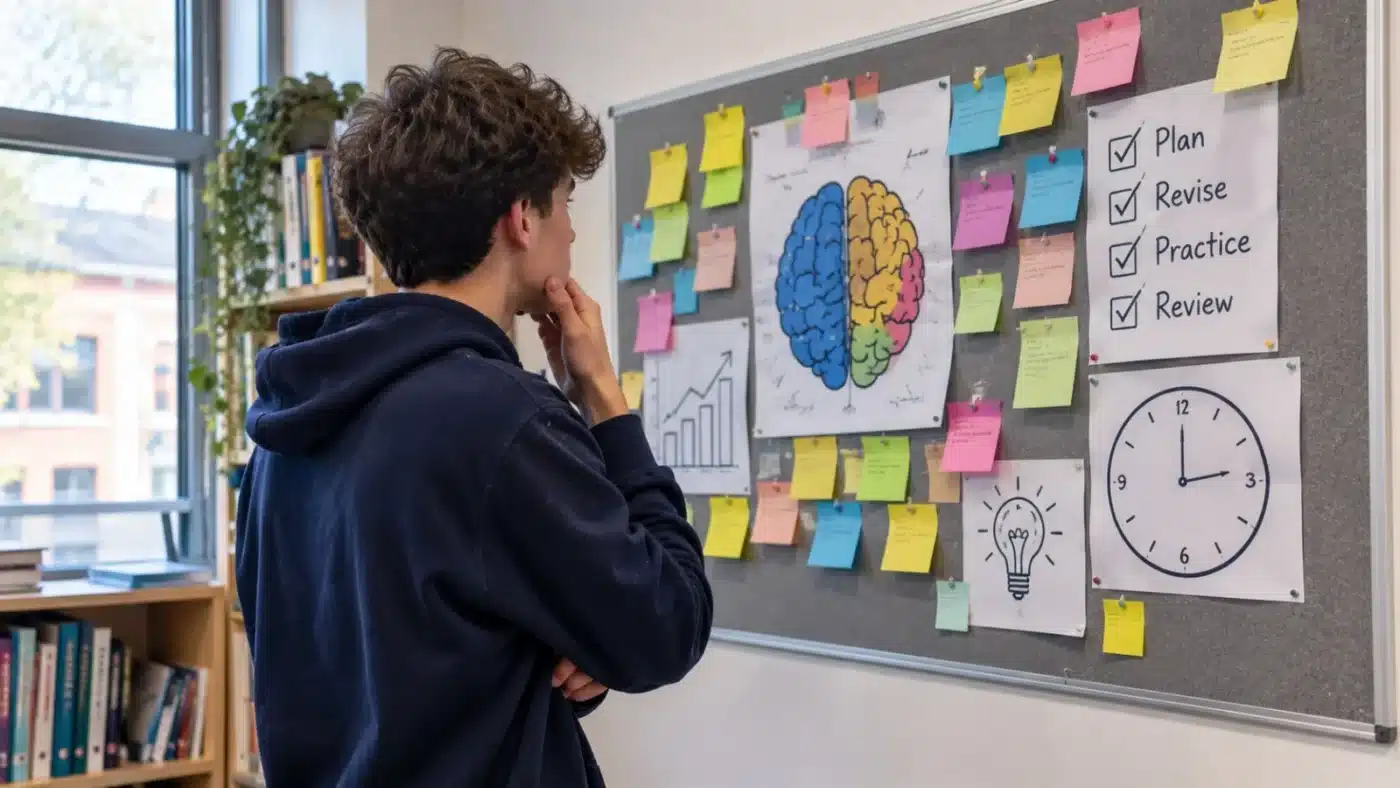
Quick Answer: To revise effectively, test yourself instead of rereading, spread your study over several days, mix up topics, and practise with past papers. Add short focused sessions, enough sleep, and regular review of mistakes. Research shows these methods beat highlighting and rereading, which feel productive but build weak memory. Most students do not fail because they are lazy. They fail because nobody ever showed them how to revise effectively. Think about the usual routine. You read your notes. You highlight the important bits. You make a neat summary. Then the exam paper arrives and your mind goes blank. It feels unfair, because you did put in the hours. The problem is the method, not the effort. Psychologists have studied how memory works for over a century, and the results are clear. Some study habits build strong memory. Others only create a feeling of knowing. This guide covers eight techniques that research supports. They work for GCSE, IGCSE and A Level, and you can start using them tonight. Why does rereading notes not work? Rereading feels easy, and that is exactly the trap. When you read a page you have seen before, it looks familiar. Your brain mistakes that familiarity for learning. An exam does not ask “does this look familiar?” It asks you to pull information out of your head with nothing in front of you. Those are two different skills. A well-known review by psychologist John Dunlosky and colleagues compared ten common study methods. Practice testing and spreading study over time came out as the most useful. Highlighting and rereading ranked among the least useful. That single finding should change how you plan your week. Technique 1: Active recall Active recall means pulling information out of your memory instead of putting it in. It is the single best answer to how to revise effectively. Here is a simple way to do it. Read a topic once. Close the book. Write down everything you can remember on a blank page. Then check what you missed and try again. It feels harder than rereading, and that is a good sign. The effort of remembering is what makes the memory stick. You can also use flashcards, quiz a friend, or explain the topic out loud as if you were the teacher. Technique 2: Spaced repetition Your brain forgets quickly. A German psychologist named Hermann Ebbinghaus showed this in the 1880s with what is now called the forgetting curve. Most new information fades within days unless you revisit it. Spaced repetition fixes this by reviewing a topic just as you are about to forget it. A simple pattern looks like this: Study the topic on day one Review it on day two Review it again after a week Review it once more after a month Apps like Anki can schedule this for you. A paper calendar works too. The key is to return to old topics, not just move on to new ones. Technique 3: Interleaving Most people revise one topic for a whole afternoon. This is called blocked practice. Interleaving means mixing different topics or question types in one session. For example, in Maths you might do three algebra questions, then two geometry questions, then one probability question, then repeat. It feels messier, but research shows it helps you learn when to use each method. That matters in exams, where nobody tells you which topic a question belongs to. Technique 4: Past paper practice Past papers are active recall with a bonus. They teach you the content and the exam style at the same time. Do them under timed conditions, without notes. Mark them with the official mark scheme, and read the examiner report if one exists. Then write down what cost you marks and fix that before the next paper. If you want a full method, our guide to A Level Past Papers: The Ultimate Revision Strategy walks through it step by step. Technique 5: Self-explanation and the Feynman method If you cannot explain an idea in simple words, you probably do not understand it yet. This is the idea behind the Feynman technique, named after physicist Richard Feynman. Pick a topic. Explain it as if to a ten-year-old, using plain language. Wherever you get stuck or start using fancy words to hide a gap, go back to your notes and fix that part. This works well for Science, Economics and History, where you need to understand why something happens, not only what happens. Technique 6: Mind maps, used the right way Mind maps are popular, and they do have a place. They help you see how topics connect, which is useful for planning an essay or reviewing a big unit. Here is the honest part. The research on mind maps is weaker than the research on active recall. Copying a mind map from your notes is mostly passive. Drawing one from memory, with the book closed, turns it into active recall. That small change makes it far more useful. Technique 7: The Pomodoro technique The Pomodoro technique splits your study into short bursts. The classic version is 25 minutes of focused work, then a 5 minute break. After four rounds, take a longer break of 15 to 30 minutes. There is less direct research on Pomodoro than on active recall, so think of it as a tool for focus, not a memory method. Still, many students find it stops them from drifting onto their phone. Put the phone in another room during each round and you will notice the difference. Technique 8: Sleep, food and breaks This one is not glamorous, but it matters. Your brain stores what you learned during sleep. A student who studies until 2am and sleeps four hours often remembers less than one who stops earlier and sleeps properly. Drink water, eat regular meals and take real breaks away from screens. Short walks help you reset. If you want to revise effectively for months, not just one night, protect your sleep. Which technique works […]
Category Archives: Study Skills & Revision
These study skills and revision guides help students study smarter, not longer. Learn eight science-backed revision techniques, build a step-by-step GCSE study plan, find the best revision websites and apps, and use IGCSE and A Level past papers the right way. If revision still feels stuck, a tutor can find the exact topics where marks are being lost. See how our tutoring works or book a free trial.
Sep
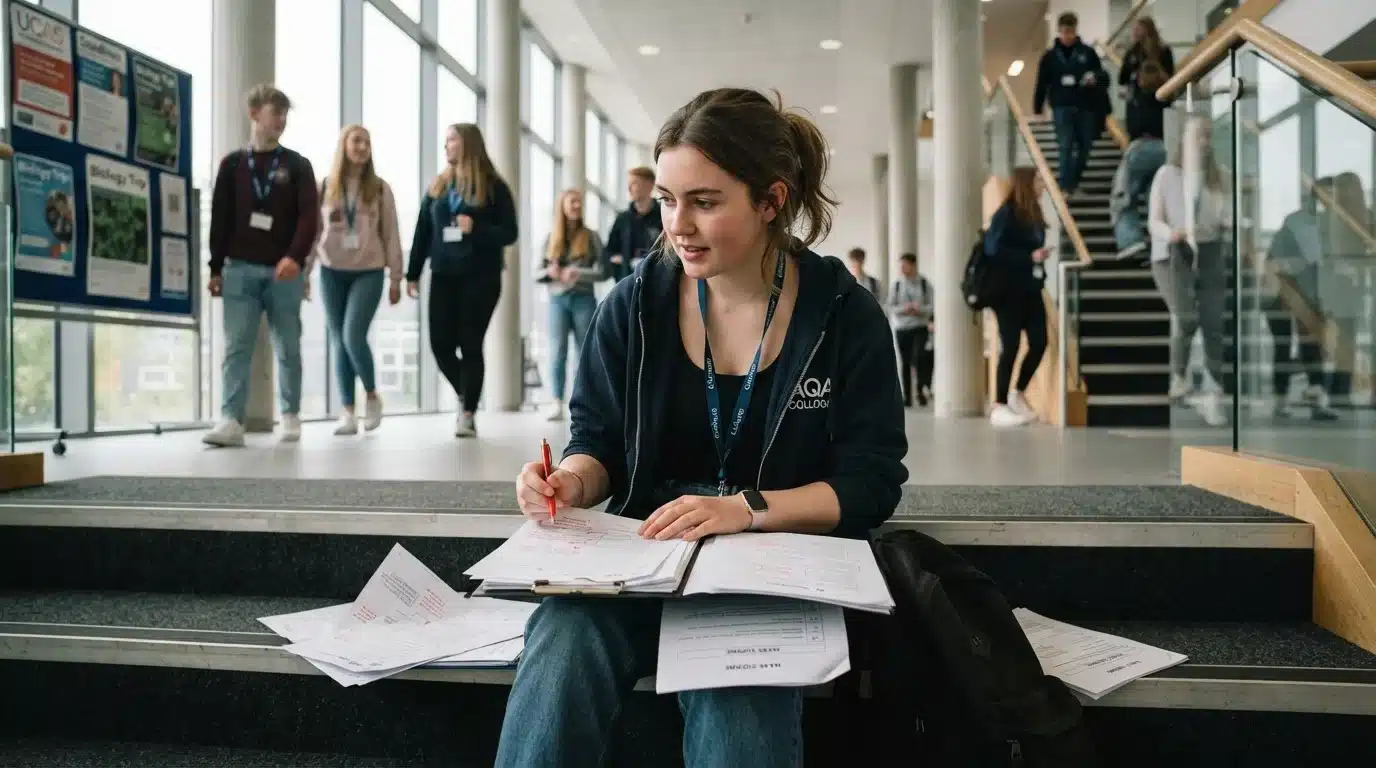
Quick Answer: A Level past papers are the single most effective revision tool available, but only when used correctly. Top students attempt papers under timed exam conditions, mark using official mark schemes, read examiner reports to understand what cost marks, and track errors by topic rather than just recording a score. Most A Level students do past papers. Very few do them in a way that actually moves their grade. The difference between students who improve significantly through past paper practice and those who plateau despite doing paper after paper is almost never about effort. It is about method. Sitting a paper casually, checking answers loosely, and moving on to the next one produces the feeling of revision without the reality of it. This guide explains exactly how top A Level students use past papers, from where to find them, to when to start, to what to do after marking that makes every paper genuinely useful rather than just another exercise completed. Why A Level Past Papers Are the Most Effective Revision Tool Before getting into method, it is worth understanding why past papers work so much better than other revision activities, because students who understand the reason use them more deliberately. A Level exams test a specific set of skills under specific conditions: retrieving knowledge under time pressure, applying understanding to unfamiliar contexts, and producing written responses in the precise format mark schemes reward. These are skills that only develop through practice under those same conditions. Reading notes builds familiarity with content. Watching explanations builds recognition. Neither builds the retrieval speed, the exam fluency, or the mark scheme awareness that past paper practice under proper conditions builds. There is also a familiarity effect that is easy to underestimate. Students who have sat ten A Level papers under timed conditions before their real exam arrive having already experienced the format, the pressure, and the pacing required. Students who have only revised from notes arrive at the real exam meeting those conditions for the first time. That difference shows up in results, consistently. Where to Find A Level Past Papers Free AQA A Level Past Papers: Where to Find Them AQA publishes past papers, mark schemes, and examiner reports on its official website at aqa.org.uk. Papers are organised by subject and qualification level. The most recent papers, typically the last one to two years, may be restricted to registered school centres, but a substantial bank of earlier papers is publicly accessible. Students whose schools use AQA should ask their subject teachers for access to recent papers through the school’s AQA All About Maths or AQA teacher portal subscription, which provides a larger bank of materials than the public site. Edexcel A Level Past Papers: Where to Find Them Pearson Edexcel publishes past papers and mark schemes through its qualifications website at qualifications.pearson.com. Papers are searchable by subject and year. As with AQA, recent papers may be school-restricted, while earlier papers are available publicly. The Edexcel Mathematics Emporium is a particularly well-organised resource specifically for A Level Mathematics past materials, including papers, mark schemes, and topic-based question banks. A Level Past Papers Free: Third Party Resources Several third-party websites compile A Level past papers from multiple boards in one place, making navigation easier than the official board websites. The most consistently useful include: Physics Maths Tutor: comprehensive past paper banks for Mathematics, Sciences, and other subjects across AQA and Edexcel, organised by topic as well as by full paper Save My Exams: topic-specific question banks alongside full past papers with worked solutions Revision World and Past Papers: aggregate sites with papers across multiple subjects and boards Important: Always use the official mark scheme from the exam board website, even if the paper itself was found on a third-party site. Third-party mark scheme versions vary in accuracy and may not reflect the current specification. When to Start Using A Level Past Papers Should Year 12 Students Do Past Papers? Yes, but in a targeted way rather than attempting full papers before sufficient content has been covered. In Year 12, the most productive use of past papers is topic-specific question practice rather than full paper attempts. Working through all the questions on a specific topic, all the integration questions from five years of AQA Maths papers, for example, builds focused understanding and makes familiar how that topic is examined before the pressure of a full paper applies. Full past paper practice under exam conditions becomes the primary revision activity in the later stages of Year 13, when sufficient content has been covered to attempt complete papers meaningfully. The transition from topic-level practice to full timed papers is one of the most important shifts in A Level revision strategy. A Level Papers by Topic: Why This Approach Works in Year 12 Working through papers by topic rather than chronologically: Makes gaps in a specific topic area immediately visible Builds familiarity with how a topic is examined across different years and question phrasings Allows focused revision of one area without the distraction of managing a full paper Produces more efficient learning per hour than full papers at stages where many topics are still being studied for the first time Physics Maths Tutor and Save My Exams both organise questions by topic for the major A Level subjects, making this approach practically straightforward. How to Use A Level Past Papers Effectively: The Method That Works Step One: Attempt Under Strict Exam Conditions This is the step most students compromise on, and it is the most important one. Strict exam conditions means: the exact time limit of the real paper, no notes open, no textbook reference, calculator available only if permitted in the real exam, and working through the paper in order without skipping questions to return to later. A student who works through a past paper with unlimited time and notes open is not practising the exam. They are doing homework. The exam environment is specific, time pressure, no reference materials, a blank answer sheet, and […]
Jul
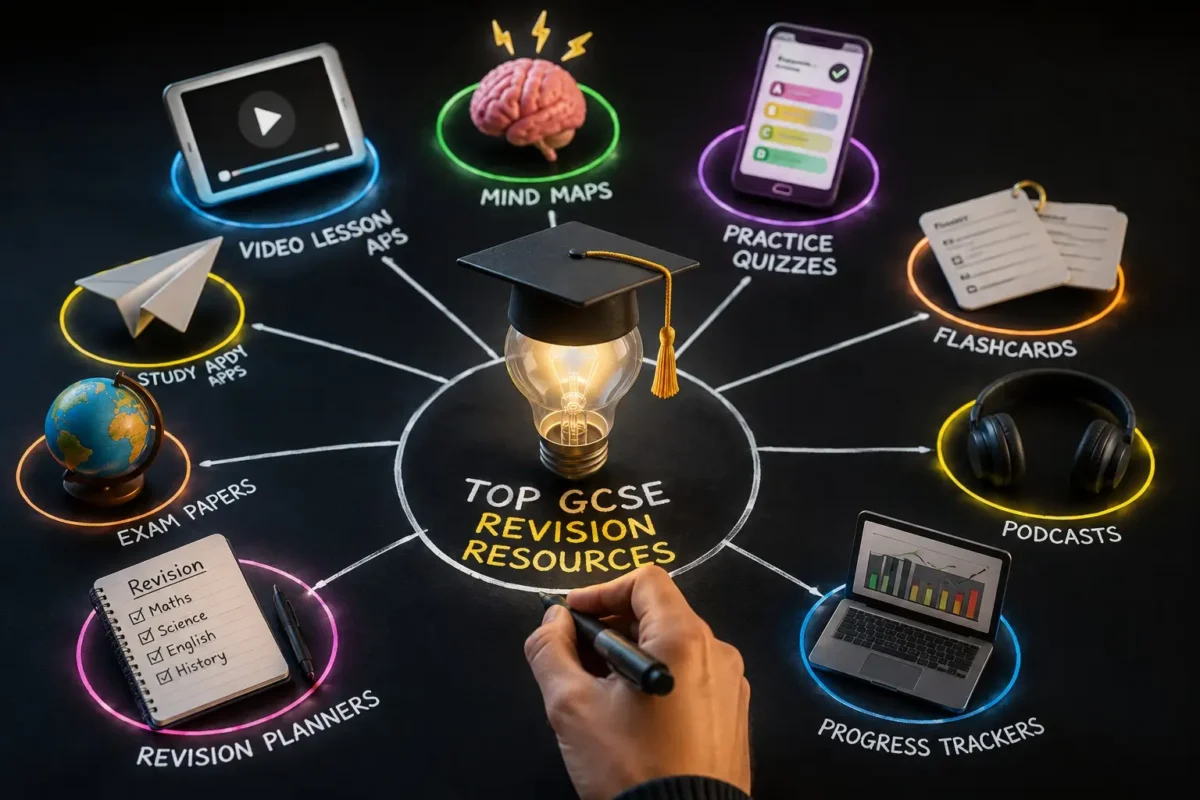
Every student revising for GCSEs has access to the same content. The same topics, the same past papers, the same specification documents sitting on the same exam board websites. What separates the students who use that content effectively from those who do not is rarely effort. It is usually the quality of the tools they are using and, more importantly, how they are using them. There are hundreds of GCSE revision websites, apps, and tools available. Most students end up using two or three of them passively, watching videos, reading summaries, highlighting digital notes in a way that feels productive without building the active recall and exam technique that actually move grades. This guide cuts through the noise. It covers the resources that genuinely help GCSE students improve, what each one is good for, how to use it in a way that produces results, and where each tool fits in a broader revision plan. No padding, no generic lists, just the honest breakdown of what works and why. Why the Right GCSE Revision Resources Make a Real Difference Before getting into specific tools, it is worth understanding what makes a revision resource genuinely useful versus one that just feels useful. The most effective revision resources have one thing in common: they require the student to actively do something rather than passively consume information. Watching a video explanation of quadratic equations is not the same as attempting quadratic equation problems. Reading a Biology summary is not the same as testing yourself on the content from memory. The best GCSE revision tools are the ones that build active recall, forcing the brain to retrieve information rather than just recognise it, and that provide immediate feedback on whether the retrieval was correct. Those two features, more than anything else, determine whether a resource produces genuine learning or just the comfortable feeling of it. With that principle in mind, here is the honest breakdown. BBC Bitesize GCSE: What It Is Good For and Where It Falls Short Strengths of BBC Bitesize GCSE BBC Bitesize is the most widely known GCSE revision resource and for good reason. Its coverage is genuinely broad, it covers most GCSE subjects across multiple exam boards, with clear explanations, diagrams, and worked examples that are accessible to students across the ability range. For building initial understanding of a topic, Bitesize is hard to beat for accessibility. The explanations are written in plain language, the structure is logical, and the interactive elements, quizzes, drag-and-drop activities, and short tests at the end of each section introduce an element of active recall that passive reading alone does not. Bitesize is particularly useful for: Getting a clear initial explanation of a topic before working through more detailed material Checking understanding of a concept at a basic level Providing a starting point for students who are not sure where to begin on a topic Supporting students who find textbook language difficult to access Where BBC Bitesize GCSE Has Limitations The limitation of Bitesize is depth. The explanations are accessible precisely because they are simplified, and for students aiming at grade 6 and above, particularly in sciences and Maths, the level of detail on Bitesize is often insufficient for the harder exam questions. Students who revise exclusively from Bitesize and then sit a challenging past paper often find that the questions go further than what Bitesize covered. It is an excellent starting point and a useful reference, but it should not be the only resource in a serious revision plan. Save My Exams GCSE: Structured Revision Built Around Past Paper Questions Why Save My Exams GCSE Is One of the Most Useful Tools Available Save My Exams has become genuinely popular among GCSE students, and the reasons are specific and practical. The platform organises revision by exam board and by topic, providing concise notes, worked examples, and practice questions that are closely modelled on actual past paper question styles. For students who want to move beyond Bitesize into more exam-focused practice, Save My Exams bridges the gap between content understanding and exam technique more effectively than most free resources. The practice questions on Save My Exams are particularly useful because they are structured to mirror the difficulty progression of actual papers, starting with accessible questions that build confidence before moving to harder application questions that replicate what higher-grade exam questions look like. Answers and full worked solutions are provided, which makes self-marking meaningful rather than approximate. Save My Exams is especially strong for: GCSE Sciences: Biology, Chemistry, and Physics notes and questions are detailed, well-organised, and closely tied to specific board specifications GCSE Mathematics: worked examples and practice questions are structured by topic and difficulty level GCSE English: mark scheme guidance and model responses for reading and writing questions Students who learn best from a structured, topic-by-topic progression with immediate feedback How to Use Save My Exams GCSE Effectively The students who get the most from Save My Exams are not the ones who read through the notes and feel reassured. They are the ones who attempt the practice questions first, without reading the notes, to identify what they do not know, then use the notes to address the gaps revealed. That order, attempt, identify gap, study, attempt again, produces significantly better outcomes than reading notes and then attempting questions. The initial attempt without notes is the active recall component that makes subsequent learning stick. Seneca Learning GCSE: Spaced Repetition Built Into the Platform What Makes Seneca Learning GCSE Different Seneca Learning is built around a specific learning science principle: spaced repetition. The platform tracks which questions a student gets right and wrong and automatically adjusts the frequency with which material is reviewed, showing topics that are insecure more often and topics that are well-known less often, until everything reaches a confident baseline. This is particularly valuable for content-heavy subjects where the sheer volume of material makes it difficult to keep everything active in memory simultaneously. GCSE Biology, Chemistry, History, and Geography all involve large […]

Jun
Most GCSE revision advice is the same advice repackaged. Make flashcards. Use colour-coded notes. Revise somewhere quiet. These things are not wrong, but they are so general they barely help. A student who is genuinely struggling to improve their grades does not need another reminder to revise somewhere quiet. They need to understand why what they are currently doing is not working, and what to do differently. That is what this guide is actually about. Not a list of vague suggestions, but a specific, honest breakdown of the revision methods that consistently produce grade improvements, and the ones that feel productive without being productive. The difference between those two categories is where most GCSE results are won or lost. Why Most GCSE Revision Does Not Work Before getting into what works, it is worth being honest about what does not, because most students spend the majority of their revision time on methods that research and exam results consistently show to be ineffective. Re-reading notes is the most common revision activity and one of the least effective. It creates a feeling of familiarity with the material that students often mistake for understanding. But recognising information when you see it is not the same as being able to retrieve it in an exam hall with nothing in front of you. Re-reading builds recognition. Exams test retrieval. Those are different skills. Highlighting has the same problem. A page covered in four colours of highlighter feels like evidence of work done. It rarely is. If a student cannot explain what they highlighted without looking at it, the highlighting has not helped them learn it. Passive note-taking, copying out textbook sections into neater handwriting, is perhaps the most time-consuming form of revision that produces the least return. The act of copying does not require understanding. A student can copy a paragraph about enzyme action perfectly without understanding a word of it. Understanding why these methods underperform is the foundation of better revision, because once a student sees the pattern, they stop defending habits that are not working. What the Evidence Actually Says About GCSE Revision Techniques Two revision techniques are consistently supported by research as the most effective for long-term retention and exam performance. Everything else in this guide builds on them. Active Recall Revision: The Most Powerful GCSE Study Method Active recall is the practice of retrieving information from memory without looking at notes or textbooks. Testing yourself, attempting to remember something before checking whether you were right, is fundamentally more effective than re-reading, because retrieval itself strengthens the memory in a way that passive review does not. In practice, active recall revision looks like: Closing notes and trying to write down everything remembered about a topic Using flashcards with a question on one side and the answer on the other, and genuinely testing before flipping Attempting past paper questions from memory rather than with notes open Explaining a concept out loud as if teaching it to someone else , which forces the retrieval that silent re-reading does not The discomfort of not immediately knowing an answer during active recall practice is not a sign that the method is not working. It is the method working. That moment of struggle before successful retrieval is what builds the memory trace that survives to exam day. Spaced Repetition GCSE: Why Timing Matters as Much as Method Spaced repetition is the practice of revisiting material at increasing intervals rather than covering it once and moving on. Research consistently shows that information revisited after a delay, rather than immediately, is retained significantly better over time. In practical terms, spaced repetition GCSE revision means: Revisiting topics studied a week ago, not just topics studied yesterday Building a revision schedule that cycles back through earlier material rather than progressing linearly through the syllabus and never returning Using flashcard apps that automate the spacing, showing cards more frequently when they are being got wrong and less frequently as they become secure Planning revision across the full revision period with deliberate gaps between passes through each topic The combination of active recall and spaced repetition is the most evidence-supported foundation for GCSE revision. Everything else in this guide works better when it is built on these two habits. GCSE Revision Schedule: How to Build One That Actually Gets Used A revision schedule that looks impressive on paper but gets abandoned by the second week is worse than no schedule at all, because the student loses time creating it and then feels guilty rather than productive when it falls apart. How to Build a Realistic GCSE Revision Timetable Here is how to build a revision timetable that actually holds: Start with what is fixed. School hours, sports commitments, family events, and anything else that cannot move goes in first. This is the real skeleton of the week — not an ideal version of it. Be honest about available time. Most students overestimate how many hours of effective revision they can sustain in a day. Two hours of focused, active revision is more productive than five hours of unfocused, passive revision. Build a schedule based on focused hours, not total hours at a desk. Allocate subjects based on need, not preference. Students naturally gravitate toward revising subjects they already find easy and avoiding the ones they struggle with. A GCSE revision schedule should do the opposite, more time to weaker subjects and less to stronger ones, while maintaining some presence of every subject throughout. Build in review sessions. For every new topic covered, schedule a review of that topic one week later and again three weeks after that. This is spaced repetition built directly into the timetable rather than left to chance. Leave buffer space. A schedule with no slack breaks the moment one session runs long or one day goes differently than planned. Building in one free revision slot per week, available to cover anything that fell behind, makes the whole schedule more resilient. GCSE Revision Timetable, When to Start This is […]
Jun
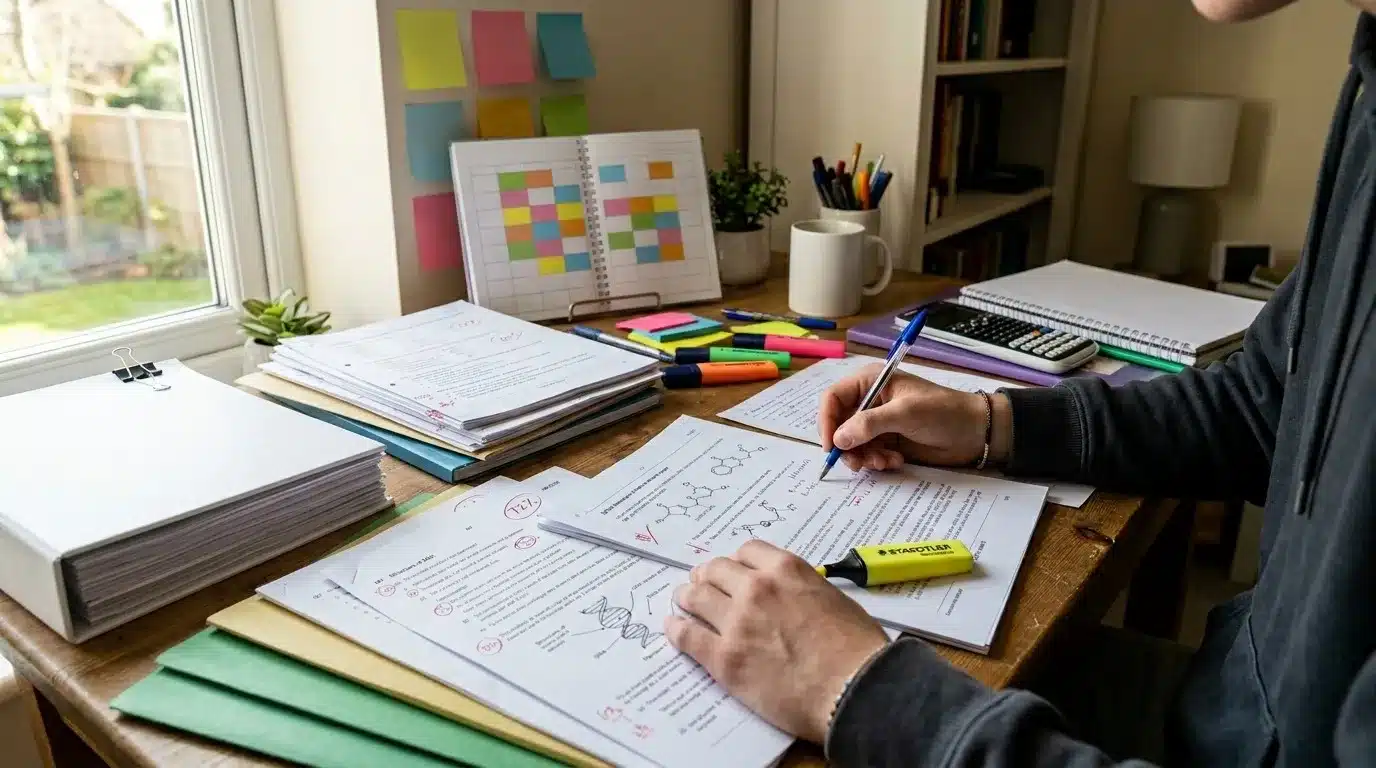
Every IGCSE student has been told to do past papers. Very few have been told how. There is a version of past paper practice that feels productive, sitting down with a paper, working through it at a comfortable pace, checking answers loosely against the back of a revision guide, and moving on. Most students have done this version. Most students also find, when the real exam arrives, that it did not prepare them nearly as well as they thought it would. Then there is the version that actually moves grades. It looks different, feels more uncomfortable, and produces results that the casual version never does. This guide is about the second version. It covers exactly how to use IGCSE past papers to get the most out of them, from where to find them, to how to sit them, to what to do after you have marked them. If your child is preparing for Cambridge or Edexcel IGCSE exams, this is the revision approach that consistently separates students who improve from those who stay stuck. Why IGCSE Past Papers Are the Most Powerful Revision Tool Available Before getting into method, it is worth understanding why past papers work so much better than other forms of revision, because when students understand the reason, they tend to use them more deliberately. Most revision activities are passive. Reading notes, watching explanations, highlighting textbooks, these feel like learning, and they have some value in the early stages of revision. But they do not replicate the conditions of an exam. They do not force a student to retrieve information under pressure, apply knowledge to unfamiliar questions, or produce written answers within a time limit. IGCSE practice papers do all of those things at once. They train the specific skills the exam tests, not just knowledge of the content, but the ability to use that knowledge in the format the examiner is looking for. And because Cambridge IGCSE past papers and Edexcel IGCSE past papers are drawn from real previous exams, they show students exactly what their actual papers will look and feel like. There is also an element of familiarity that is easy to underestimate. Students who have sat ten past papers under timed conditions arrive at the real exam having already experienced the format, the pressure, and the pacing required. Students who have only revised from notes arrive at the real exam meeting those conditions for the first time. That difference shows up in results. Where to Find IGCSE Past Papers Free and Legally One of the most common questions students ask is where to find past papers, particularly free ones. Here is the straightforward answer. Cambridge IGCSE Past Papers: Official Sources Cambridge makes past papers available through two main channels: Cambridge International’s official website provides past papers, mark schemes, and examiner reports for all Cambridge IGCSE subjects. The most recent papers, typically the last two to three years, are often restricted to registered school centres, but a significant bank of earlier papers is publicly accessible. School portals and teacher resources most schools that run Cambridge IGCSE programmes have a subscription to Cambridge’s school support hub, which gives access to a larger bank of past papers. Students should ask their subject teachers for access to these resources before spending time searching online. Legitimate third-party revision sites host several revision platforms that legally host Cambridge IGCSE past papers with Cambridge’s permission. These are worth using for convenience, but always cross-reference with the official mark scheme from Cambridge’s own website rather than relying on unofficial answer versions. Edexcel IGCSE Past Papers, Where to Find Them Pearson makes Edexcel IGCSE past papers available through its official qualifications website. Papers, mark schemes, and examiner reports are available for most subjects going back several years. The search interface is straightforward; filter by qualification type, subject, and year. As with Cambridge, some of the most recent Edexcel IGCSE past papers may be restricted to school access. Students whose schools use Edexcel should ask their teachers for access to recent materials through the school’s Pearson account. IGCSE Past Papers Free: A Word of Caution Unofficial sites hosting IGCSE past papers free of charge vary significantly in quality. Some are accurate and useful. Others contain errors in mark schemes, host papers from the wrong specification year, or present answers that do not reflect current mark scheme standards. The safest approach is always to use official board websites for mark schemes, even if papers themselves are found elsewhere. The mark scheme is the most important resource, and getting it wrong defeats the purpose of the exercise. IGCSE Mark Schemes: Why They Matter As Much As the Papers Themselves This is where most students’ past paper practice falls down. They do the paper. They check whether their answers are roughly right. They move on. What they miss is the most valuable part of the whole exercise: understanding exactly what the examiner was looking for and whether their answer provided it. How to Read an IGCSE Mark Scheme Properly IGCSE mark schemes are more detailed than most students realise. They do not just list the correct answer; they show: Which specific points earn marks, often with alternatives and variations that are also acceptable The exact terminology is required particularly in science subjects where vague language does not earn marks even when the underlying understanding is correct How marks are allocated across multi-step questions, showing which steps earn method marks independently of the final answer What common errors look like, examiner reports, published alongside mark schemes, describe the mistakes that appear most frequently and why they cost marks A student who reads the mark scheme this carefully after every past paper is not just checking answers, they are learning how the examiner thinks. That understanding shapes how they write subsequent answers, and that shift in approach is where significant grade improvements come from. IGCSE Mark Schemes by Subject: What to Pay Attention To Different subjects reward different things, and mark schemes reflect that: In Science subjects, […]