

There is a question that comes up in almost every international school parent group at some point, usually from a family who is new to the system or choosing between schools. Does it matter which exam board my child sits? Is Cambridge better than Edexcel? And what is the actual difference between them? Most people asking this question get one of two responses. Either a confident “Cambridge is more respected” from someone who sat it themselves twenty years ago, or a vague “they are basically the same” from someone who has not looked into it properly. Neither answer is quite right. The truth is more specific and more useful than either. Cambridge and Edexcel IGCSE are both legitimate, well-recognised qualifications at the same academic level, but they assess differently, suit different types of learners, and are more or less appropriate depending on what a student plans to do next. Understanding those differences properly is what this guide is for. Choosing between Cambridge and Edexcel IGCSE? Get expert guidance to find the right fit for your child! GET A FREE TRIAL CLASS NOW What Is the Difference Between Cambridge and Edexcel IGCSE? Before comparing the two boards, it helps to understand what each one actually is and where it comes from. Cambridge IGCSE is developed by Cambridge Assessment International Education, a department of the University of Cambridge. It is the most widely taken international qualification at secondary level globally, available in over 160 countries and offered at thousands of international and independent schools worldwide. Cambridge IGCSE grades run on an A* to G lettered scale. Pearson Edexcel IGCSE is developed by Pearson, one of the largest education companies in the world. Edexcel is the dominant exam board in the UK for standard GCSEs, and its International GCSE was developed to bring that domestic experience to an international school setting. Edexcel IGCSE uses the 9 to 1 numerical grading scale, the same as the standard GCSE. Both are externally examined, internationally recognised, and accepted by universities as equivalent to each other and to the standard GCSE. The differences between them are in paper structure, assessment style, grading scale, and which school communities tend to use each one. CIE vs Edexcel IGCSE, The Core Differences Explained This is where most comparison guides go vague. Here is a clear, honest breakdown of how the two boards actually differ. Grading Scale: Cambridge A* to G vs Edexcel 9 to 1 The most immediately visible difference between the two boards is how grades are expressed. Cambridge IGCSE uses the traditional A* to G lettered scale. A* is the highest grade, followed by A, B, C, D, E, F, and G, with U for ungraded. This is the same scale that GCSEs used before the UK Government moved to the numerical system in 2017. Edexcel International GCSE uses the 9 to 1 numerical scale. 9 is the highest grade, broadly equivalent to an A*, and 4 is broadly equivalent to a C. This alignment makes Edexcel IGCSE results more immediately comparable to standard GCSE results for families and institutions familiar with the domestic UK system. For most universities and sixth forms, the conversion between the two scales is well understood and does not disadvantage students on either board. But for families with children in mixed-board situations, or who are moving between international and domestic school systems, the Edexcel numerical scale can simplify grade comparisons. Paper Structure: How Cambridge CAIE IGCSE and Pearson Edexcel IGCSE Differ Paper structure varies meaningfully between the two boards, and this is where the practical impact on students is most significant. Cambridge IGCSE tends to use a tiered entry system in some subjects, Core and Extended, where the tier a student is entered for determines which grade range is available to them. In Mathematics, for example, Core entry limits grades to C at best, while Extended entry opens the full A* to G range. This tiering means schools and students need to make active decisions about which level of entry is appropriate. Edexcel International GCSE generally uses a single-tier entry system across most subjects, meaning all students sit the same papers and the full grade range is available to everyone. This removes the tiering decision but means papers need to accommodate a wide range of ability within a single set of questions. In terms of question style, Cambridge papers tend toward more open-ended questions that require students to determine their own method and approach. Edexcel papers often break multi-step questions into more structured sub-parts, guiding students through the method more explicitly. Neither approach is harder in absolute terms, but they suit different revision habits and different types of learners. Assessment Components: IGCSE Exam Boards and Coursework Both boards have moved toward more examination-based assessment in recent years, reducing the coursework component in many subjects. However, some subjects on both boards still include coursework, oral assessment, or practical components alongside written papers. The specific components vary by subject rather than by board overall. Families should check the assessment structure for each specific subject their child is taking, not assume that one board is more or less coursework-heavy across the board. Which IGCSE Board Is Better, Cambridge or Edexcel? This is the question everyone is really asking, and the honest answer is: neither is universally better. The right board depends on the student, the school, and what comes next. When Cambridge IGCSE Is the Better Choice Cambridge IGCSE tends to be the stronger choice in these situations: The student is at an international school with a strong Cambridge tradition. Teachers trained in Cambridge materials, past papers built around Cambridge specifications, and a school community familiar with Cambridge expectations all create an environment where Cambridge IGCSE students are well supported. The student plans to continue with Cambridge A-Levels. The Cambridge pathway, IGCSE into A-Level, is a well-established progression, and students who have learned to navigate Cambridge question styles and mark schemes are better prepared for what A-Level Cambridge papers demand. The student will apply to […]
Monthly Archives: May 2026
May
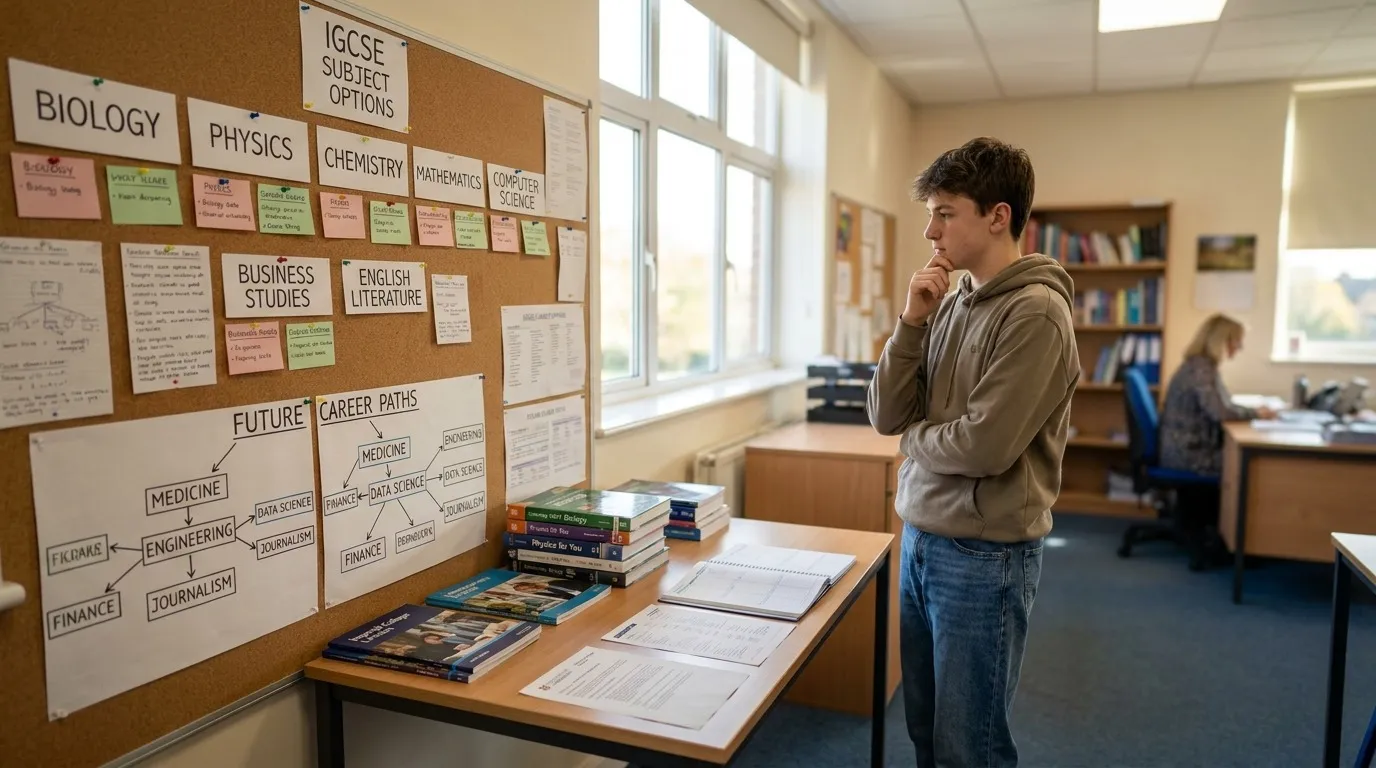
Nobody warns you how permanent this decision feels at the time. You are thirteen or fourteen years old, sitting in a school hall or a parent meeting, being handed a subject selection form that, according to every teacher in the room, will shape the next four years of your academic life. You have to pick from a list of subjects you have only partially studied, for a qualification you do not fully understand yet, in preparation for a future you have barely started thinking about. It is a lot to ask of a teenager. And the advice they usually get, “pick what you enjoy” or “choose your strongest subjects,” is not wrong exactly, but it is incomplete. Because IGCSE subject choices are not just about what a student likes or finds easy right now. They are about keeping the right doors open for what comes next. This guide gives students and parents the strategic thinking behind good IGCSE subject selection, what to consider, what to avoid, and how to build a subject combination that works for the future, not just for Year 10. Why IGCSE Subject Choices Matter More Than Most Students Realise Subject choices at IGCSE directly affect which A-Level or IB subjects are available afterward. Some A-Level subjects have informal or formal prerequisites at IGCSE level. A-Level Chemistry, for example, is extremely difficult without a solid IGCSE Chemistry foundation. A-Level Mathematics is significantly harder, and in some schools, not available, without a strong IGCSE Maths result and ideally some exposure to Additional Mathematics. A-Level Economics, Computer Science, and even some arts subjects benefit from related IGCSE preparation. This is what makes IGCSE subject selection genuinely strategic rather than just personal. A student who drops all sciences at IGCSE because they currently find them boring has closed off medicine, engineering, architecture, environmental science, and most STEM career pathways before they are old enough to know whether those pathways interest them. The goal of good subject selection is not to predict the future. It is to keep enough options open that the future can be chosen with real information rather than limited by decisions made at fourteen. IGCSE Compulsory Subjects: What Most Schools Require Before a student gets to choose anything, most schools have already decided a portion of the timetable. Understanding what is typically compulsory helps families see how much genuine choice actually exists. What Are the Standard IGCSE Compulsory Subjects? Most international and independent schools running the Cambridge IGCSE programme require students to take: English Language: almost universally compulsory and the single most important subject on the IGCSE timetable in terms of what it signals to universities and sixth forms Mathematics: compulsory at virtually every school, and the subject where the grade carries the most weight in subsequent applications At least one Science: most schools require two, and many strongly recommend three for students who have not ruled out science subjects at A-Level Beyond this core, schools vary considerably in what else they require. Some mandate a humanities subject. Some require a modern language. Some leave the remaining choices entirely open. Families should get a clear picture from the school of exactly what is fixed before thinking about the optional subjects. Why English and Maths IGCSE Results Matter So Much It is worth being direct about this: English and Maths are not just two subjects among many. They are the foundation on which every subsequent application, sixth form entry, university admissions, and in many cases employer assessments, is evaluated. A weak grade in either of these subjects creates problems that follow a student for years. A strong grade in both opens doors regardless of what else is on the transcript. If there is a subject that deserves the most revision time, the right IGCSE English tutor or IGCSE Maths tutor support and the most careful attention during Years 10 and 11, it is these two, every time. Best IGCSE Subjects: How to Think About Your Options Once the compulsory core is set, the question becomes how to use the remaining subject slots wisely. Here is how to think about it strategically. IGCSE Subject Combinations That Keep Options Open The most common strategic mistake students make at IGCSE is narrowing down too early. A student who is certain at thirteen that they want to study law drops history, drops economics, drops a language, and then discovers at sixteen that most competitive law programs expect a broad, academically rigorous subject profile, not a narrow set of subjects chosen for comfort. The safest approach is to build a subject combination that covers multiple academic areas: At least one humanity, History, Geography, Economics, or Business Studies At least one language beyond English, even if it is not the student’s strongest area Sciences, ideally two, and three for any student who has not definitively ruled out science at the A-level A creative or technical subject if the school allows it and the student has genuine interest This does not mean ignoring personal interest. It means making sure the combination as a whole does not close doors that the student has not consciously decided to close. Which IGCSE Subjects to Take for University Applications Different university destinations and subject areas value different things in an IGCSE profile. Here is a practical breakdown: For students considering medicine, dentistry, or veterinary science: Biology, Chemistry, and Physics at IGCSE are close to essential. Mathematics with a strong grade is expected. Working early with an IGCSE Biology tutor, IGCSE Chemistry tutor, or IGCSE Physics tutor provides a genuine advantage for building the foundation required for the transition to A-Level sciences. For students considering engineering or computer science: Mathematics (ideally including Additional Mathematics), Physics, and Computer Science at IGCSE provide the strongest foundation. Chemistry is also useful for some engineering disciplines. For students considering humanities, law, or social sciences: A broad mix including History or Geography, Economics or Business, and a language alongside the core English and Maths profile is what competitive programmes look for. For students considering […]

May
Some subjects reward students who are naturally gifted. English is not really one of them. That might sound strange. But here is what years of IGCSE English results actually show: the students who jump from a C or a 5 to an A or A* are almost never the ones who suddenly became better writers overnight. They are the ones who figured out what the examiner was looking for, and then practised giving it to them, consistently, until it became automatic. If your child is sitting somewhere in the middle of the grade range right now and wondering what it actually takes to get to the top, this guide is the honest answer to that question. No vague advice about “reading more books.” Just a clear breakdown of what IGCSE English actually tests, where marks are being lost, and what to do about it. What Is IGCSE English Revision, And Why Most Students Get It Wrong Before diving into strategy, it helps to understand what IGCSE English revision actually is, because most students approach it completely differently from how they should. IGCSE English is not a knowledge subject in the way Biology or Chemistry is. There is no syllabus of facts to memorise. What it tests is a set of skills, reading carefully, writing precisely, structuring arguments, and using language with control and purpose. Those skills improve through practice and feedback, not through re-reading notes. If you want to accelerate that improvement, working directly with a qualified IGCSE English tutor provides the targeted feedback on your essays needed to fix specific mistakes quickly. This means that a student who spends their revision time highlighting a revision guide is not really revising for IGCSE English. They are doing something that feels productive without building the skills the exam actually rewards. Real IGCSE English revision looks like this: reading past paper questions carefully, writing timed responses, marking those responses against the mark scheme, identifying exactly where marks were lost, and then practising the specific skill that caused the problem. Repeat. That cycle, write, mark, identify, practise, is what actually moves grades in this subject. Cambridge IGCSE English vs Edexcel IGCSE English, Know Your Board First Before anything else, students need to know which board they are sitting and which papers are involved. Cambridge IGCSE offers English as a First Language (0500 and 0990) and English Literature (0475 and 0992) as separate qualifications. Edexcel offers its own International GCSE English Language and English Literature. The paper structures, assessment objectives, and mark scheme language differ between boards, and revising from the wrong board’s past papers is a genuine waste of time. If your child is sitting Cambridge IGCSE English as a First Language, their revision should be built entirely around Cambridge materials. If they are sitting Edexcel, the same applies. Get this clear before anything else. IGCSE English Language Guide, Understanding What Each Paper Tests Most students have a vague sense of what IGCSE English involves. Very few have a precise understanding of what each paper actually tests and what skills earn marks in each section. That gap is where a lot of grades are quietly lost. Reading Skills, What Cambridge IGCSE English Actually Rewards Reading questions in IGCSE English are not testing whether students understood the passage. They are testing whether students can select relevant information, interpret the writer’s choices, and express what they found in precise, well-organised language. The difference matters. A student who understood the passage completely but wrote a vague, unstructured answer will score lower than a student who engaged more carefully with the specific question and wrote a focused, evidence-based response. What reading mark schemes consistently reward: Precise selection: choosing the most relevant detail from the text, not just anything that seems related Inference: going beyond what is stated to explain what is implied or suggested Specific quotation: embedding short, relevant quotes rather than lifting long chunks of text Developed comment: explaining why a quotation or detail is significant, not just identifying it Students who practise these four habits on every reading question they attempt will see improvement in their reading scores faster than students who simply write more. Writing Skills, How IGCSE English Grade Boundaries Are Actually Crossed Writing tasks in IGCSE English are where the biggest grade jumps happen, and where the most marks are unnecessarily lost. The examiner is not looking for the longest essay or the most dramatic story. They are looking for writing that is controlled, purposeful, and technically accurate. A short, well-structured piece with precise vocabulary and varied sentence structures will consistently outscore a long, sprawling piece that loses focus halfway through. IGCSE English Tips for Directed Writing Tasks Directed writing tasks ask students to write in a specific form. a letter, a report, a speech, an article, for a specific audience and purpose. Students who treat these as generic essays, ignoring the form and audience, lose marks before the examiner has even assessed the quality of their writing. The key habits for directed writing: Read the task carefully and identify the form, audience, and purpose before writing a single word Use format features appropriate to the form, a letter needs an address and greeting, a report needs headings, a speech needs direct address to the audience Maintain a consistent register throughout, formal where the task demands it, personal where it suits the audience Draw on the source material provided but transform it, do not copy chunks of the original text into your response IGCSE English Tips for Creative Writing Tasks Creative writing is where students either gain significant marks or give them away, depending almost entirely on how well they understand what “good” writing looks like at IGCSE level. The most common mistake: students write what happened rather than how it felt and what it meant. A narrative that simply describes a sequence of events, however exciting the events are, scores lower than a narrative that uses language deliberately, varied sentence lengths for effect, precise and unexpected word choices, sensory detail […]

May
Biology should be the most straightforward of the three sciences. That is what a lot of students think going into Year 10. And for the first few months, it feels that way. The content is interesting, the diagrams make sense, the topics feel manageable. Then somewhere around the middle of Year 11, the volume of material catches up with them, and what felt like a subject they had under control suddenly feels like trying to hold water in their hands. The IGCSE Biology syllabus is genuinely large. Not difficult in the way Chemistry or Physics can be difficult, where one concept blocks everything that follows, but demanding in a different way. It requires students to hold a lot of information accurately, retrieve it precisely under exam conditions, and apply it to questions phrased differently every year even when the underlying topic is familiar. Students who manage that well do not just work harder. They work differently. This guide shows you how. What Is IGCSE Biology, Cambridge vs Edexcel Explained Before opening a single revision guide, every student needs to get one thing clear: which board are they sitting? The Cambridge IGCSE Biology syllabus and the Edexcel IGCSE Biology syllabus cover similar ground but are not the same qualification. Paper structures differ. Question styles differ. What mark schemes reward in written answers differs. Revising from the wrong board’s materials is not just unhelpful, it actively builds habits that do not match what the actual exam rewards. Download the current syllabus document for your specific board from the official Cambridge or Edexcel website. Read every learning objective. Every topic listed is fair game in the exam. Every topic not listed is not worth revision time, no matter how thoroughly a teacher covered it in class. The syllabus document also distinguishes Core from Extended content, critical for Cambridge IGCSE Biology specifically. Core is assessed for all students. Extended content appears in higher-grade questions and is essential for anyone targeting A or A*. Knowing which category each topic falls into shapes how revision time should be allocated from the start. IGCSE Biology Topics, Complete Syllabus Breakdown for A and A* The Cambridge IGCSE Biology syllabus is organised across several major areas. Here is an honest breakdown of each, what it covers, how it is examined, and where marks are most commonly lost. Cell Biology and Organisation, IGCSE Biology Foundation Topics Cell biology is where the syllabus begins and where a solid foundation is built. Understanding the differences between plant and animal cells, the function of each organelle, and how cells organise into tissues, organs, and systems is fundamental. These topics appear in early exam questions that should be reliable mark-scorers, but only for students who have learned them precisely rather than approximately. Movement In and Out of Cells, Diffusion, Osmosis and Active Transport This is a topic where students often think they understand it until they try to explain it in writing. The distinction between diffusion and osmosis, why osmosis involves water moving across a partially permeable membrane, and how active transport differs from passive processes, these need to be expressed in precise scientific language because the mark scheme is specific about the terminology it accepts. Enzymes and Biological Molecules, Key IGCSE Biology Topics for Exam Success Enzyme questions are among the most consistently tested in the entire Biology paper. How enzymes work, what affects their activity, and what happens when conditions move outside the optimum all appear regularly. Students who genuinely understand enzyme action rather than just memorising the lock-and-key model handle the harder questions significantly better than those who learned only the surface version. Photosynthesis and Plant Nutrition, High Mark IGCSE Biology Topics Diagrams matter as much as written explanations here. Understanding what photosynthesis produces, what conditions affect the rate, and how to interpret graphs showing the effect of light intensity or carbon dioxide concentration on photosynthesis rate are all regularly tested. Limiting factors questions appear in almost every sitting in some form. Human Nutrition and Digestion, IGCSE Biology Study Guide This topic rewards students who understand the process end-to-end rather than just memorising organ names. Questions that ask students to explain what happens to a food molecule from ingestion to absorption require joined-up understanding that rote learning simply does not build. Respiration, One of the Most Mishandled IGCSE Biology Topics Students lose marks here more unnecessarily than almost anywhere else on the paper. The difference between aerobic and anaerobic respiration, the word and chemical equations for each, and what happens to products of anaerobic respiration in different organisms, these are precise, and the mark scheme is equally precise. Students who understand respiration broadly but write vague answers lose marks their knowledge should have earned. Gas Exchange and Transport, Cambridge IGCSE Biology Extended Content Gas exchange questions require students to explain not just what happens but why the structures involved are suited to their function. The features of gas exchange surfaces, large surface area, thin walls, maintained concentration gradient, need to be understood as functional adaptations, not memorised as a list. Transport topics covering the circulatory system, blood components, and how water and minerals move through plants connect closely to this area and are examined together regularly. Homeostasis and Coordination, High Value IGCSE Biology Notes Area This is one of the most concept-heavy areas of the syllabus and where students most often know the facts but struggle to explain the processes in sufficient depth. How a reflex arc works, how blood glucose is regulated, how the kidneys filter blood, all require explanation at the level of mechanism, not just outcome. These topics carry significant marks in the harder questions at the end of the paper. Genetics and Reproduction, IGCSE Biology Grade A* Territory Genetics questions at the harder end require students to interpret crosses involving multiple traits and work out genotype ratios, skills that need practice, not just understanding. Punnett squares, dominant and recessive alleles, and the distinction between genotype and phenotype appear regularly. This is also one of the areas […]

May
Let me be honest with you, IGCSE Physics is not easy. There are moments when you stare at a circuit diagram or a wave equation and genuinely wonder if any of it will ever make sense. I get it. Most students feel exactly the same way. But here is something worth knowing: the students who do well in IGCSE Physics are rarely the ones who are naturally “good at science.” They are the ones who figured out how to revise properly. And that is something anyone can learn. This guide will show you exactly what to do, from building your revision plan to nailing your exam technique. Let us get into it. Start With the Syllabus, Seriously, Do Not Skip This I know this sounds boring. But downloading the official Cambridge IGCSE Physics syllabus before you start revising is honestly one of the smartest things you can do. Why? Because it tells you exactly what will and will not be tested. No guessing, no wasted time studying something that is not even on the paper. Every topic, every command word, every learning objective, it is all laid out for you. Go through it once. Highlight the topics where you already feel okay. Circle the ones that make you go “I have absolutely no idea what this is.” Those circled topics? That is where you start. The main areas covered in Cambridge IGCSE Physics are general physics, thermal physics, waves, electricity and magnetism, and atomic physics. Each one has sub-topics, and some carry more exam weight than others, which brings us to the next point. Focus on the Topics That Show Up Every Single Year Not all topics are equal. Some come up in almost every past paper. If you are short on time, and most students are, you need to know where to focus your energy first. Electricity and circuits is probably the topic that catches the most students off guard. It looks simple on the surface, but the questions get tricky fast. Make sure you genuinely understand series and parallel circuits, not just which formula to use. Know how current, voltage, and resistance relate to each other. Understand how transformers work and why they matter for power transmission. Forces and motion comes up constantly. Speed, velocity, acceleration, Newton’s Laws, these are the building blocks of the whole paper. Get comfortable reading and drawing distance-time graphs and velocity-time graphs. A lot of students lose easy marks here simply because they confuse the two. Waves and the electromagnetic spectrum, know all seven parts of the EM spectrum in order. Know the difference between transverse and longitudinal waves. Be able to describe what happens when a wave reflects, refracts, or diffracts. These questions are very predictable, which means they are very winnable. Radioactivity comes up every year without fail. Alpha, beta, gamma, know their properties inside out. Know what happens to the nucleus during each type of decay. Understand half-life and how to work with decay graphs. Once you get this topic, it actually becomes one of the more straightforward ones. Do Past Papers, More Than You Think You Need To If there is one piece of advice I would give to every IGCSE Physics student, it is this: do more past papers than you think you need to. Not to tick a box. Not to feel productive. But because past papers are literally a window into the exam. The question styles repeat. The phrasing repeats. The types of mistakes the examiner is watching out for, they repeat too. Here is how to actually use them well. Sit down, set a timer, and do the paper properly under exam conditions. No notes, no phone, no looking things up. Then go through the mark scheme question by question, not just to see if you got it right, but to understand exactly what the examiner wanted. That gap between what you wrote and what the mark scheme says? That is your revision target. Cambridge IGCSE Physics past papers are available on the Cambridge Assessment International Education website. Physics and Maths Tutor is also excellent, they have questions sorted by topic, which is really useful when you are revising one specific area. Learn Your Equations in a Way That Actually Sticks There is no getting around it, you need to know your IGCSE Physics equations. But cramming a list of formulas the night before the exam is one of the least effective ways to learn them. Instead, make yourself a single equations sheet. Every formula, what each letter means, and the units. Keep it somewhere visible, your bedroom wall, the back of your door, your desk. Look at it every day, even just for thirty seconds. Passive exposure does more than you think. Then go further. Practise rearranging equations regularly. The exam loves to give you two values and ask you to find the third. If you freeze up every time you need to rearrange a formula, you are going to lose a lot of time. The more you practise it, the more automatic it becomes. Some equations to be especially confident with: speed equals distance divided by time, power equals voltage multiplied by current, and wave speed equals frequency multiplied by wavelength. These come up in one form or another on almost every paper. Make Revision Notes That Are Actually Useful Most students make revision notes the wrong way. They sit down, open a textbook, and copy out pages of information word for word. An hour later, they feel like they have done a lot of revision. In reality, they have just done a lot of writing. Useful revision notes are short, visual, and force you to think. Try mind maps for connecting topics, put something like “Waves” in the middle and branch out to reflection, refraction, diffraction, and the EM spectrum. Add quick definitions and examples as you go. Flashcards work brilliantly for equations, definitions, and key facts. Write the question on the front, the answer on the back. Use spaced repetition, […]

May
Chemistry has a reputation. Ask any group of IGCSE students which subject keeps them up at night, and Chemistry comes up more than almost anything else. Not because the students are not capable, but because Chemistry demands three completely different types of thinking at the same time. You need to remember facts. You need to understand concepts. And you need to apply both of them to questions you have never seen before, under time pressure, in an exam hall. That combination catches a lot of students off guard. They revise hard, feel reasonably confident going in, and then find the paper harder than they expected, not because the content was unfamiliar, but because the questions were phrased in ways their revision had not prepared them for. This guide fixes that. It covers the topics that matter most, how to actually use past papers rather than just doing them, and the specific habits that separate students who get A and A* from those who know the material but cannot quite show it when it counts. Struggling with IGCSE Chemistry? Get expert help with tricky topics, past papers and exam technique to boost your confidence and grades. GET A FREE TRIAL CLASS NOW Before You Revise Anything, Get Clear on Your Syllabus This sounds obvious. Most students skip it anyway. The Cambridge IGCSE Chemistry syllabus and the Edexcel IGCSE Chemistry syllabus cover similar ground, but they are not identical. The paper structures differ. The way questions are phrased differs. What mark schemes reward in written answers differs. A student revising from the wrong board’s materials is not just wasting time, they are actively building habits that do not match what their actual exam rewards. Before opening a revision guide or watching a single YouTube explanation, download the current syllabus document for your specific board from the official Cambridge or Edexcel website. Read through it. Use it as a checklist. Every topic on that document is fair game for the exam. Every topic not on it is not worth your revision time, no matter how interesting it is or how much your teacher covered it in class. This one habit, revising to the syllabus rather than to the textbook, is something that consistently distinguishes organised, high-scoring students from those who work just as hard but cover the wrong things. IGCSE Chemistry Topics, Where the Marks Actually Are The Chemistry syllabus is broad, and not every topic carries equal weight in the exam. Based on past papers across multiple sittings, these are the areas where marks are consistently concentrated: Atomic Structure and the Periodic Table appear in almost every paper, often in the earlier questions where marks are more straightforward to pick up. Students who are shaky on electron configuration, periods and groups, and the properties of metals versus non-metals drop marks here that should be automatic. Chemical Bonding is one of the topics where the gap between surface understanding and real understanding shows up most clearly in exam answers. Knowing that ionic bonding involves electron transfer is not enough, students need to be able to draw dot-and-cross diagrams correctly, explain why ionic compounds have high melting points, and describe the properties of covalent substances in terms of their structure. The questions go deeper than definitions, and revision needs to match that. Acids, Bases and Salts is a topic that rewards students who have done the practical work — or who have revised it thoroughly enough that they understand what actually happens in neutralisation reactions, salt preparation, and titration. This topic also connects directly to pH, indicators, and the properties of oxides, so understanding it properly has a multiplying effect across several question types. Rates of Reaction appears consistently and is one of the topics where exam questions are most predictable in structure. Students who understand how temperature, concentration, surface area, and catalysts affect reaction rate, and who can explain each effect in terms of particle collision theory, tend to pick up marks here reliably. Organic Chemistry is where a significant number of students lose confidence and marks, particularly in the second half of the Extended syllabus. The homologous series, functional groups, and reactions of alkanes, alkenes, and alcohols need to be learned systematically rather than in isolation. Students who try to memorise individual reactions without understanding the underlying patterns find organic chemistry overwhelming. Students who learn the patterns find it surprisingly manageable. Electrolysis trips up students who have learned the rules without understanding why they apply. Which electrode does each ion go to? What is produced at each electrode in different electrolytes? Why does the product change depending on concentration? These are exactly the kinds of questions that appear in the harder marks of a Chemistry paper, and they require genuine understanding rather than surface recall. IGCSE Chemistry Past Papers, How to Use Them Properly Every Chemistry revision guide tells students to do past papers. Very few explain how to get real value out of them. If you want personalized feedback on your past paper practice to spot exactly where you’re losing marks, working with a specialist IGCSE Chemistry tutor can accelerate your progress. Here is the approach that actually produces results: Start with topic-specific questions before full papers. In the early stages of revision, working through questions on a single topic, all the bonding questions from the last five years, for example — is more effective than doing full papers. It builds focused understanding and makes it clear exactly which parts of a topic are solid and which are not. When you move to full papers, time them properly. The exam environment is specific. Sitting with unlimited time and your notes nearby is not revision for an exam, it is just doing homework. Once you are doing full papers, set a timer, put everything away, and work through it the way you will on the actual day. Mark using the official mark scheme, not your own judgment. Chemistry mark schemes are precise about the language they accept. A student who writes […]