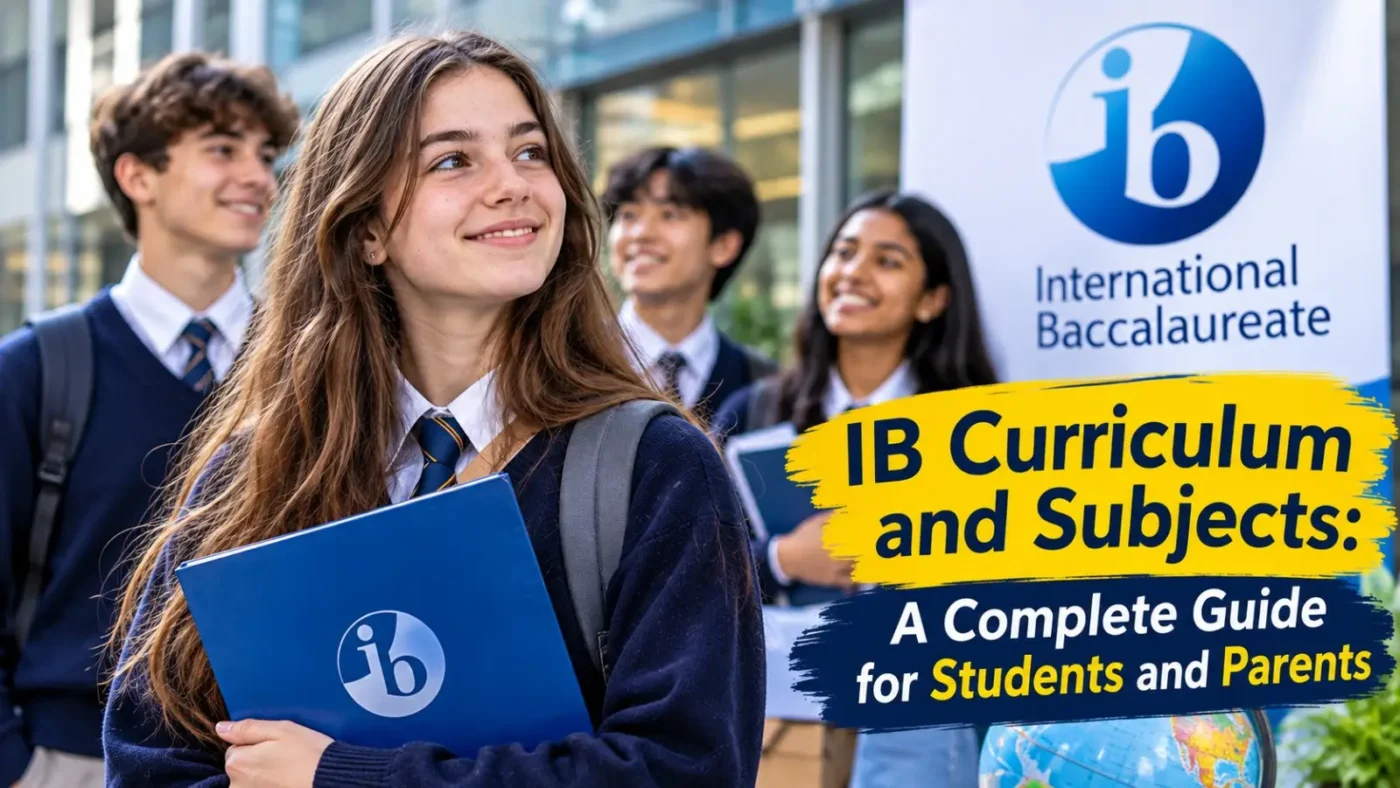
Quick Answer: The IB curriculum is an international education framework with four programmes. Its best known one, the Diploma Programme (ages 16 to 19), has six subject groups plus a core of Theory of Knowledge, an Extended Essay and CAS. Students take three subjects at Higher Level and three at Standard Level, and are scored out of 45 points.
A parent once told me that explaining the IB to friends felt harder than learning it. There are groups, levels, a core, internal assessments and a points system. It sounds like a lot before you see how the pieces fit.
Here is the good news. Once you see the structure, the IB curriculum is easy to follow. This guide explains it in plain English, so you know what your child will study, how they will be marked and how to choose subjects with confidence.
What Is the IB Curriculum?
The International Baccalaureate (IB) is a non-profit organisation that runs education programmes in thousands of schools across more than 150 countries. The IB curriculum focuses on more than exam facts. It asks students to think critically, research independently, write clearly and understand different points of view.
Universities around the world accept IB results, which is one reason many families choose it. Students who finish the Diploma are often described as well prepared for university study, because the course trains research and time management skills early.
The Four IB Programmes
The IB programme is not just one course. It has four stages, and a student can follow them from early childhood to age 19.
Programme | Age group | What it offers |
Primary Years Programme (PYP) | 3 to 12 | Learning through enquiry and projects |
Middle Years Programme (MYP) | 11 to 16 | Broad subjects linked to real life |
Diploma Programme (DP) | 16 to 19 | The best known pre-university course |
Career-related Programme (CP) | 16 to 19 | IB study mixed with career training |
Most families searching for the IB mean the Diploma Programme, so the rest of this guide focuses on it.
IB Curriculum Structure: The Six Subject Groups
The Diploma Programme has six subject groups. A student normally picks one subject from each group, which keeps their education broad. Here is what the groups contain.
Group | Area | Example subjects |
1 | Studies in language and literature | English A, Literature, other first languages |
2 | Language acquisition | French, Spanish, Mandarin, English B |
3 | Individuals and societies | History, Economics, Geography, Psychology, Business |
4 | Sciences | Biology, Chemistry, Physics, Computer Science |
5 | Mathematics | Analysis and Approaches, Applications and Interpretation |
6 | The arts | Visual Arts, Music, Theatre (or a second subject from groups 1 to 4) |
Subject lists can differ from school to school. Not every school offers every course, so always check what your own school provides.
Higher Level vs Standard Level
Each student takes three subjects at Higher Level (HL) and three at Standard Level (SL). Some students take four HL subjects, but this is much heavier.
- Higher Level: about 240 teaching hours, deeper content, more demanding assessment
- Standard Level: about 150 teaching hours, similar skills but less depth
Your HL subjects should match your future degree. A future engineer might choose HL Maths and HL Physics. A future lawyer might choose HL History and HL English.
The IB Maths Choice
Maths has two courses at both levels. Analysis and Approaches suits students who enjoy algebra, calculus and proof, often for science and engineering. Applications and Interpretation suits students who prefer data, modelling and technology. Check your target university’s requirements before choosing.
The IB Core: What Every Student Must Complete
On top of the six subjects, every Diploma student completes three core parts.
- Theory of Knowledge (TOK): a course about how we know what we know, assessed with an essay and an exhibition
- Extended Essay (EE): an independent research paper of up to 4,000 words on a topic the student chooses
- Creativity, Activity, Service (CAS): experiences outside the classroom, such as sport, art and volunteering
Many students find the core as demanding as a subject. Start planning the Extended Essay early, because leaving it to the last minute is one of the most common IB mistakes.
How the IB Curriculum Is Assessed and Scored
Most subjects use two kinds of assessment: external exams at the end of the course, and internal assessments marked by the teacher and checked by the IB. Internal assessments might be a lab report, a presentation, an essay or a portfolio.
Each subject is scored from 1 to 7. With six subjects, that gives up to 42 points. The core can add up to 3 bonus points, so the maximum total is 45.
To earn the Diploma, a student generally needs at least 24 points and must meet the other requirements, including the core. Many competitive universities ask for much higher scores, so check each course’s offer.
Choosing Subjects in the IB Curriculum
Picking subjects is a big decision. Follow this simple method.
- Start with the degree or career you might want.
- Check the entry requirements of two or three universities.
- Choose HL subjects that fit those requirements.
- Add SL subjects that balance your workload.
- Think honestly about your strengths and interests.
If you are comparing the IB with other routes, our guide on how to choose A Level subjects shows how to think about options, and our overview of what the IGCSE is explains the course many students take before starting the Diploma.
IB Syllabus: Where to Find Exactly What Is Examined
Each subject has an official subject guide, which is the IB syllabus for that course. It lists the topics, the assessment format, the command terms and the marking criteria. Ask your teacher for the current version, and use it as a checklist.
Because the syllabus can change between teaching cycles, always make sure your notes and past papers match the version your school follows.
Tips for Success in the IB
- Start early and keep a weekly plan, because the workload is steady
- Treat the internal assessments as real marks, not extras
- Practise past paper questions under timed conditions
- Learn the command terms, like “discuss” and “evaluate”, since they decide how you answer
- Ask for feedback and act on it quickly
For study methods that work across subjects, read our guide on how to revise effectively.
When IB Tutoring Can Help
The IB moves fast, and small gaps can grow quickly. A tutor can help most when a student is stuck on an HL topic, needs help with the Extended Essay structure, or wants feedback on internal assessments.
Key Takeaways
- The IB curriculum has four programmes, and the Diploma suits ages 16 to 19
- Students take six subjects, one from each group, three at HL and three at SL
- The core includes TOK, the Extended Essay and CAS
- Each subject scores out of 7, and the total maximum is 45 points
- Choose HL subjects based on your future degree
- Use the official subject guide as your syllabus checklist
- Start the Extended Essay and internal assessments early
Frequently Asked Questions
What is the IB curriculum?
It is an international education framework run by the International Baccalaureate, with four programmes for ages 3 to 19. The Diploma Programme is the most common pre-university route.
What subjects are in the IB?
There are six groups: language and literature, language acquisition, individuals and societies, sciences, mathematics and the arts. Students choose one subject from each group.
What is the difference between HL and SL?
Higher Level subjects have about 240 teaching hours and more depth. Standard Level subjects have about 150 hours. Students take three of each.
How is the IB scored?
Each subject is scored from 1 to 7, and the core can add up to 3 bonus points. The maximum total is 45.
What score do you need to pass the IB Diploma?
Generally at least 24 points, along with meeting the core and other requirements. Competitive universities usually ask for higher scores.
Is the IB harder than A Levels?
It is different rather than simply harder. The IB is broader, with six subjects and a core. A Levels are narrower, with three or four subjects in more depth.
Where do I find the IB syllabus?
Your teacher will give you the official subject guide for each course. Use the version your school follows.
Can I take the IB without taking the IGCSE first?
Yes. Entry requirements depend on your school, which may accept students from different backgrounds.
Final Thoughts: Making Sense of the IB Curriculum
The IB curriculum looks big from the outside, but it follows a clear pattern: six subject groups, three HL and three SL, plus a core. Once you understand that, planning becomes much simpler. Start by listing your possible degree choices, then match your subjects to them. That one step makes every other decision easier.