
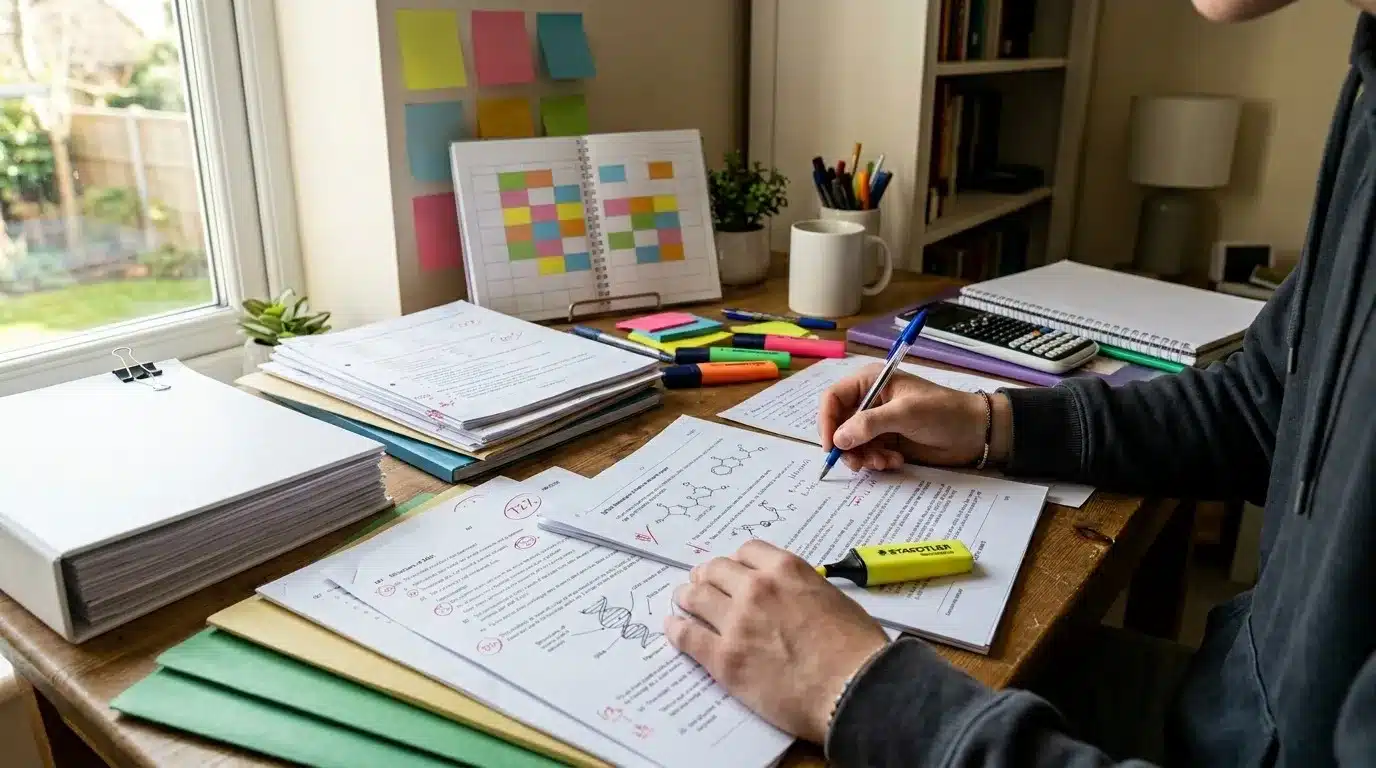
Every IGCSE student has been told to do past papers. Very few have been told how. There is a version of past paper practice that feels productive, sitting down with a paper, working through it at a comfortable pace, checking answers loosely against the back of a revision guide, and moving on. Most students have done this version. Most students also find, when the real exam arrives, that it did not prepare them nearly as well as they thought it would.
Then there is the version that actually moves grades. It looks different, feels more uncomfortable, and produces results that the casual version never does.
This guide is about the second version. It covers exactly how to use IGCSE past papers to get the most out of them, from where to find them, to how to sit them, to what to do after you have marked them. If your child is preparing for Cambridge or Edexcel IGCSE exams, this is the revision approach that consistently separates students who improve from those who stay stuck.
Why IGCSE Past Papers Are the Most Powerful Revision Tool Available
Before getting into method, it is worth understanding why past papers work so much better than other forms of revision, because when students understand the reason, they tend to use them more deliberately.
Most revision activities are passive. Reading notes, watching explanations, highlighting textbooks, these feel like learning, and they have some value in the early stages of revision. But they do not replicate the conditions of an exam. They do not force a student to retrieve information under pressure, apply knowledge to unfamiliar questions, or produce written answers within a time limit.
IGCSE practice papers do all of those things at once. They train the specific skills the exam tests, not just knowledge of the content, but the ability to use that knowledge in the format the examiner is looking for. And because Cambridge IGCSE past papers and Edexcel IGCSE past papers are drawn from real previous exams, they show students exactly what their actual papers will look and feel like.
There is also an element of familiarity that is easy to underestimate. Students who have sat ten past papers under timed conditions arrive at the real exam having already experienced the format, the pressure, and the pacing required. Students who have only revised from notes arrive at the real exam meeting those conditions for the first time.
That difference shows up in results.
Where to Find IGCSE Past Papers Free and Legally
One of the most common questions students ask is where to find past papers, particularly free ones. Here is the straightforward answer.
Cambridge IGCSE Past Papers: Official Sources
Cambridge makes past papers available through two main channels:
Cambridge International’s official website provides past papers, mark schemes, and examiner reports for all Cambridge IGCSE subjects. The most recent papers, typically the last two to three years, are often restricted to registered school centres, but a significant bank of earlier papers is publicly accessible.
School portals and teacher resources most schools that run Cambridge IGCSE programmes have a subscription to Cambridge’s school support hub, which gives access to a larger bank of past papers. Students should ask their subject teachers for access to these resources before spending time searching online.
Legitimate third-party revision sites host several revision platforms that legally host Cambridge IGCSE past papers with Cambridge’s permission. These are worth using for convenience, but always cross-reference with the official mark scheme from Cambridge’s own website rather than relying on unofficial answer versions.
Edexcel IGCSE Past Papers, Where to Find Them
Pearson makes Edexcel IGCSE past papers available through its official qualifications website. Papers, mark schemes, and examiner reports are available for most subjects going back several years. The search interface is straightforward; filter by qualification type, subject, and year.
As with Cambridge, some of the most recent Edexcel IGCSE past papers may be restricted to school access. Students whose schools use Edexcel should ask their teachers for access to recent materials through the school’s Pearson account.
IGCSE Past Papers Free: A Word of Caution
Unofficial sites hosting IGCSE past papers free of charge vary significantly in quality. Some are accurate and useful. Others contain errors in mark schemes, host papers from the wrong specification year, or present answers that do not reflect current mark scheme standards.
The safest approach is always to use official board websites for mark schemes, even if papers themselves are found elsewhere. The mark scheme is the most important resource, and getting it wrong defeats the purpose of the exercise.
IGCSE Mark Schemes: Why They Matter As Much As the Papers Themselves
This is where most students’ past paper practice falls down. They do the paper. They check whether their answers are roughly right. They move on.
What they miss is the most valuable part of the whole exercise: understanding exactly what the examiner was looking for and whether their answer provided it.
How to Read an IGCSE Mark Scheme Properly
IGCSE mark schemes are more detailed than most students realise. They do not just list the correct answer; they show:
- Which specific points earn marks, often with alternatives and variations that are also acceptable
- The exact terminology is required particularly in science subjects where vague language does not earn marks even when the underlying understanding is correct
- How marks are allocated across multi-step questions, showing which steps earn method marks independently of the final answer
- What common errors look like, examiner reports, published alongside mark schemes, describe the mistakes that appear most frequently and why they cost marks
A student who reads the mark scheme this carefully after every past paper is not just checking answers, they are learning how the examiner thinks. That understanding shapes how they write subsequent answers, and that shift in approach is where significant grade improvements come from.
IGCSE Mark Schemes by Subject: What to Pay Attention To
Different subjects reward different things, and mark schemes reflect that:
- In Science subjects, mark schemes specify exact scientific terminology. “The enzyme changes shape” is not equivalent to “the active site of the enzyme changes shape, preventing the substrate from binding. ” The difference in marks is real, and students who learn this from mark scheme analysis stop making the error.
- In English, band descriptors replace point-by-point mark allocation. Students need to read the band descriptors honestly, place their response in the band it actually belongs in, and understand specifically what would need to change to reach the next band up.
- In Mathematics, mark schemes show method marks separately from accuracy marks. A student who gets the wrong final answer but shows correct working can still earn most of the marks. A student who writes only the answer earns nothing if it is wrong, regardless of whether their method was correct. If you struggle to structure your working to capture these method marks, working with an IGCSE Maths tutor can quickly train you to present solutions the way examiners require.
- In Humanities, mark schemes for essay and extended writing questions show the qualities examiners look for at each mark level. Students who compare their responses against these level descriptors honestly get much clearer feedback than those who just count the marks they received.
How to Use IGCSE Past Papers Effectively: A Step by Step Approach
Here is the method that produces real grade improvement — not the comfortable version, but the one that works.
Step One: Start With Topic Questions Before Full Papers
In the early stages of revision, doing full past papers is less effective than working through questions on a single topic across multiple years. Pulling all the electrolysis questions from the last five Cambridge IGCSE Chemistry past papers, for example, and working through them in one session builds focused understanding and makes gaps visible quickly. Working alongside a dedicated IGCSE Chemistry tutor during topic-by-topic practice ensures you master difficult concepts like electrolysis before attempting full papers under timed conditions.
This approach, sometimes called topic-by-topic past paper practice, is particularly effective for subjects with large, distinct topic areas like Biology, Chemistry, Physics, History, and Geography.
Step Two: Move to Timed Full Papers Once Topics Are Solid
Once topic revision is reasonably solid, the focus shifts to full papers under proper exam conditions. This means:
- Timer set for the exact paper duration, no extensions, no stopping early
- All notes and revision materials put away, completely
- Working through the paper in the order it will be sat, not skipping around to comfortable questions first
- Writing in the answer booklet or on paper, not on screen, which changes the experience in ways that affect performance
The purpose of this stage is not just to practise the content. It is to practise managing time, handling questions that are hard or unfamiliar, and maintaining concentration across the full paper duration. These are skills that develop through repetition under realistic conditions, not through reading about them.
Step Three: Mark Carefully Using the Official Mark Scheme
After completing a timed paper, mark it using the official Cambridge or Edexcel mark scheme, not a revision guide answer key, not an estimated mark based on whether the answer seems right.
For each question where marks were lost, note:
- What the mark scheme required that the response did not provide
- Whether the issue was missing terminology, incomplete explanation, wrong method, or a content gap
- Whether this type of error has appeared before on other papers
This categorisation is the most important part of the entire exercise. It is what converts past paper practice from a measurement of current performance into a tool for improvement. If you notice recurring gaps in key terms or mechanistic explanations, an IGCSE Biology tutor can review your marked answers to pinpoint exactly which precise terminology mark schemes are looking for.
Step Four: Fix the Errors Before Doing Another Paper
This is the step most students skip. They mark the paper, feel vaguely aware of where they lost marks, and move straight on to the next paper, which means they make the same errors again.
The productive approach is to address errors before moving on:
- If marks were lost to a content gap, go back to the topic, understand it properly, and make notes on the specific points the mark scheme requires
- If marks were lost to imprecise terminology, add the correct terms to flashcards and practise using them in written answers
- If marks were lost to exam technique, practise that specific question type again before the next full paper
This cycle, attempt, mark, identify, fix, is what produces steady grade improvement rather than the plateau most students hit when they just keep doing papers without analysing the results.
IGCSE Past Papers 2024: Using the Most Recent Papers Strategically
The most recent past papers are the most valuable revision resource, and they should be used last, not first.
Why Recent Papers Should Be Saved
Cambridge IGCSE past papers and Edexcel IGCSE past papers from the most recent sittings reflect the current version of each syllabus, the current mark scheme style, and the current question formats. They are the most accurate representation of what the actual exam will look and feel like.
Students who use their most recent papers early in revision, when they are still building topic knowledge, waste this resource. They sit papers they are not yet prepared for, get lower marks than they will eventually achieve, and use up papers that would have been more valuable later.
The most effective approach is to work through older papers during the topic-building phase of revision, and then save the two or three most recent sittings for the final month before the exam, when they function as the closest possible simulation of the real thing.
What to Look For in Recent IGCSE Exam Papers
Beyond using recent papers as a final simulation, it is worth analysing them specifically for:
- Topics that appear consistently: some areas of the syllabus appear in almost every sitting; others are rarer. Identifying the consistent topics from recent papers tells students where revision time is most likely to pay off.
- Question format shifts, exam boards occasionally adjust how they ask certain types of questions. Recent papers show the current format; older papers may show slightly different question styles that are less representative of what to expect.
- Mark scheme language, the specific terminology mark schemes accept can shift slightly over time. Recent mark schemes are the most accurate guide to what examiners currently reward.
Cambridge IGCSE Past Papers vs Edexcel IGCSE Past Papers — Key Differences in Practice
Students sitting Cambridge IGCSE and students sitting Edexcel IGCSE should be using their own board’s past papers exclusively for timed practice, not mixing materials from different boards even for the same subject.
Here is why the distinction matters in practice:
Cambridge IGCSE past papers tend to include more open-ended questions where students determine their own method or approach. Mark schemes for Cambridge papers often include a wider range of acceptable answers, reflecting the more open question style. Students revising on Cambridge materials develop the habit of constructing their own approach, which is exactly what Cambridge papers reward.
Edexcel IGCSE past papers tend to break multi-step questions into structured sub-parts, guiding students through the method more explicitly. Mark schemes for Edexcel papers are often more specific about the expected steps because the question format provides more structure. Students revising on Edexcel materials develop the habit of following structured question formats, which is what Edexcel papers reward.
A student who has been practicing on Cambridge papers and then sits Edexcel papers may find the structured format slightly different from what they expected, and vice versa. This is a small difference but a real one, and it is another reason board-specific revision materials matter.
IGCSE Practice Papers: Subject Specific Tips for Maximum Impact
Across different subjects, the way past papers should be used varies in specific ways that are worth knowing.
Using IGCSE Practice Papers in Mathematics
In Maths, the non-calculator paper deserves separate focused practice. Many students naturally lean toward calculator methods when revising, which leaves them under-prepared for Paper 1. Deliberately practising mental arithmetic and written methods without a calculator, using past Paper 1 questions specifically, is more effective than general Maths revision for this paper.
Method marks are also critical in Maths past paper practice. Students should get into the habit of showing every step of working, even for steps that feel obvious. The mark scheme awards marks for method independently of the final answer, and the only way to access those marks is to show the work.
Using IGCSE Previous Papers in English
In English, marking using band descriptors requires genuinely uncomfortable honesty. Most students place their writing in a higher band than it belongs in when self-marking. The question to ask for each band descriptor is not “does my work have any of these qualities?” but “does my work consistently demonstrate all of these qualities?” The latter is the standard the examiner applies.
Reading the examiner reports published alongside English mark schemes is particularly valuable for this subject, they describe in plain terms what distinguished the highest-scoring responses from the middle-band ones, which is more actionable feedback than the band descriptors alone.
Using IGCSE Exam Papers in Sciences
In Science subjects, practical-based questions appear regularly in written papers even when the practical assessment is separate. Students who revise only from textbooks and miss the experimental methodology questions, identifying variables, evaluating results, suggesting improvements to procedures, consistently leave marks on the table that targeted past paper practice would have recovered.
How The Tutor Globe Helps Students Use IGCSE Past Papers More Effectively
The single biggest limitation of self-directed past paper practice is that students cannot see their own blind spots.
A student who consistently loses marks on inference questions in English does not always know that this is the pattern, they just know they are not doing as well as they hoped. A student who writes incomplete explanations in Biology mark scheme terms does not always recognise that their answer is incomplete, it feels complete to them.
This is where working with a specialist tutor through Tutor Globe makes the most visible difference. A tutor who knows the specific board, Cambridge or Edexcel, and the specific subject can look at a student’s past paper responses and identify the exact patterns that are costing marks. Not generally, but specifically, this sentence is too vague, this working step is missing, this mark scheme point was consistently skipped.
Tutor Globe’s board-level filtering means finding a tutor who works with the exact papers being sat, not a generalist who covers the subject broadly. Whether you need an IGCSE Physics tutor to walk through complex calculation steps or a specialist in another subject, bringing a marked past paper to the first session gives your tutor the exact roadmap needed to boost your grade. The tutor’s analysis of what went wrong, and why, is often the most useful single piece of feedback a student receives in their entire revision period.
A trial session is low commitment and high value. It is the most practical starting point for any student who has been doing past papers and not seeing the grade improvement they expected.
Frequently Asked Questions About IGCSE Past Papers
How many past papers should a student do before the exam?
As many as possible under proper timed conditions. Working through the five most recent sittings fully, with careful mark scheme review after each, is more valuable than doing twice as many papers casually. Quality of review matters more than quantity of papers.
Where can I find IGCSE past papers free?
Official board websites, Cambridge Assessment International Education and Pearson Edexcel, provide past papers and mark schemes directly. Some years are restricted to school access, but a significant bank of papers is publicly available. Always use official mark schemes regardless of where the paper itself was found.
Should students do papers from other boards for extra practice?
For subject content practice in the early stages, cross-board questions can be useful. For timed full-paper practice, students should use only their own board’s papers; the question style and mark scheme expectations differ enough that mixed-board timed practice builds slightly wrong habits.
How far back should students go with past papers?
Generally, five to seven years is a useful range for most subjects. Papers older than that may reflect a previous version of the syllabus that differs from the current one. Always check the syllabus year on the paper against the current specification before using it.
What should a student do if they keep making the same mistakes on past papers?
This is the most important signal that a different approach is needed, not more papers, but targeted work on the specific skill or topic causing the repeated error. A tutor who can identify the root cause of a persistent mistake and address it directly is significantly more effective than doing another paper and hoping the problem resolves itself.
Are IGCSE past papers from 2024 available to students?
The most recent papers are often restricted to school centre access through official board portals. Students should ask their subject teachers to provide access to recent papers through the school’s board subscription. Earlier papers from publicly accessible years remain available on official board websites.
Final Thoughts: IGCSE Past Papers Done Right
Past papers are not revision in themselves. They are a tool, and like any tool, the results depend entirely on how they are used.
The students who get the most out of IGCSE practice papers are the ones who sit them properly, mark them honestly, and fix their errors systematically before moving on to the next one. That cycle, attempt, mark, identify, fix, repeated consistently across the revision period, is what produces the grade improvements that casual past paper practice never quite achieves.
If your child is working through past papers and not seeing the results they expected, the issue is almost always in the review stage, not the sitting stage. Getting a specialist tutor to look at their marked papers and identify exactly what the mark scheme was looking for is the fastest way to break through a grade plateau.
Tutor Globe has subject specialists who work with Cambridge and Edexcel IGCSE students specifically, tutors who know the papers, the mark schemes, and the exact habits that earn marks in each subject. A trial session with a past paper attempt in hand is the most productive starting point.
