

Chemistry has a way of humbling students who thought they were good at science. You can leave your GCSE with an A* in Chemistry, walk into Year 12 feeling confident, and then spend the first half term quietly wondering whether you accidentally enrolled in a different subject. The content is denser. The questions go deeper. The mark scheme expects a level of precision that most students have never had to produce before. That experience is normal. It is also fixable. If you find the jump in difficulty overwhelming, working alongside a specialist A Level Chemistry tutor helps bridge the gap between GCSE foundations and A Level rigor. The students who do best in A Level Chemistry are not the ones who find it naturally easy. They are the ones who figured out early that this subject rewards a very specific kind of preparation, and who built that preparation into their revision before the exam season rather than discovering what they needed to do when it was too late. What A Level Chemistry Revision Actually Requires Before getting into topics and techniques, it helps to understand why A Level Chemistry revision fails for so many students who are working genuinely hard. The most common pattern: a student reads through notes, watches explanations, highlights content, feels reasonably prepared, and then opens a past paper and finds the questions are harder and more specific than anything their revision prepared them for. This happens because A Level Chemistry tests three distinct types of thinking simultaneously, and most revision approaches only address one or two of them. Factual recall: definitions, reagents, conditions, equations, mechanisms. The content that needs to be memorised precisely and retrieved accurately under exam pressure. Conceptual understanding: why reactions happen, what drives equilibria, how bonding affects properties, what trends in the periodic table mean at an atomic level. The understanding that allows knowledge to be applied to unfamiliar contexts. Exam technique: knowing what each question type is asking, what the mark scheme requires in written answers, how to structure explanations, when to use specific terminology. The skill of showing what you know in a form that earns marks. Students who revise only for recall can answer straightforward recall questions but struggle with application. Students who understand the concepts deeply but have not practised exam technique lose marks on questions they actually understand. Effective A Level Chemistry revision builds all three simultaneously, and the structure of revision time needs to reflect that. AQA A Level Chemistry vs Edexcel A Level Chemistry: Know Your Board First The practical starting point for any A Level Chemistry revision plan is knowing which board is being sat, and building every element of revision around that board’s specification, past papers, and mark scheme language. AQA A Level Chemistry and Edexcel A Level Chemistry cover the same core content, organic chemistry, physical chemistry, inorganic chemistry. Still, they structure it differently, assess it with different question formats, and reward slightly different things in written answers. AQA past papers and Edexcel past papers are not interchangeable for timed practice, and using the wrong board’s materials builds habits that do not match the actual exam. Download the current specification document for the correct board. Every topic in that document is fair game. Every topic outside it is not worth revision time regardless of how interesting it is or how thoroughly it was covered in class. A Level Chemistry Topics: Complete Breakdown by Area The A Level Chemistry specification covers three broad areas: Physical Chemistry, Inorganic Chemistry, and Organic Chemistry. Understanding what each area demands, and where the most marks are concentrated, shapes how revision time should be allocated. Physical Chemistry Topics: A Level Chemistry Foundation Physical chemistry is the most mathematically demanding area of A Level Chemistry and the one where students who are comfortable with numbers have a genuine advantage. The major topics are: Atomic Structure and Bonding builds on GCSE foundations but goes significantly deeper, electron configuration in subshells, ionisation energies and trends, the shapes of molecules using VSEPR theory, and the detailed relationship between bonding type and physical properties. This content underpins almost everything else in the specification and needs to be genuinely understood rather than superficially memorised. Energetics covers enthalpy changes, Hess’s Law, bond enthalpies, and in A2 moves into lattice enthalpy, entropy, and Gibbs free energy. Calculation questions in energetics are common and reliable marks for students who have practised the methods carefully. Conceptual questions about why certain reactions are or are not feasible require understanding of entropy and Gibbs free energy that goes beyond GCSE. Kinetics covers rate of reaction at a deeper level than GCSE, rate equations, orders of reaction, rate constants, and the Arrhenius equation. Rate equation questions appear frequently and reward students who have practised interpreting experimental data to determine orders of reaction, a skill that requires deliberate practice rather than just content knowledge. Equilibria covers dynamic equilibrium, Le Chatelier’s principle (extended from GCSE), and the equilibrium constant Kc and Kp. Equilibrium questions are among the most consistently tested in A Level Chemistry and among the most consistently mishandled, students who understand Le Chatelier’s principle qualitatively often struggle with quantitative equilibrium calculations, which require a different level of preparation. Acids and Bases at A Level introduces pH calculations, weak acids and bases, buffer solutions, and titration curves. This is a topic where precise calculation methodology matters enormously, a small error in the setup of a pH calculation costs the method marks that would otherwise be available even with arithmetic errors. Practising the calculation setups rather than just understanding the concepts is essential. Electrochemistry covers electrode potentials, the electrochemical series, and predicting the feasibility of reactions using standard electrode potentials. This is a topic that many students find confusing initially, the sign conventions are precise and the reasoning involved is more abstract than most physical chemistry topics, but it becomes much more manageable with structured practice. Inorganic Chemistry Topics, A Level Chemistry Inorganic chemistry covers the chemistry of elements across the periodic table […]
Monthly Archives: July 2026

Jul
Most students who choose A Level Maths know it is going to be harder than GCSE. What they underestimate is how differently it needs to be approached. GCSE Maths rewards students who have learned methods and can apply them reliably to familiar question types. A Level Maths rewards something different, the ability to think mathematically, to connect ideas across different topic areas, to construct multi-step solutions to problems that do not look like anything practised before, and to do all of this fluently under timed exam conditions. That shift in what the subject demands catches a lot of capable students off guard. Students who achieved grade 8 or 9 at GCSE, who never had to work particularly hard at Maths before, sometimes find A Level Maths genuinely difficult for the first time. Not because they lack the ability, but because the subject has changed in ways they were not prepared for. This guide explains what A Level Maths actually involves, how to approach the topics that cause the most difficulty, what the exams require, and what separates students who get an A+ from those who plateau somewhere below it. What Is A Level Maths: How It Differs From GCSE A Level Mathematics: The Structure of the Qualification A Level Maths is a two-year qualification, typically studied in Years 12 and 13 (Lower and Upper Sixth). It is examined entirely at the end of Year 13, there are no modular exams or coursework components, which means two years of content is assessed across a series of papers sat over a few weeks in the summer of Year 13. All A Level Maths specifications include two core components: Pure Mathematics: the largest component, covering the foundational mathematical content that underpins the rest of the qualification. Pure Maths typically accounts for two thirds of the total marks. It includes topics that extend significantly from GCSE, algebra, functions, calculus, trigonometry, vectors, and proof, plus content that is entirely new, including exponentials and logarithms, integration, and more advanced algebraic manipulation. Applied Mathematics: the remaining third of the specification, divided between Statistics and mechanics. All A Level Maths students study both Statistics and Mechanics, though the balance and depth vary slightly between exam boards. Understanding this structure from the start shapes how revision time should be allocated. and helps students avoid the common pattern of over-investing in the applied content because it feels more accessible while under-revising the pure content where the majority of marks sit. A Level Maths Difficulty: Why the Jump From GCSE Is Bigger Than Expected The difficulty jump from GCSE to A Level Maths is one of the most consistently underestimated transitions in secondary education. Several things change simultaneously: Content volume increases dramatically. The A Level Maths specification covers significantly more material than GCSE, introduced at a faster pace, with less repetition and consolidation time built into the teaching sequence. Questions require multi-step reasoning. GCSE questions often test one skill in a relatively direct way. A Level Maths questions routinely require combining ideas from different topic areas, using results from one part of a question in the next, and constructing solutions that involve several steps, none of which are signposted by the question itself. Algebraic fluency is assumed. At A Level, time cannot be spent working out how to manipulate expressions or solve equations, those skills need to be automatic. Students who arrive at A Level with shaky algebraic foundations find the content much harder than it needs to be, because every new topic is being processed through an uncertain foundation. Independent study becomes essential. GCSE content is generally taught and retaught until most students understand it. A Level Maths moves faster and expects students to consolidate understanding independently between lessons, which requires a self-directed revision habit that many students have not needed to develop before. A Level Maths Topics: Complete Breakdown by Area Pure Mathematics Topics: The Core of A Level Maths Pure Maths is where the majority of marks are available and where revision effort has the highest return. Here is a breakdown of the major pure topics and what each requires: Algebra and Functions builds directly from GCSE algebra but goes significantly further. Polynomial division, the factor theorem, partial fractions, and functions including composite and inverse functions are all introduced in Year 12. Students who are fluent algebraic manipulators find these topics manageable. Students with GCSE algebraic gaps find them compounding, each new topic requires the previous ones to be secure. Coordinate Geometry covers straight lines, circles, and the use of parametric equations to describe curves. Circle questions at A Level are more complex than at GCSE and frequently combine with algebra in multi-step problems. Coordinate geometry questions appear consistently across all A Level papers and are a reliable source of marks for students who have practised them thoroughly. Sequences and Series introduces arithmetic and geometric sequences at greater depth than GCSE, plus the binomial expansion, a topic that appears regularly in A Level papers and rewards students who have learned it precisely. The sigma notation used in sequences also appears in Statistics, making this a topic with cross-topic value. Trigonometry expands dramatically at A Level. Radians, reciprocal trigonometric functions, inverse trig functions, compound angle formulae, double angle formulae, and the R-addition formulae all build on GCSE trigonometry in ways that most students find challenging initially. Trigonometry is one of the topics where A Level Maths feels genuinely hard, but it responds very well to structured practice because the patterns are consistent once the underlying identities are secure. Exponentials and Logarithms is entirely new at A Level, there is no GCSE equivalent of the same depth. Understanding exponential growth and decay, the natural logarithm, and the laws of logarithms are all introduced in Year 12. These topics also connect to calculus, making them important to understand properly rather than memorise superficially. Calculus, Differentiation and Integration is the most significant new content at A Level and the topic area that carries the most marks across most specifications. Differentiation covers […]
Jul
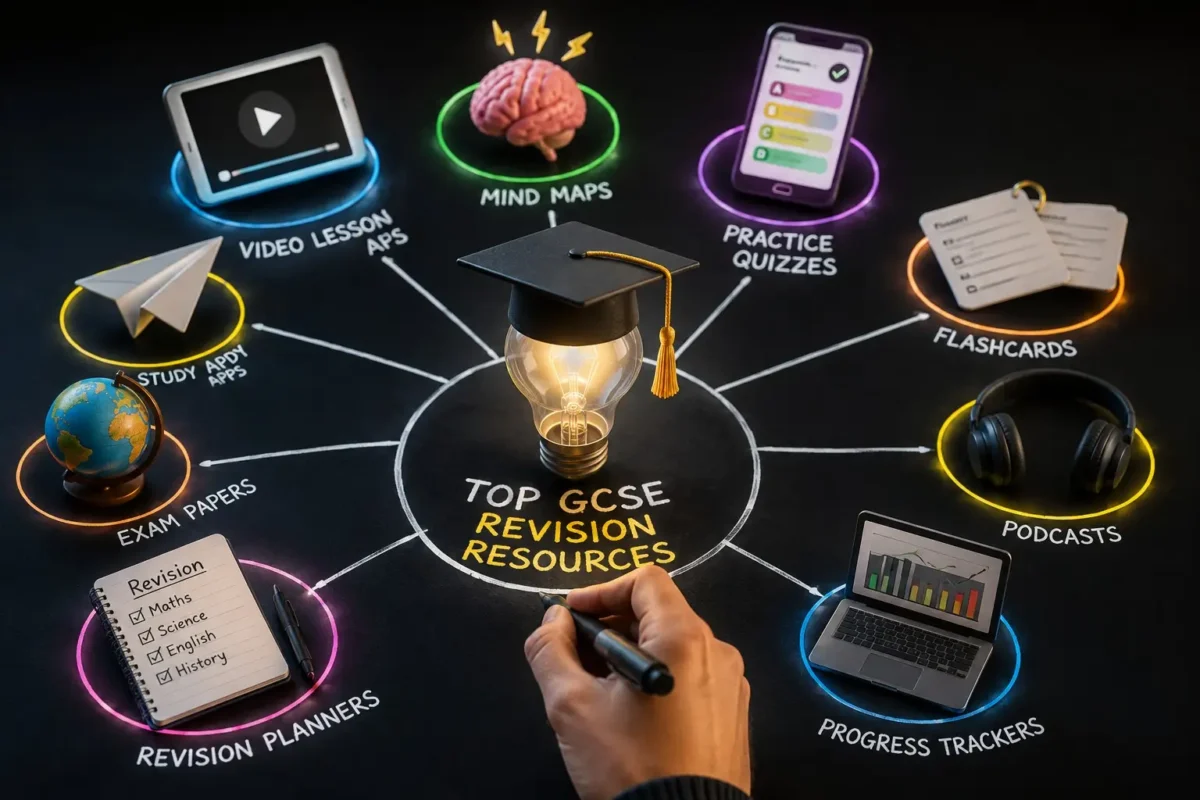
Every student revising for GCSEs has access to the same content. The same topics, the same past papers, the same specification documents sitting on the same exam board websites. What separates the students who use that content effectively from those who do not is rarely effort. It is usually the quality of the tools they are using and, more importantly, how they are using them. There are hundreds of GCSE revision websites, apps, and tools available. Most students end up using two or three of them passively, watching videos, reading summaries, highlighting digital notes in a way that feels productive without building the active recall and exam technique that actually move grades. This guide cuts through the noise. It covers the resources that genuinely help GCSE students improve, what each one is good for, how to use it in a way that produces results, and where each tool fits in a broader revision plan. No padding, no generic lists, just the honest breakdown of what works and why. Why the Right GCSE Revision Resources Make a Real Difference Before getting into specific tools, it is worth understanding what makes a revision resource genuinely useful versus one that just feels useful. The most effective revision resources have one thing in common: they require the student to actively do something rather than passively consume information. Watching a video explanation of quadratic equations is not the same as attempting quadratic equation problems. Reading a Biology summary is not the same as testing yourself on the content from memory. The best GCSE revision tools are the ones that build active recall, forcing the brain to retrieve information rather than just recognise it, and that provide immediate feedback on whether the retrieval was correct. Those two features, more than anything else, determine whether a resource produces genuine learning or just the comfortable feeling of it. With that principle in mind, here is the honest breakdown. BBC Bitesize GCSE: What It Is Good For and Where It Falls Short Strengths of BBC Bitesize GCSE BBC Bitesize is the most widely known GCSE revision resource and for good reason. Its coverage is genuinely broad, it covers most GCSE subjects across multiple exam boards, with clear explanations, diagrams, and worked examples that are accessible to students across the ability range. For building initial understanding of a topic, Bitesize is hard to beat for accessibility. The explanations are written in plain language, the structure is logical, and the interactive elements, quizzes, drag-and-drop activities, and short tests at the end of each section introduce an element of active recall that passive reading alone does not. Bitesize is particularly useful for: Getting a clear initial explanation of a topic before working through more detailed material Checking understanding of a concept at a basic level Providing a starting point for students who are not sure where to begin on a topic Supporting students who find textbook language difficult to access Where BBC Bitesize GCSE Has Limitations The limitation of Bitesize is depth. The explanations are accessible precisely because they are simplified, and for students aiming at grade 6 and above, particularly in sciences and Maths, the level of detail on Bitesize is often insufficient for the harder exam questions. Students who revise exclusively from Bitesize and then sit a challenging past paper often find that the questions go further than what Bitesize covered. It is an excellent starting point and a useful reference, but it should not be the only resource in a serious revision plan. Save My Exams GCSE: Structured Revision Built Around Past Paper Questions Why Save My Exams GCSE Is One of the Most Useful Tools Available Save My Exams has become genuinely popular among GCSE students, and the reasons are specific and practical. The platform organises revision by exam board and by topic, providing concise notes, worked examples, and practice questions that are closely modelled on actual past paper question styles. For students who want to move beyond Bitesize into more exam-focused practice, Save My Exams bridges the gap between content understanding and exam technique more effectively than most free resources. The practice questions on Save My Exams are particularly useful because they are structured to mirror the difficulty progression of actual papers, starting with accessible questions that build confidence before moving to harder application questions that replicate what higher-grade exam questions look like. Answers and full worked solutions are provided, which makes self-marking meaningful rather than approximate. Save My Exams is especially strong for: GCSE Sciences: Biology, Chemistry, and Physics notes and questions are detailed, well-organised, and closely tied to specific board specifications GCSE Mathematics: worked examples and practice questions are structured by topic and difficulty level GCSE English: mark scheme guidance and model responses for reading and writing questions Students who learn best from a structured, topic-by-topic progression with immediate feedback How to Use Save My Exams GCSE Effectively The students who get the most from Save My Exams are not the ones who read through the notes and feel reassured. They are the ones who attempt the practice questions first, without reading the notes, to identify what they do not know, then use the notes to address the gaps revealed. That order, attempt, identify gap, study, attempt again, produces significantly better outcomes than reading notes and then attempting questions. The initial attempt without notes is the active recall component that makes subsequent learning stick. Seneca Learning GCSE: Spaced Repetition Built Into the Platform What Makes Seneca Learning GCSE Different Seneca Learning is built around a specific learning science principle: spaced repetition. The platform tracks which questions a student gets right and wrong and automatically adjusts the frequency with which material is reviewed, showing topics that are insecure more often and topics that are well-known less often, until everything reaches a confident baseline. This is particularly valuable for content-heavy subjects where the sheer volume of material makes it difficult to keep everything active in memory simultaneously. GCSE Biology, Chemistry, History, and Geography all involve large […]
Jul
Nobody chooses to struggle with Maths. Students who are finding GCSE Maths genuinely difficult are not lazy, not unintelligent, and not beyond help. They are almost always students who fell behind at some point, a topic that did not click, a term where things moved too fast, a foundational concept that was never quite secure, and who have been trying to keep up ever since while the gaps quietly compounded underneath them. If that sounds familiar, this guide is written for you. Not the version that assumes you just need to “try harder” or “do more past papers.” The version that starts from where you actually are and gives you a realistic, specific plan for getting to a grade 4 and beyond, if that is what you need. Why Students Struggle With GCSE Maths: And Why It Is Not What Most People Think Before getting into the plan, it is worth understanding why GCSE Maths causes so many students genuine difficulty, because the reason matters for how to fix it. Maths is a sequential subject. Each topic builds on what came before. A student who does not fully understand fractions will struggle with algebra. A student who is shaky on algebra will struggle with quadratics, graphs, and simultaneous equations. A student who misses the foundations of ratio will find proportion and percentage problems consistently unreliable. This means that when a GCSE Maths student is struggling, the problem is almost never the current topic. It is almost always something that came before the current topic, a gap in foundational knowledge that has been making everything harder for months or years without ever being identified and fixed. This is the most important thing to understand before starting any revision plan. If a student cannot do quadratics, the answer is not to spend two weeks on quadratics. The answer is to find out what earlier foundation is missing and fix that first. When the foundation is in place, the harder topic usually becomes significantly more manageable. Why Failing GCSE Maths Happens More Often Than It Should GCSE Maths failure is rarely about intelligence. It is almost always about foundational gaps, exam technique issues, or bot, combined with a revision approach that addresses neither specifically. The three most common patterns that lead to underperformance in GCSE Maths: Unidentified foundation gaps from Key Stage 3 that were never fully secured and have been silently limiting performance in Year 10 and Year 11 ever since Avoiding difficult topics: students naturally gravitate toward practising what they already can do, which means weak areas never improve, while comfortable areas get stronger Not showing working method marks account for a significant proportion of available marks in GCSE Maths, and students who do calculations mentally and write only the answer lose those marks, even when their final answer is correct GCSE Maths Foundation Tier: Understanding What You Are Actually Sitting What Is GCSE Maths Foundation Tier? GCSE Maths has two tiers: Foundation and Higher. Foundation tier covers grades 1 to 5. Higher tier covers grades 4 to 9. Most students sitting Foundation tier are aiming for grade 4, the standard pass, or grade 5. If a student is aiming for grade 4 specifically, Foundation tier is the right entry level. The Foundation tier specification covers the topics needed to demonstrate the level of mathematical understanding that a grade 4 represents — and revising Foundation tier content thoroughly is more effective than attempting Higher tier content without the foundations in place. What Topics Appear on GCSE Maths Foundation Tier? Foundation tier covers a broad range of topics across number, algebra, geometry, and statistics. The areas that appear most consistently in Foundation papers and carry significant marks include: Number: fractions, decimals, percentages, ratio and proportion, powers and roots, standard form Algebra: simplifying expressions, solving equations, substitution, sequences, graphs of linear and quadratic functions Geometry: area and perimeter, volume, angles, Pythagoras’ theorem, transformations, similarity Statistics and Probability: mean, median, mode and range, probability, interpreting graphs and charts Students targeting grade 4 should focus the majority of their revision time on these areas, particularly the number and algebra topics that underpin everything else on the paper. How to Pass GCSE Maths: A Realistic Step by Step Plan Step One: Find the Gaps Before You Revise Anything This is the step most struggling students skip, and it is the most important one. Before starting topic revision, do a diagnostic test across the Foundation tier specification. This does not need to be a full past paper, it can be a set of questions covering each topic area, one or two questions per topic, with the explicit purpose of finding out which areas are solid and which are not. The results of that diagnostic are the foundation of the entire revision plan. Topics where answers are consistently correct with confidence need less time. Topics where answers are wrong, guessed, or skipped entirely need the most time. Topics where answers are sometimes right but inconsistently need structured practice. Most students who do this exercise discover that their weaknesses are more specific than they realised, not “I can’t do Maths” but “I struggle specifically with fractions, algebraic manipulation, and anything involving angles.” That specificity is useful. It makes revision targetable rather than overwhelming. Step Two: Fix Foundation Gaps Before Moving to Harder Topics Once the gaps are identified, the order of revision matters significantly. Start with the most foundational topics, number skills, fractions, basic algebra, before moving to topics that build on them. A student who cannot confidently add and subtract fractions should not be spending revision time on algebraic fractions, because they will hit the same wall every time and attribute the difficulty to the new topic rather than the underlying gap. For each gap identified: Find a clear, worked explanation of the topic, not a textbook paragraph to read, but a worked example that shows every step Work through similar examples yourself, writing every step even when it feels unnecessary Then attempt questions on that topic […]

Jul
History is one of those subjects where students can know everything and still not get the grade they deserve. That sounds harsh, but any History teacher who has marked GCSE essays will tell you the same thing. The student who spent weeks learning dates, causes, consequences, and key individuals, and then wrote an essay that described events rather than analysed them, will score in the middle bands. Every time. Regardless of how much they know. The students who score at the top of the grade range are not always the ones who know the most history. They are the ones who understand what a history examiner is actually looking for and have practised producing it. That distinction, between knowing history and demonstrating historical thinking in an exam essay, is what this guide is about. What GCSE History Revision Actually Requires Before getting into essay technique, it is worth being clear about what GCSE History is fundamentally testing, because most students have a slightly wrong picture of it. GCSE History is not a memory test. Yes, knowledge matters. You cannot write a convincing analytical essay about the causes of the First World War without knowing what those causes were. But knowledge is the raw material, not the finished product. The finished product is an argument, a clear, evidenced, analytical response to a specific historical question. This is what the mark scheme rewards at every grade level above the middle bands. Not more facts, but better use of the facts already known. Not longer essays, but more focused, better structured arguments. The shift from describing what happened to explaining why it happened, how significant it was, and how it connects to the question asked, that is what moves grades at GCSE History. Understanding this changes how revision should work. It means content knowledge and essay technique need to be developed together, not separately. A student who knows all the content but cannot structure an analytical argument will plateau. A student who can argue clearly but does not know enough content will run out of evidence. Both sides matter. AQA GCSE History vs Edexcel GCSE History: Know Your Specification First The first practical step in GCSE History revision is knowing exactly which board and which specification applies, because AQA GCSE History and Edexcel GCSE History assess through different question types, different paper structures, and in some cases very different content. AQA GCSE History is structured around thematic studies, period studies, British depth studies, and historic environment studies. Each component has specific question types with specific mark allocations and specific assessment demands. Edexcel GCSE History similarly combines period studies, thematic studies, British depth studies, and a historic environment component, but the specific topics offered, the question formats, and the mark scheme language differ from AQA in ways that matter for preparation. Every past paper, mark scheme, and examiner report used in revision should come from the correct board and the correct specification for the topics being studied. Using resources from the wrong board wastes revision time and builds the wrong habits for the actual exam. GCSE History Topics: Building the Knowledge Base That Essays Require Content knowledge is the foundation. Without it, essay technique has nothing to work with. Here is how to build it efficiently. How to Learn GCSE History Topics Without Passive Re-Reading The most common mistake in History content revision is re-reading notes or textbook sections and mistaking the feeling of familiarity for genuine retention. Re-reading produces recognition, the ability to identify information when you see it. Exams require recall, the ability to retrieve information when nothing is in front of you. The revision habits that build genuine recall for History content: Knowledge organisers used actively: not read, but covered and reproduced from memory. Write down everything remembered about a topic without looking, then check what was missed and try again Timeline construction from memory: particularly for topics with complex chronology, being able to place events in sequence without reference materials is a genuine exam advantage Cause and consequence mapping: for each major topic, being able to explain not just what happened but why it happened and what followed is the analytical foundation that essay questions build on Flashcards for key individuals, dates, and turning points: tested regularly rather than read passively GCSE History Topics: What to Prioritise Different GCSE History specifications cover very different content, so the specific topics worth prioritising depend entirely on the specification being sat. However, across most specifications, certain types of content deserve particular attention because they appear most frequently in exam questions: Key turning points: moments that changed the direction of events significantly, which examiners use as the basis for significance questions Causes and consequences of major events: the analytical framework that explanation questions are built around The role of key individuals: how much influence specific people had compared to wider forces, which feeds into evaluation questions Change and continuity: what changed across a period and what stayed the same, which underpins thematic and period study questions Source evaluation: how to assess the utility and reliability of historical sources, which appears explicitly in several question types GCSE History Essay Tips: The Structure That Earns Top Marks This is the section most students need most, and the one most vaguely covered in general revision guides. Here is specifically what top-grade History essays do and what middle-grade ones do not. What GCSE History Examiners Look For in Top Grade Essays The mark schemes for GCSE History extended writing questions are structured around levels, with higher levels rewarding increasingly sophisticated historical thinking. The qualities that distinguish each level are specific and learnable. Level 1 responses mostly describe events or list information without connecting it to the question. They tell the examiner what happened rather than why it mattered in relation to what was asked. Level 2 responses begin to explain rather than just describe. They make points that are relevant to the question and support them with some evidence. But they tend to deal with each point […]

Jul
Results day is one of those mornings that feels enormous before it arrives. For most students, it goes reasonably well, not always perfectly, but well enough. For some, it does not. They open the envelope or log in to the portal, and the grades staring back at them are not what they needed, not what they were predicted, and not what they spent the last several months working toward. If that is where you are right now, or where you are preparing for in case it happens, this guide is for you. Not the version that tells you everything will be fine without explaining what actually to do. The version that tells you exactly what your options are, what the realistic timelines look like, and how to make the best decision quickly on a day when everything feels urgent, and nothing feels clear. When Are GCSE Results 2026? Key Dates to Know GCSE Results Day Date in 2026 GCSE results day in 2026 falls in August, as it does every year. The exact date is confirmed by exam boards and schools in the months leading up to results day, but historically it lands on the third or fourth Thursday of August, typically between 20 and 27 August. Students collect results from their school in person on results day morning or access them through the school’s online portal if physical collection is not possible. Schools usually open early on results day, often from 8am, to allow students to collect and process results before next steps need to be decided. Parents and students should confirm the specific date and collection arrangements with the school directly in the weeks before results day. Each school manages the day slightly differently, and knowing the logistics in advance removes one source of stress on the day itself. GCSE Results 2026: What Comes With the Results Slip The results slip shows grades for every GCSE subject sat. For most students this is straightforward. A few things worth knowing: Combined Science results show as a double grade, two grades expressed together, such as 6-6 or 6-7, reflecting performance across the combined Biology, Chemistry, and Physics content. This is normal and is read as two separate GCSE grades by sixth forms and universities. Spoken language endorsements for English Language are reported separately from the main GCSE grade and do not affect the numerical grade. They are shown as Pass, Merit, or Distinction. Component grades, the breakdown by individual paper, are not shown on the results slip but can be requested through the school if needed for appeals or resit decisions. What to Do After GCSE Results: The First Hour Take a Breath Before Making Any Decisions This is genuinely the most important advice for results day morning, and the hardest to follow in the moment. Results day creates a pressure to act immediately that is not always justified by the actual timelines involved. Most decisions do not need to be made within the first hour of receiving grades. Sixth form places are not automatically withdrawn the moment results come in. Resit registrations have deadlines that are days or weeks away, not minutes. The first thing to do is read the results carefully and sit with them for a few minutes before reacting. Check every subject. Note which grades met requirements and which did not. Work out specifically what the gap is, one grade short in one subject, or multiple subjects below the required threshold, before deciding what needs to happen next. A clear picture of exactly what the results show is the foundation of every good decision that follows. Check Sixth Form and College Requirements Against Your Actual Results Most students applying to sixth form or college will have received a conditional offer, entry subject to achieving specific grades. The first practical step after reading results is to compare actual grades against those conditions specifically. Some students discover their results are better than their conditions required, which is a straightforward situation. Others find they have missed one or more subject requirements. The key distinction is whether a grade was missed narrowly, one or two marks, or by a wider margin, because the appropriate response differs significantly between those two situations. What to Do After GCSE Results If Grades Are Disappointing Option One: Contact Your School or Sixth Form Immediately If grades are below the conditions of a sixth form offer, the first call to make is to the school or college directly, not to panic, not to immediately register for resits, but to have a conversation about what flexibility exists. Many sixth forms build some flexibility into their results day processes for students who have just missed their conditions. A student who needed a 6 in Chemistry and got a 5, but met all other conditions with strong grades, is in a different position from a student who missed multiple subjects by wide margins. Schools make individual decisions on results day and in the days that follow, and having that conversation early, calmly, with specific grades ready to discuss, is always better than assuming a place has been lost. Even if the sixth form cannot accommodate the current grades immediately, they may be able to offer a place conditional on a successful resit, which leads directly into the next option. Option Two: GCSE Resit A GCSE resit allows a student to sit an exam again in a subsequent series to improve a grade. This is the most common response when a grade falls short of a required threshold by a small margin in a high-priority subject. The most important things to know about GCSE resits: English Language and Mathematics resits are sat in November of the same year for students who did not achieve grade 4. This is the most common resit scenario and most schools actively support students through it. Other GCSE subject resits are generally available in the following summer’s exam series rather than November, though this varies by board and subject. Students planning to resit […]

Jul
Nobody gives you a straight answer to this question. Ask a teacher, and they say, “It depends.” Ask a sixth form prospectus and it lists requirements for specific subjects without explaining the bigger picture. Ask a parent who went through a different system and you get advice that may not apply anymore. So here is the straight answer, followed by all the context that actually makes it useful. The number of GCSEs a student needs depends entirely on what they want to do next. But there are patterns, thresholds, and minimum requirements that apply across almost every post-16 and post-18 pathway, and understanding those clearly is what this guide is about. How Many GCSEs Do You Need: The Honest Overview There is no single universal number. But there is a range that covers the requirements of virtually every destination a GCSE student might be heading toward. For most students, seven to nine GCSEs is the range that works. Fewer than seven can look thin on sixth form and college applications. More than ten rarely add meaningful value and often spreads revision time too thin, producing lower grades across the board rather than the strong profile that competitive applications require. What matters far more than the number of GCSEs is the grades achieved — particularly in English Language and Mathematics, which sit at the foundation of almost every post-16 requirement regardless of direction. Minimum GCSEs Required: What the Actual Thresholds Are How Many GCSEs to Pass in English and Maths English Language and Mathematics are the two subjects where minimum grade requirements apply most universally. In most educational systems, students who do not achieve at least a grade 4 in both subjects are required to continue studying them post-16 — resitting alongside whatever else they are doing in sixth form, college, or an apprenticeship. This makes English and Maths the two subjects that deserve the most revision time and, where needed, the earliest specialist support. A grade 4 in both is the floor. A grade 5 in both is what most competitive pathways actually expect. What Counts as the Minimum GCSE Requirement for Most Post-16 Routes Beyond English and Maths, the general minimum that most sixth forms and colleges set as an entry requirement is five GCSEs at grade 4 or above. This is the baseline — not a competitive profile, but the floor below which options start to narrow significantly. Students who meet this minimum but only just should be aware that while they may technically qualify for post-16 study, many individual A-Level subjects have their own GCSE prerequisites that sit above grade 4. Meeting the overall entry threshold does not automatically mean all subjects are available. GCSEs for Sixth Form: What Schools Actually Expect What GCSE Grades Do You Need for Sixth Form Entry? Sixth form entry requirements vary between schools and colleges, but the most common structure looks like this: Most sixth forms require a minimum overall profile — often five GCSEs at grade 4 or above including English Language and Mathematics. Selective and high-performing sixth forms typically set this threshold higher, requiring five or more GCSEs at grade 5 or above, again with English and Maths specifically included. Subject-specific requirements then sit on top of the overall entry threshold. These are the grades a student needs in a particular subject at GCSE to be allowed to study it at A-Level. Common examples include: A-Level Mathematics grade 6 or 7 at GCSE Maths, with many competitive schools requiring a 7 A-Level Sciences grade 6 at minimum in the relevant GCSE science, with Combined Science grades checked carefully A-Level English Literature grade 6 in GCSE English Language and often GCSE English Literature as well A-Level Modern Languages grade 6 in the relevant GCSE language A-Level History or Geography grade 5 or 6 in the same subject at GCSE These requirements are published on individual school websites and should be checked specifically for any sixth form a student is planning to apply to. Assuming the general threshold applies to every subject is one of the more common mistakes made at this stage. How Many GCSEs for Sixth Form: Does the Number Matter? The number of GCSEs matters less than the profile. A student with nine GCSEs, mostly at grade 5 and 6, is in a weaker position than a student with seven GCSEs at grade 7 and above when applying to a competitive sixth form. The quality of grades outweighs the quantity of subjects consistently across sixth form admissions. Students who are tempted to take more GCSEs than they can manage well should consider whether the additional subjects improve or dilute their overall grade profile. GCSEs for A Levels: What the Transition Actually Requires What GCSE Results Do You Need to Take A Levels? A-Level entry is governed primarily by the sixth form’s overall entry requirements and the subject-specific GCSE prerequisites described above. Beyond those thresholds, the most important consideration is whether the GCSE subjects taken actually support the A-Level choices being made. A student who drops all sciences at GCSE and then decides they want to study Medicine at university is in a very difficult position. Not only have they missed the IGCSE or GCSE science foundations that A-Level Chemistry and Biology require, but they have also removed the GCSE science grades from their transcript that many medical school applications check. The connection between GCSE subject choices and A-Level options is tighter than most students realise when they are making those choices at age fourteen. Here is a practical breakdown of which GCSE subjects directly enable which A-Level pathways: A-Level Mathematics and Further Mathematics require strong GCSE Maths, with grade 7 or above strongly recommended and some schools requiring it A-Level Chemistry, Biology, and Physics require corresponding GCSE science at grade 6 or above, with Combined Science grades checked against the equivalent Triple Science grade A-Level Economics typically requires grade 5 or 6 in GCSE Maths given the quantitative content involved A-Level Computer Science benefits significantly from GCSE […]