
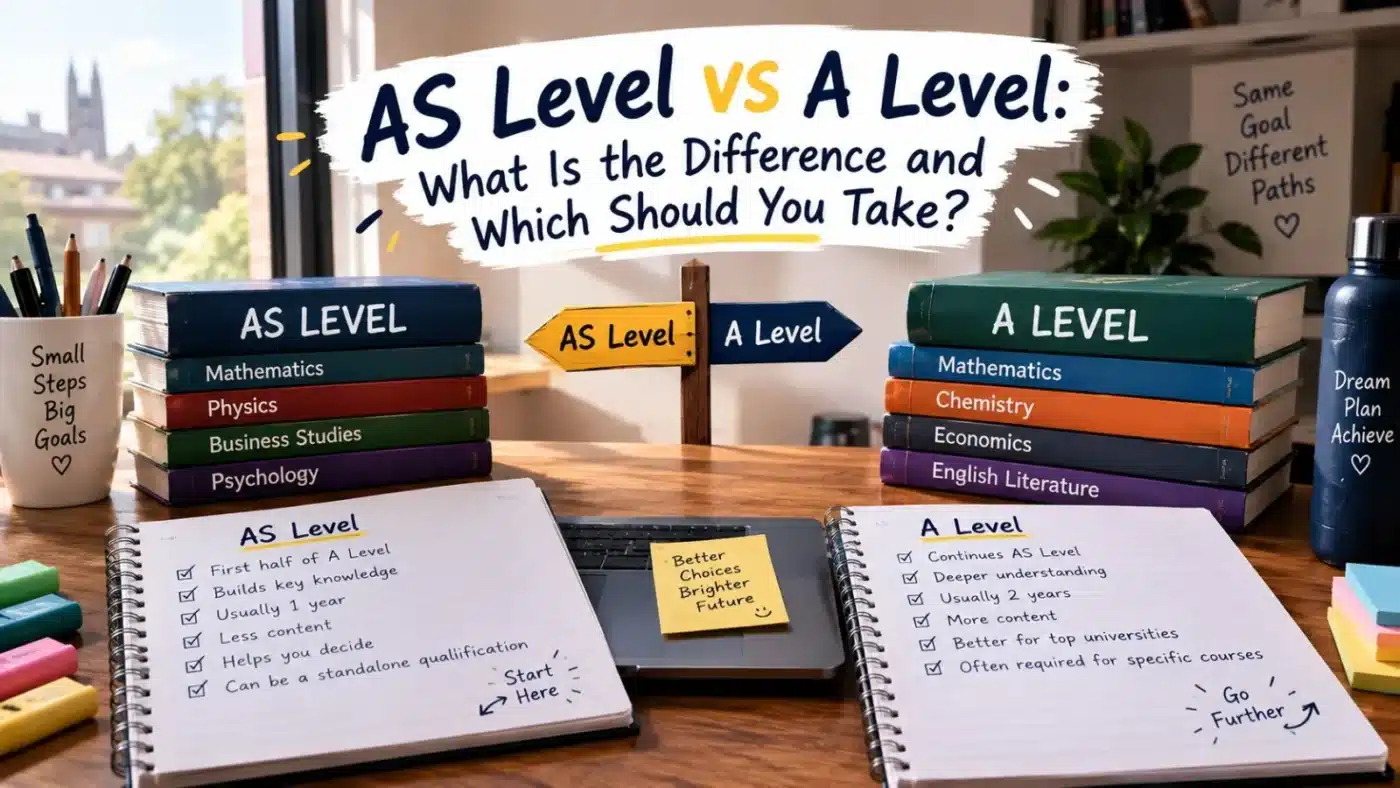
Quick Answer: AS Level is a standalone one-year qualification worth half an A Level, while A Level is a two-year qualification assessed entirely at the end of Year 13. Most students in 2026 take full A Levels rather than AS Levels, as AS results no longer count toward final A Level grades and carry limited weight in UCAS applications. If you have heard both terms thrown around in school and nobody has properly explained the difference, you are not alone. AS Level and A Level sound like they should be part of the same thing, and historically they were. But a series of qualification reforms changed the relationship between them significantly, and the advice students receive about whether to take AS Levels varies so much between schools that many families genuinely do not know what applies to their situation. This guide explains clearly what each qualification is, how they differ, whether AS Levels still matter for university applications, and how to decide which path makes sense for your child. What Is an AS Level? AS Level Explained An AS Level (Advanced Subsidiary Level) is a standalone qualification that covers the first year of A Level content. It is assessed at the end of Year 12 through examinations, and results are awarded on the same A to E grading scale used for A Levels. Before 2015, AS Levels were the first half of a full A Level, students took AS exams at the end of Year 12, and those results contributed 50% of the final A Level grade. Since qualification reforms took effect from 2017 onward, this is no longer the case. AS Levels are now entirely separate from A Levels, and AS results do not count toward A Level grades in any way. An AS Level is roughly equivalent to half an A Level in terms of content and assessment, but it is a complete qualification in its own right, not a stepping stone to a full A Level. AS Level Meaning: What the Qualification Actually Represents In 2026, an AS Level represents: One year of study in a subject at advanced level External examination at the end of Year 12 A standalone qualification graded A to E Approximately 40% of the content of a full A Level (the content covered in Year 12 of the full A Level course) It does not represent the first half of an A Level grade, and it does not automatically progress into a full A Level, though students can continue to A Level in the same subject if their school offers it. What Is the Difference Between AS Level and A Level? AS Level vs A Level: Side by Side Comparison Feature AS Level A Level Duration 1 year (Year 12) 2 years (Years 12 and 13) Assessment Exams at end of Year 12 All exams at end of Year 13 Grading scale A to E A* to E Contributes to A Level grade No, separate qualification Yes, this is the A Level UCAS points Yes, lower than A Level Yes, full tariff points University entry requirement Rarely accepted as substitute Standard requirement Availability Offered by some schools Universal The most important practical difference is that A Level exams are sat entirely at the end of Year 13, covering two full years of content. AS Level exams are sat at the end of Year 12, covering only Year 12 content. A student who takes an AS Level and then continues to A Level in the same subject will sit two separate sets of exams, the AS at the end of Year 12, and the full A Level at the end of Year 13, but neither result affects the other. A Level vs AS Level UK: How the Reform Changed Things Before the Ofqual reforms introduced between 2015 and 2017, the AS Level was formally the first half of an A Level. Students typically took four subjects to AS Level in Year 12, dropped one, and continued three subjects to full A Level in Year 13. The AS result contributed 40 to 50% of the final A Level grade depending on the subject. Since the reform, A Levels are linear, assessed entirely at the end of the two-year course with no contribution from Year 12 performance. The AS Level became a separate qualification that happens to cover similar Year 12 content but carries no weight in the A Level grade. This change fundamentally altered how schools approach Year 12. Most schools in 2026 no longer enter students for AS Level examinations as a matter of course, the additional exam burden in Year 12 without any grade benefit to the A Level has made AS Levels largely redundant in many school settings. Do AS Levels Count for UCAS Points? Yes, AS Levels do generate UCAS tariff points, but significantly fewer than full A Levels. AS Level UCAS Points: What They Are Worth AS Level Grade UCAS Points A 20 B 16 C 12 D 8 E 4 For comparison, a full A Level grade A* generates 56 UCAS points, and a grade A generates 48. An AS Level grade A generates 20, less than half the points of a full A Level grade A. Do AS Levels Count Toward University Applications? This depends entirely on the university and the course. The honest answer in 2026 is: for most competitive university applications, AS Level results carry limited weight and are rarely a decisive factor. Most universities set their entry requirements in terms of full A Level grades. An AS Level result may provide some contextual information, it can show how a student performed in a subject early in their sixth form career, but it does not substitute for a full A Level in the same subject and is not a requirement for most degree programmes. The exception is a small number of universities and programmes that still list AS Levels in their admissions criteria or that use AS results as part of contextual consideration for […]
Monthly Archives: September 2026

Sep
A Level Psychology revision works best when it combines active recall of the extensive factual content with deliberate practice of the specific essay and evaluation skills the AQA and Edexcel mark schemes reward. Students who revise content and exam technique together consistently outperform those who treat them as separate tasks. Most students who choose A Level Psychology do so because the subject genuinely interests them. Human behaviour, mental health, research methods, the biology of the brain. these are topics that feel relevant in a way that abstract academic subjects sometimes do not. What surprises many of them is how demanding it turns out to be. A Level Psychology is not the soft option it is sometimes assumed to be. The content volume is large, the research methodology component is genuinely mathematical, and the mark scheme rewards a very specific type of evaluative writing that takes most students a significant amount of time and practice to develop. Students who arrive expecting an engaging discussion-based subject and find a specification full of precise terminology, statistical tests, and 16-mark essay requirements sometimes feel blindsided. This guide is the honest preparation for what the subject actually demands, and what revision needs to look like to produce the grades the content knowledge deserves. What Is A Level Psychology and What Does It Actually Test? A Level Psychology is a two-year qualification that covers the scientific study of human behaviour and mental processes. It combines biological, cognitive, social, and developmental approaches to psychology with a substantial research methods component that requires students to understand how psychological research is designed, conducted, and evaluated. The subject is assessed through written examinations at the end of Year 13, with no coursework component. The mark scheme rewards three things simultaneously: Knowledge and Understanding: accurate recall and explanation of psychological theories, studies, and concepts Application: the ability to apply psychological knowledge to novel scenarios or case studies presented in exam questions Evaluation: the ability to critically assess theories and research, considering their strengths, limitations, and the evidence for and against them Students who revise only for knowledge: which is the most natural revision instinct, consistently find that the evaluation marks elude them. Those marks require a different kind of preparation. How to Revise A Level Psychology: The Methods That Work Is Active Recall Better Than Re-Reading for Psychology? Yes, significantly. Active recall is the most evidence-supported revision method for content-heavy subjects, and A Level Psychology is one of the most content-heavy A Levels available. Re-reading notes produces recognition, the ability to identify information when you see it. Exams require retrieval, the ability to produce information from memory with nothing in front of you. These are different cognitive tasks, and only one of them is what the exam tests. Active recall for Psychology looks like: Cover and reproduce: covering notes on a study or theory and writing everything recalled from memory, then checking gaps Flashcard testing: one side shows the psychologist’s name or theory, the other shows the key details, methodology, findings, and evaluation points, tested in both directions Self-explanation: explaining a theory or study out loud in precise psychological terminology, as if teaching it to someone who knows nothing about it Past paper questions from memory: attempting short-answer and essay questions without notes before checking the mark scheme What Is the Best Way to Revise Psychology Studies? For each psychological study, students need to know and be able to reproduce: Aim: what the researcher was trying to investigate Methodology: design, sample, procedure, and key methodological decisions Findings: specific results, including quantitative data where relevant Conclusions: what the findings suggest about human behaviour or mental processes Evaluation: at least three specific strengths and three specific limitations, including methodological criticisms, ethical issues, and real-world applications The specific detail matters. “Milgram found that most people obeyed” is not the same as “Milgram found that 65% of participants delivered the maximum 450-volt shock when instructed to do so by an authority figure.” The second is what mark schemes reward. A Level Psychology Topics: Complete Specification Breakdown What Topics Are Covered in AQA A Level Psychology? AQA A Level Psychology, the most widely sat specification, covers the following major topic areas across Years 12 and 13: Social Influence covers conformity, obedience, minority influence, and social change. Key studies include Asch’s conformity experiments, Milgram’s obedience research, and Moscovici’s work on minority influence. This topic appears in almost every paper and is one of the most predictable in terms of question format. Memory covers the multi-store model, the working memory model, eyewitness testimony, and cognitive interview. The evaluation of competing models of memory, their strengths, limitations, and supporting research is regularly examined alongside the applied content on eyewitness testimony. Attachment covers theories of attachment, types of attachment, the Strange Situation procedure, and the role of early attachment in later development. Bowlby’s theory, Ainsworth’s research, and the cross-cultural studies of attachment are all regularly examined. Psychopathology covers definitions of abnormality, characteristics of mental disorders including phobias, depression, and OCD, and psychological and biological treatments. This is a topic where both the characteristics of each disorder and the evaluation of each treatment approach need to be known in specific detail. Approaches in Psychology is a Year 12 topic that covers the biological, behaviourist, cognitive, humanistic, and psychodynamic approaches. This topic is heavily examined in essay questions that ask students to compare approaches or discuss the assumptions of a named approach. Biopsychology covers the nervous system, the brain, localisation of brain function, neuroplasticity, and ways of studying the brain including fMRI, EEG, and post-mortem studies. This is one of the most factually demanding topics in the specification and one where the biological detail needs to be known precisely. Research Methods is the topic that most distinguishes A Level Psychology from what many students expect. It covers experimental design, sampling methods, ethical guidelines, statistical tests, and the interpretation of psychological data. Research methods questions appear on every paper and in every question type, including embedded within questions about specific topics. Year […]

Sep
Economics has a habit of making students feel like they understand it, right up until they sit down to write an exam answer. The content makes sense in class. The concepts feel logical when discussed. Supply and demand, monetary policy, market failure, comparative advantage, these are ideas that click in a way that feels genuinely intuitive. Then the exam paper arrives, and the question asks for something more specific than “explain” and more demanding than “describe,” and the student who felt prepared discovers they were prepared for a different subject than the one being examined. A Level Economics rewards a very particular combination of skills, precise analytical writing, confident data interpretation, and the ability to construct and evaluate arguments rather than simply present them. Those skills do not develop by reading notes or watching explanations. They develop through deliberate practice with honest feedback. This guide shows you exactly what that practice looks like. What A Level Economics Revision Actually Tests Before getting into specific topics and techniques, it is worth being clear about what A Level Economics is fundamentally assessing, because the answer is more specific than most students realise. A Level Economics is not testing whether a student knows the content. It is testing whether a student can use the content to construct, support, and evaluate economic arguments in response to specific questions, using data where it is provided, applying theory to real-world contexts, and demonstrating the kind of evaluative judgement that distinguishes a strong answer from a merely competent one. This distinction matters for how revision should work. A student who knows every diagram in the specification but cannot write a coherent evaluative paragraph will plateau in the middle grade bands. A student who understands what evaluative writing looks like and has practised producing it, with honest mark scheme feedback, will consistently outperform students who know more content but cannot demonstrate it in the required form. AQA A Level Economics vs Edexcel A Level Economics: Know Your Board First The practical foundation of any A Level Economics revision plan is knowing which board is being sat, and aligning every element of revision with that board’s specific papers, mark schemes, and assessment style. AQA A Level Economics assesses through three papers. Paper 1 covers markets and market failure. Paper 2 covers the national and international economy. Paper 3 is a synoptic paper drawing on both micro and macro content, requiring students to apply economic thinking across the full specification in response to a case study and extended essay questions. Edexcel A Level Economics also uses a three-paper structure, with Papers 1 and 2 assessing microeconomics and macroeconomics respectively, and Paper 3, the synoptic paper, requiring integrated application of both. Edexcel uses specific themes rather than general topic headings in some areas of the specification, which affects how content is organised and examined. Both boards reward the same underlying skills, analysis, application, and evaluation, but through question formats, mark scheme structures, and assessment emphasis that differ enough to make board-specific preparation genuinely important. Use the correct specification, correct past papers, and correct mark schemes from the start. A Level Economics Topics: Complete Breakdown A Level Economics is divided between microeconomics and macroeconomics, with content that builds across Years 12 and 13. Here is an honest breakdown of every major topic area and what each demands. Microeconomics Topics: A Level Economics Year 12 Foundation Supply, Demand and Price Determination is the topic that underpins almost everything else in microeconomics. Understanding how markets reach equilibrium, how equilibrium changes when supply or demand conditions change, and how to draw and interpret supply and demand diagrams precisely, these are foundational skills that more advanced microeconomics topics build directly on. The most common error in supply and demand questions is imprecision in diagram drawing and diagram explanation. A shift in demand needs to be drawn correctly, the whole curve moving, not a movement along it, and the explanation needs to identify the specific factor causing the shift, the direction of the resulting price and quantity change, and why. These are learnable habits that only develop through repeated, checked practice. Elasticity covers price elasticity of demand, price elasticity of supply, income elasticity, and cross elasticity. Calculation questions appear regularly and reward students who practise the formula applications carefully, including the interpretation of negative values and the significance of elasticity magnitude. Essay questions on elasticity require students to evaluate the implications of elastic or inelastic demand for firms, consumers, and government policy, which requires genuine understanding rather than formula memorisation. Market Failure is one of the most consistently examined topic areas across both AQA and Edexcel and one where exam questions are most predictable in structure. Public goods, positive and negative externalities, information failure, and market power all appear regularly. The key demand of market failure questions, beyond identifying the failure, is evaluating the effectiveness of different government interventions, which requires understanding the limitations of each policy as well as its intended effect. Theory of the Firm covers different market structures, perfect competition, monopolistic competition, oligopoly, and monopoly, and the behaviour of firms within each. Diagram accuracy matters significantly in theory of the firm questions. The profit-maximising output under different market structures, the shape of cost curves, and the differences between short-run and long-run equilibria all appear in both calculation and essay questions. Macroeconomics Topics: A Level Economics Year 12 and Year 13 Aggregate Demand and Aggregate Supply is the central framework of macroeconomics at A Level and the model that most macroeconomic questions draw on in some form. Understanding the components of aggregate demand, the factors that shift both AD and AS, and the short-run versus long-run implications of demand and supply shocks is essential for almost every macroeconomics essay question. Economic Growth, Unemployment and Inflation the three main macroeconomic policy objectives — are examined both individually and in relation to each other. The conflicts and trade-offs between policy objectives appear consistently in evaluation questions: the trade-off between unemployment and inflation, the short-run versus long-run […]