
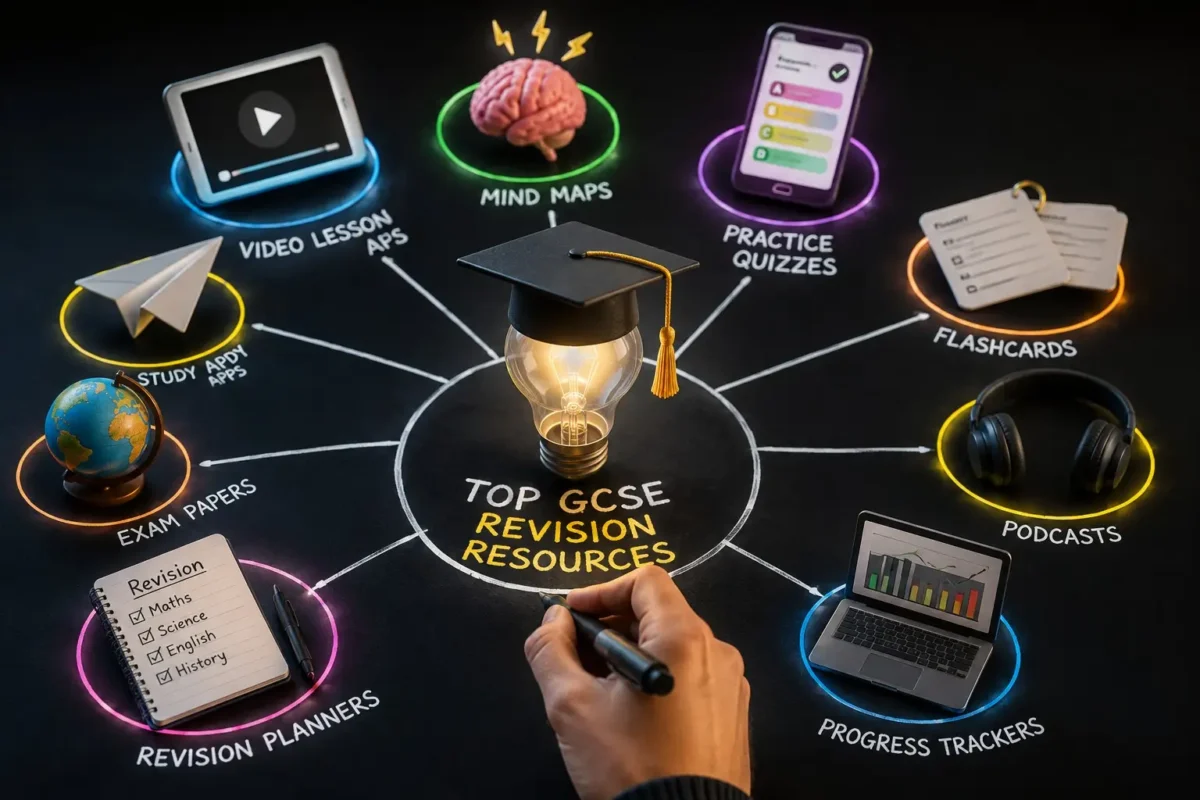
Every student revising for GCSEs has access to the same content. The same topics, the same past papers, the same specification documents sitting on the same exam board websites.
What separates the students who use that content effectively from those who do not is rarely effort. It is usually the quality of the tools they are using and, more importantly, how they are using them.
There are hundreds of GCSE revision websites, apps, and tools available. Most students end up using two or three of them passively, watching videos, reading summaries, highlighting digital notes in a way that feels productive without building the active recall and exam technique that actually move grades.
This guide cuts through the noise. It covers the resources that genuinely help GCSE students improve, what each one is good for, how to use it in a way that produces results, and where each tool fits in a broader revision plan. No padding, no generic lists, just the honest breakdown of what works and why.
Why the Right GCSE Revision Resources Make a Real Difference
Before getting into specific tools, it is worth understanding what makes a revision resource genuinely useful versus one that just feels useful.
The most effective revision resources have one thing in common: they require the student to actively do something rather than passively consume information. Watching a video explanation of quadratic equations is not the same as attempting quadratic equation problems. Reading a Biology summary is not the same as testing yourself on the content from memory.
The best GCSE revision tools are the ones that build active recall, forcing the brain to retrieve information rather than just recognise it, and that provide immediate feedback on whether the retrieval was correct. Those two features, more than anything else, determine whether a resource produces genuine learning or just the comfortable feeling of it.
With that principle in mind, here is the honest breakdown.
BBC Bitesize GCSE: What It Is Good For and Where It Falls Short
Strengths of BBC Bitesize GCSE
BBC Bitesize is the most widely known GCSE revision resource and for good reason. Its coverage is genuinely broad, it covers most GCSE subjects across multiple exam boards, with clear explanations, diagrams, and worked examples that are accessible to students across the ability range.
For building initial understanding of a topic, Bitesize is hard to beat for accessibility. The explanations are written in plain language, the structure is logical, and the interactive elements, quizzes, drag-and-drop activities, and short tests at the end of each section introduce an element of active recall that passive reading alone does not.
Bitesize is particularly useful for:
- Getting a clear initial explanation of a topic before working through more detailed material
- Checking understanding of a concept at a basic level
- Providing a starting point for students who are not sure where to begin on a topic
- Supporting students who find textbook language difficult to access
Where BBC Bitesize GCSE Has Limitations
The limitation of Bitesize is depth. The explanations are accessible precisely because they are simplified, and for students aiming at grade 6 and above, particularly in sciences and Maths, the level of detail on Bitesize is often insufficient for the harder exam questions.
Students who revise exclusively from Bitesize and then sit a challenging past paper often find that the questions go further than what Bitesize covered. It is an excellent starting point and a useful reference, but it should not be the only resource in a serious revision plan.
Save My Exams GCSE: Structured Revision Built Around Past Paper Questions
Why Save My Exams GCSE Is One of the Most Useful Tools Available
Save My Exams has become genuinely popular among GCSE students, and the reasons are specific and practical.
The platform organises revision by exam board and by topic, providing concise notes, worked examples, and practice questions that are closely modelled on actual past paper question styles. For students who want to move beyond Bitesize into more exam-focused practice, Save My Exams bridges the gap between content understanding and exam technique more effectively than most free resources.
The practice questions on Save My Exams are particularly useful because they are structured to mirror the difficulty progression of actual papers, starting with accessible questions that build confidence before moving to harder application questions that replicate what higher-grade exam questions look like. Answers and full worked solutions are provided, which makes self-marking meaningful rather than approximate.
Save My Exams is especially strong for:
- GCSE Sciences: Biology, Chemistry, and Physics notes and questions are detailed, well-organised, and closely tied to specific board specifications
- GCSE Mathematics: worked examples and practice questions are structured by topic and difficulty level
- GCSE English: mark scheme guidance and model responses for reading and writing questions
- Students who learn best from a structured, topic-by-topic progression with immediate feedback
How to Use Save My Exams GCSE Effectively
The students who get the most from Save My Exams are not the ones who read through the notes and feel reassured. They are the ones who attempt the practice questions first, without reading the notes, to identify what they do not know, then use the notes to address the gaps revealed.
That order, attempt, identify gap, study, attempt again, produces significantly better outcomes than reading notes and then attempting questions. The initial attempt without notes is the active recall component that makes subsequent learning stick.
Seneca Learning GCSE: Spaced Repetition Built Into the Platform
What Makes Seneca Learning GCSE Different
Seneca Learning is built around a specific learning science principle: spaced repetition. The platform tracks which questions a student gets right and wrong and automatically adjusts the frequency with which material is reviewed, showing topics that are insecure more often and topics that are well-known less often, until everything reaches a confident baseline.
This is particularly valuable for content-heavy subjects where the sheer volume of material makes it difficult to keep everything active in memory simultaneously. GCSE Biology, Chemistry, History, and Geography all involve large amounts of factual content that needs to be retrievable on demand, and Seneca’s spaced repetition approach addresses this more systematically than most manual revision plans do.
Seneca covers most GCSE subjects and major exam boards, with content organised by topic and presented through a combination of explanations and interactive questions that require active responses rather than passive reading.
Best Use Cases for Seneca Learning GCSE
Seneca Learning works best for:
- Content consolidation in knowledge-heavy subjects, particularly Sciences, History, and Geography
- Students who struggle to maintain a systematic revision schedule and benefit from a platform that manages the spacing automatically
- Regular low-stakes testing across a broad subject range, ten to fifteen minutes per subject several times a week rather than long single-subject sessions
- Building a baseline of secure knowledge across all topics before moving to full past paper practice
The limitation of Seneca is that it focuses primarily on knowledge recall rather than exam technique. A student who knows all the content but cannot apply it to the specific question formats of their exam paper will not get everything they need from Seneca alone. It works best as one component of a broader revision plan rather than the whole thing.
Physics Maths Tutor GCSE: The Best Free Past Paper Resource Available
Why Physics Maths Tutor Is Invaluable for Past Paper Practice
Despite its name, Physics Maths Tutor covers a much wider range of subjects and is consistently one of the most practically useful resources available to GCSE students, primarily because of how comprehensively it organises past paper materials.
The website hosts past papers, mark schemes, and examiner reports for multiple GCSE subjects across AQA, Edexcel, OCR, and other boards, organised by subject, board, and year in a way that is significantly easier to navigate than the official exam board websites themselves.
For students who are at the stage of doing timed past paper practice, Physics Maths Tutor removes the friction of finding materials. Everything needed for systematic past paper revision, paper, mark scheme, and examiner report, is available in one place, organised clearly.
Physics Maths Tutor is particularly strong for:
- GCSE Maths: an extensive bank of topic-specific practice questions alongside full papers, organised by difficulty level and topic area
- GCSE Sciences: comprehensive past paper banks with mark schemes for all major boards
- Any student at the past paper stage of revision who needs quick, organised access to official materials
How to Use Physics Maths Tutor GCSE Effectively
The most effective use of Physics Maths Tutor is not downloading papers and doing them casually. It is using the topic-specific question banks in the early revision phase, working through all the questions on a specific topic across multiple years to build concentrated understanding, and then moving to full timed papers in the later phase.
The examiner reports available on the site deserve specific attention. Reading what examiners wrote about student performance in a particular subject and year tells a student more precisely what to do and avoid than almost any other revision resource.
GCSE Revision Apps: Which Are Worth Using and Which Are Not
The Best GCSE Revision Apps for Active Learning
Apps work best when they build the same active recall habits that the best desktop resources do. Here is an honest assessment of which apps deliver on that promise:
Anki is a flashcard app built entirely around spaced repetition. Unlike Seneca, which provides pre-built content, Anki requires students to create their own flashcards, which is itself a valuable active recall exercise. The spaced repetition algorithm is more sophisticated than most alternatives, and the platform works across devices. Anki is genuinely useful for any subject involving precise recall of definitions, dates, formulae, or terminology.
Quizlet provides similar flashcard functionality with a larger bank of pre-made card sets for GCSE topics. The pre-made sets vary in quality, and students should check that any set they use matches their specific board and specification rather than a generic version of the subject. Quizlet’s game-based learning modes add an engagement element that can be useful for students who find traditional flashcard revision motivating.
Revision apps built by exam boards: AQA and other boards have released their own revision apps for some subjects. These are worth checking for subjects where they exist, as they are the most reliably specification-accurate source of practice material.
GCSE Revision Apps to Approach With Caution
Not all highly rated revision apps produce the learning they promise. Apps that are primarily passive, video content, reading summaries, listening to audio explanations, have the same limitation as passive desktop resources: they build recognition without building retrieval.
Students who spend significant revision time on passive apps and then struggle in timed past paper conditions have usually experienced this gap. The app felt useful because the content was familiar. The exam was harder because familiarity is not retrieval.
Top GCSE Revision Websites: The Full Picture
Beyond the individual resources covered above, here is a broader view of what is available and where each fits:
GCSE Online Resources by Subject Type
For Maths specifically:
Physics Maths Tutor’s topic question banks are the strongest free resource for practice questions by difficulty level. Save My Exams provides worked solutions that explain method clearly, while working with a dedicated GCSE Maths tutor helps resolve persistent method errors. Official exam board websites provide the actual past papers and mark schemes that define what the exam rewards.
For Sciences:
Save My Exams and Seneca Learning are both strong for Biology, Chemistry, and Physics, covering knowledge consolidation and topic-level practice respectively. The required practicals sections of these platforms deserve specific attention given how frequently practical-based questions appear in exam papers—an area where guidance from a GCSE Biology tutor can help translate complex content into precise mark-scheme answers.
For English Language and Literature:
No app or website substitutes for actually writing under timed conditions and having responses marked against official band descriptors. While official mark schemes and examiner reports describe what top-band responses require, regular feedback from an experienced GCSE English tutor is often the most effective way to elevate analysis and structure to those higher grade bands.
For Humanities: History and Geography:
Seneca Learning is strong for knowledge consolidation. Save My Exams provides structured notes and practice questions for specific topics. But for the extended writing questions that carry the most marks in these subjects, past paper practice with mark scheme review is irreplaceable, and no online resource substitutes for it.
Best GCSE Revision Tools: Putting It All Together
The mistake most students make is using too many resources without a clear purpose for each one. Switching between five different websites and three apps, spending a bit of time on each, produces the feeling of comprehensive revision without the depth that any one area needs.
A more effective approach assigns each resource a specific role in the revision plan:
How to Build a Revision Plan Using These Resources
Early revision. knowledge building phase:
Use Seneca Learning for daily low-stakes recall practice across all subjects. Use BBC Bitesize to get clear initial explanations of topics that are unfamiliar or confusing. Build Anki or Quizlet flashcard decks for any subject that requires precise recall of definitions, formulae, or terminology.
Middle revision, topic consolidation phase:
Use Save My Exams for topic-level notes and practice questions. Attempt questions before reading notes to identify gaps first. Use Physics Maths Tutor for topic-specific question banks in Maths and Sciences. Mark every attempt against the official mark scheme and track which topics produce consistent errors.
Later revision, exam practice phase:
Use Physics Maths Tutor to access full past papers for timed exam-condition practice. Mark using official mark schemes from exam board websites. Read examiner reports for subjects where exam technique is still inconsistent. Focus Seneca and Anki use on the topics still producing errors in past paper practice.
Final weeks. consolidation phase:
Stop using new resources or covering new content. Use familiar tools to consolidate what is already known and sharpen performance on weak areas. Timed past papers remain the most useful activity.
How Tutor Globe Complements GCSE Revision Resources
Online resources are powerful, but they have a fundamental limitation that no app or website has solved: they cannot see what a specific student is doing wrong and tell them specifically what to fix.
A student can do ten past papers on Physics Maths Tutor, mark them all with the official mark scheme, and still not understand why their Chemistry calculation answers keep losing marks in the same place. A student can use Save My Exams for three months and still find that their English essays are sitting in the same band because nobody has looked at their writing and identified what the next band up actually requires from them specifically.
This is where Tutor Globe fills the gap that no revision resource can fill on its own.
Tutor Globe has subject specialists across all major GCSE subjects and exam boards who do exactly what online resources cannot: look at a specific student’s work, identify the specific patterns that are costing marks, and provide the precise, targeted feedback that produces improvement. Whether a student needs help making sense of why a topic keeps going wrong despite revision, wants someone to look at their essays and explain what the mark scheme is looking for that they are not providing, or is preparing for a resit and needs to change their approach rather than repeat it — the right specialist makes that process significantly more efficient.
The combination of good self-directed revision resources and targeted specialist support is consistently more effective than either alone. The resources cover the breadth. The specialist addresses the specific depth that matters most for each individual student’s grade target.
A trial session with Tutor Globe is the most useful complement to any self-directed revision plan, particularly at the point where past paper marks have plateaued and a student is not sure what to do differently.
Frequently Asked Questions About GCSE Revision Resources
What is the best free GCSE revision website?
Physics Maths Tutor is the strongest free resource for past paper access and topic-specific practice questions across Maths and Sciences. Save My Exams provides excellent structured notes and practice for multiple subjects. BBC Bitesize is the most accessible starting point for initial content understanding. The best combination depends on the subject and the stage of revision.
Is BBC Bitesize enough for GCSE revision?
For initial content understanding, Bitesize is excellent. For students aiming at grade 6 and above, it is not sufficient on its own, the depth of content and the level of exam-focused practice needed for higher grades require additional resources, particularly past papers with mark scheme analysis.
Is Seneca Learning free?
Seneca Learning has a free tier that covers a significant range of content and is sufficient for most GCSE students’ needs. A premium tier provides additional features including more detailed analytics on performance. The free version is genuinely useful and most students do not need the premium tier to benefit from the platform.
How should students use revision apps effectively?
Use apps that require active responses. flashcard apps like Anki or Quizlet, or platforms like Seneca that require answers rather than passive reading. Use them regularly for short sessions rather than infrequently for long ones, spaced repetition works through frequency, not duration. Combine app-based recall practice with timed past paper practice for a complete revision approach.
What revision resources do top GCSE students actually use?
High-achieving GCSE students consistently use official past papers with official mark schemes as the core of their revision, regardless of which other resources they use alongside. Examiner reports are used more consistently by top students than by average students. Active recall tools, Anki, Quizlet, or Seneca, feature more prominently than passive resources in the habits of students who improve most significantly.
Are paid GCSE revision resources worth it?
For most students, the free resources available, BBC Bitesize, Seneca Learning’s free tier, Physics Maths Tutor, and official exam board materials, are sufficient for strong GCSE preparation. Paid resources add convenience and sometimes additional practice question depth, but the gap between free and paid is much smaller for GCSE than students sometimes assume. The most valuable investment for most students is specialist tutor support for specific subjects and grade targets, rather than premium access to revision platforms.
Final Thoughts: The Best GCSE Revision Resources Are the Ones You Actually Use Actively
The difference between a revision resource that helps and one that does not is almost never which website or app it is. It is how the student uses it.
BBC Bitesize used actively, attempting the quizzes before reading the summaries, covering notes and testing recall, is more useful than Save My Exams used passively. Physics Maths Tutor with careful mark scheme review after every attempt is more useful than ten past papers done without checking what went wrong. Anki flashcards tested honestly are more useful than Quizlet sets read through without genuine retrieval.
The resource matters less than the habit. Active recall, spaced repetition, past paper practice with honest mark scheme analysis, these principles produce results regardless of which specific tool delivers them. The resources in this guide implement those principles better than most, but they only work when used accordingly.
If your child is using revision resources consistently but not seeing the grade improvement that effort should produce, the most likely explanation is that the resources are being used passively rather than actively, or that there are specific gaps or technique issues that no resource has identified and addressed directly. That is where Tutor Globe is worth exploring: for the targeted, specific feedback that online resources cannot provide.
