
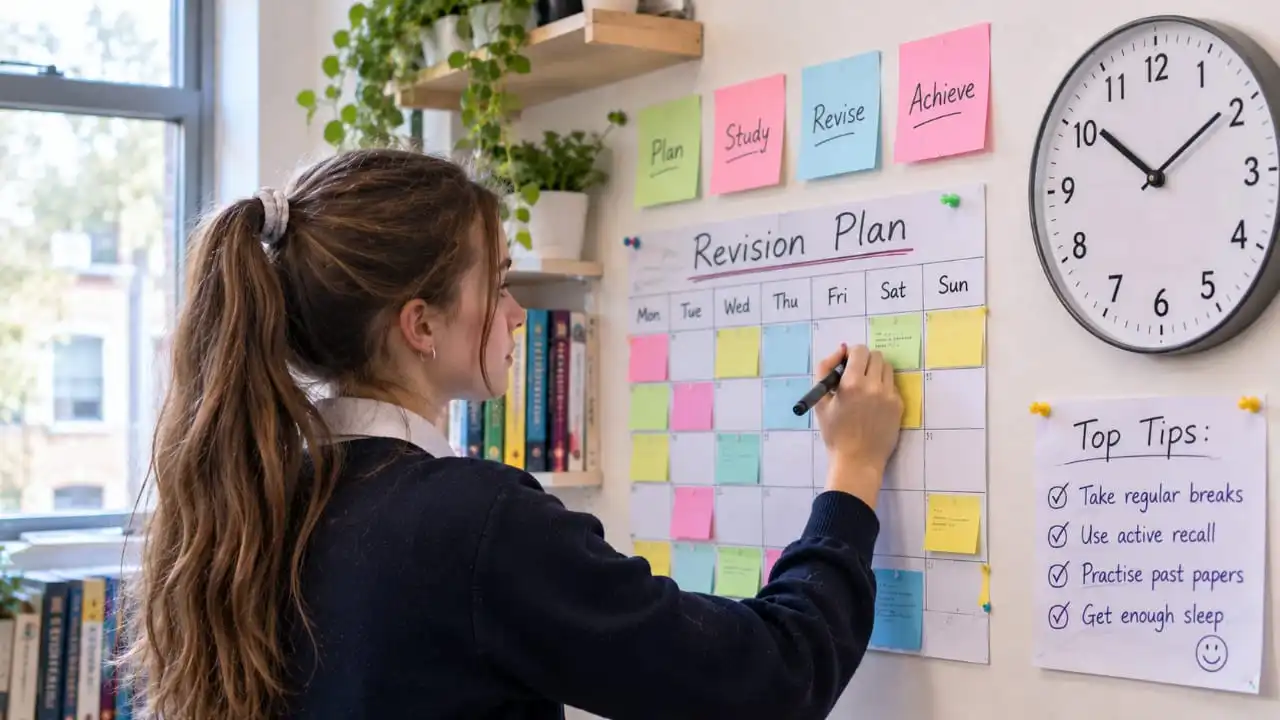
Quick Answer: To make a revision timetable, list your exams and their dates, rate each subject by how confident you feel, then block short study sessions into the time you really have. Give weaker subjects more slots, mix subjects each day, add breaks and one free day, and review the plan every week so it stays realistic.
I once watched a friend spend an entire Sunday making a beautiful colour-coded timetable. It had every subject, every hour, every break. By Wednesday he had stopped following it, and by the weekend it was lying under a pile of papers.
Sound familiar? Most students don’t fail at revision because they lack effort. They fail because their plan was never realistic. A revision timetable only works if you can follow it on a bad day, not just a perfect one.
This guide shows you how to build one that fits your real life, with simple steps you can finish in under an hour.
Why Does Your Revision Timetable Keep Failing?
Before you build a new plan, it helps to know why the last one fell apart. Here are the usual reasons:
- It was too packed, with no breaks or free time
- It ignored school, sport, family and sleep
- Every subject got the same time, even the ones you find hard
- Tasks were vague, like “revise Chemistry” for three hours
- There was no space to catch up after a missed day
A good revision timetable is not about squeezing in the most hours. It is about using the hours you have in a smart way.
How to Make a Revision Timetable in 6 Steps
Step 1: Write down your exams and dates
List every exam with its date, subject and paper. If you are sitting GCSE, IGCSE or A Level, your school or exam board will give you the dates. Put them on one page so you can see how much time you have before each one.
Step 2: Count your real free time
Mark the things you can’t move: school, travel, meals, sport, family time and sleep. Whatever is left is your study time. Be honest here. If you are tired after football on Tuesdays, don’t plan a heavy session that night.
Step 3: Rate every subject
Give each subject a score from 1 to 3. A 1 means you feel confident, a 2 means you feel okay, and a 3 means you feel lost. Weak subjects with early exams get the most time. Strong subjects still stay in the plan, just with fewer sessions.
Step 4: Break each subject into topics
“Revise Biology” is too big to start. “Do 20 minutes of active recall on enzymes” is easy to start. Copy the topic list from your exam board’s specification and tick each one off as you go. This also shows you how much is left, which makes the work feel less scary.
Step 5: Build short study blocks
Aim for sessions of 30 to 50 minutes with a short break after each. Mix subjects across the day, because switching topics helps memory and keeps you fresh. Put the hardest subject early in the day, when you have the most energy.
Step 6: Add breaks, a free day and a buffer
Plan at least one proper day off each week. Also leave one or two empty slots as a buffer, so a missed session doesn’t wreck the whole week. Your revision timetable should bend without breaking.
A Simple Revision Timetable Template You Can Copy
Here is a basic weekly layout. Change the subjects and times to suit you.
Day | After school (1 hour) | Evening (45 minutes) |
Monday | Maths, past paper questions | Biology, active recall |
Tuesday | Chemistry, topic notes | English, essay practice |
Wednesday | Physics, equations | Rest or light reading |
Thursday | Maths, weak topics | History, timeline recall |
Friday | English, quote learning | Free time |
Saturday | Two subjects, timed paper | Review the week |
Sunday | Day off | Plan next week (10 minutes) |
This is a revision timetable template, not a rule. If you are doing A Levels, you may have fewer subjects but longer sessions. If you have GCSEs, you may have more subjects and shorter sessions.
What Should a Good Revision Timetable Include?
A strong plan has five parts:
- Clear tasks. Write what you will do, not just the subject.
- Active methods. Use quizzing and past papers, not only rereading. Our guide on how to revise effectively explains the methods that work best.
- Spaced review. Come back to older topics every week or two so they don’t fade.
- Rest. Sleep, meals and breaks are part of the plan.
- Flexibility. A weekly check lets you move things around.
How Early Should You Start Your Revision Timetable?
For summer exams, start between January and February, which gives you three to four months. Starting earlier lets you use gentle, steady sessions rather than panic cramming. If you are closer to the exams than that, don’t worry. Focus on the biggest topics first, use past papers, and cut anything that doesn’t earn marks.
Revision Timetable Tips for Students Who Struggle to Stick to It
Here are some study timetable tips that really help:
- Start with just 20 minutes a day for the first week, then build up
- Put your timetable somewhere you will see it, like your desk or phone lock screen
- Study in the same place at the same time each day, so it becomes a habit
- Phone away, notifications off, during every block
- Tick off each session. It feels good and keeps you going
- Reward yourself after a full week
If you miss a session, don’t scrap the plan. Just move it to your buffer slot and carry on.
Common Mistakes When Making a Revision Timetable
The same few mistakes show up again and again:
- Planning ten hours a day, then quitting after two days
- Only revising your favourite subjects
- Leaving out weekends or social time completely
- Never updating the plan when things change
- Making the timetable so pretty that you never use it
A simple, messy plan you follow beats a perfect one you ignore.
When a Timetable Is Not Enough
Sometimes you follow your plan well and your marks still don’t move. That often means there is a specific gap, such as a topic you never understood or a habit that loses marks in exams. Our guide to GCSE Revision Tips That Actually Work covers how to find and fix those gaps, and A Level Past Papers: The Ultimate Revision Strategy shows how to use papers to see where you stand.
If you would like personal help building a plan, Tutor Globe can match you with a tutor who knows your exact exam board and subject.
Key Takeaways
- A revision timetable only works if it matches your real life
- Start by listing exams, then count your honest free time
- Give weaker subjects more sessions and strong ones fewer
- Use short blocks of 30 to 50 minutes with breaks
- Add a free day and a buffer for missed sessions
- Break big subjects into small, clear tasks
- Review your plan once a week and adjust it
Frequently Asked Questions
How do I make a revision timetable?
List your exams, count your real free time, rate each subject, break them into topics, and fit short study blocks into your week. Add breaks, a free day and a weekly review.
How many hours a day should I revise?
Most students do well with two to four focused hours a day during exam time. Quality matters more than the number of hours.
How far in advance should I start a revision timetable?
Three to four months before your exams is ideal. Starting earlier means you can study calmly instead of cramming.
Should I revise every subject every day?
Not always. Mixing two or three subjects a day works well. Give weaker subjects more sessions across the week.
What is a good revision timetable for GCSE students?
A balanced plan with short daily sessions, past paper practice on weekends, and a free day. Spread your subjects so none gets forgotten.
What if I fall behind on my revision timetable?
Use your buffer slots to catch up and focus on the highest-mark topics first. Don’t try to cram everything back into one day.
Is a revision planner app better than paper?
Neither is better. Use whichever you will actually open every day.
How often should I update my timetable?
Once a week is enough. Check what went well, what you missed, and adjust the next week.
Final Thoughts: Build a Revision Timetable You Can Follow
The best revision timetable is not the prettiest or the most packed. It is the one you can follow on an ordinary Tuesday when you feel a bit tired. Keep it simple, include rest, and update it often.
Start tonight. Write down your exam dates and block out just three study sessions this week. That small start is worth more than a perfect plan you never use.