
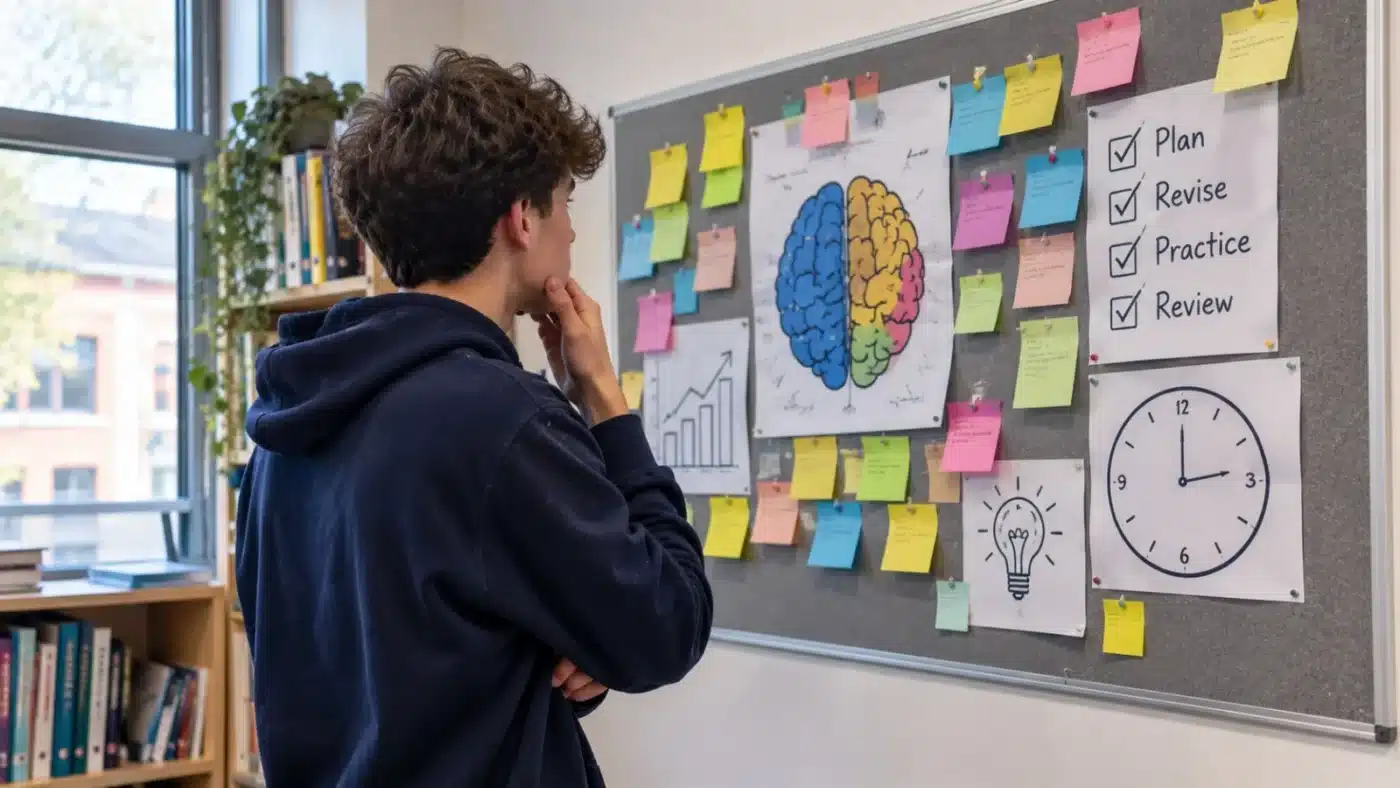
Quick Answer: To revise effectively, test yourself instead of rereading, spread your study over several days, mix up topics, and practise with past papers. Add short focused sessions, enough sleep, and regular review of mistakes. Research shows these methods beat highlighting and rereading, which feel productive but build weak memory.
Most students do not fail because they are lazy. They fail because nobody ever showed them how to revise effectively.
Think about the usual routine. You read your notes. You highlight the important bits. You make a neat summary. Then the exam paper arrives and your mind goes blank. It feels unfair, because you did put in the hours.
The problem is the method, not the effort. Psychologists have studied how memory works for over a century, and the results are clear. Some study habits build strong memory. Others only create a feeling of knowing.
This guide covers eight techniques that research supports. They work for GCSE, IGCSE and A Level, and you can start using them tonight.
Why does rereading notes not work?
Rereading feels easy, and that is exactly the trap. When you read a page you have seen before, it looks familiar. Your brain mistakes that familiarity for learning.
An exam does not ask “does this look familiar?” It asks you to pull information out of your head with nothing in front of you. Those are two different skills.
A well-known review by psychologist John Dunlosky and colleagues compared ten common study methods. Practice testing and spreading study over time came out as the most useful. Highlighting and rereading ranked among the least useful. That single finding should change how you plan your week.
Technique 1: Active recall
Active recall means pulling information out of your memory instead of putting it in. It is the single best answer to how to revise effectively.
Here is a simple way to do it. Read a topic once. Close the book. Write down everything you can remember on a blank page. Then check what you missed and try again.
It feels harder than rereading, and that is a good sign. The effort of remembering is what makes the memory stick.
You can also use flashcards, quiz a friend, or explain the topic out loud as if you were the teacher.
Technique 2: Spaced repetition
Your brain forgets quickly. A German psychologist named Hermann Ebbinghaus showed this in the 1880s with what is now called the forgetting curve. Most new information fades within days unless you revisit it.
Spaced repetition fixes this by reviewing a topic just as you are about to forget it. A simple pattern looks like this:
- Study the topic on day one
- Review it on day two
- Review it again after a week
- Review it once more after a month
Apps like Anki can schedule this for you. A paper calendar works too. The key is to return to old topics, not just move on to new ones.
Technique 3: Interleaving
Most people revise one topic for a whole afternoon. This is called blocked practice. Interleaving means mixing different topics or question types in one session.
For example, in Maths you might do three algebra questions, then two geometry questions, then one probability question, then repeat. It feels messier, but research shows it helps you learn when to use each method. That matters in exams, where nobody tells you which topic a question belongs to.
Technique 4: Past paper practice
Past papers are active recall with a bonus. They teach you the content and the exam style at the same time.
Do them under timed conditions, without notes. Mark them with the official mark scheme, and read the examiner report if one exists. Then write down what cost you marks and fix that before the next paper.
If you want a full method, our guide to A Level Past Papers: The Ultimate Revision Strategy walks through it step by step.
Technique 5: Self-explanation and the Feynman method
If you cannot explain an idea in simple words, you probably do not understand it yet. This is the idea behind the Feynman technique, named after physicist Richard Feynman.
Pick a topic. Explain it as if to a ten-year-old, using plain language. Wherever you get stuck or start using fancy words to hide a gap, go back to your notes and fix that part.
This works well for Science, Economics and History, where you need to understand why something happens, not only what happens.
Technique 6: Mind maps, used the right way
Mind maps are popular, and they do have a place. They help you see how topics connect, which is useful for planning an essay or reviewing a big unit.
Here is the honest part. The research on mind maps is weaker than the research on active recall. Copying a mind map from your notes is mostly passive. Drawing one from memory, with the book closed, turns it into active recall. That small change makes it far more useful.
Technique 7: The Pomodoro technique
The Pomodoro technique splits your study into short bursts. The classic version is 25 minutes of focused work, then a 5 minute break. After four rounds, take a longer break of 15 to 30 minutes.
There is less direct research on Pomodoro than on active recall, so think of it as a tool for focus, not a memory method. Still, many students find it stops them from drifting onto their phone. Put the phone in another room during each round and you will notice the difference.
Technique 8: Sleep, food and breaks
This one is not glamorous, but it matters. Your brain stores what you learned during sleep. A student who studies until 2am and sleeps four hours often remembers less than one who stops earlier and sleeps properly.
Drink water, eat regular meals and take real breaks away from screens. Short walks help you reset. If you want to revise effectively for months, not just one night, protect your sleep.
Which technique works best? A quick comparison
Technique | Strength of evidence | Best for | Effort level |
Active recall | Very strong | Every subject | High |
Spaced repetition | Very strong | Facts, definitions, vocabulary | Medium |
Interleaving | Good | Maths, Sciences | Medium |
Past papers | Very strong | Exam practice | High |
Self-explanation | Good | Sciences, Humanities | Medium |
Mind maps | Mixed | Planning, linking topics | Low to medium |
Pomodoro | Limited, but helpful | Staying focused | Low |
Sleep and breaks | Very strong | Memory and mood | Low |
How to revise effectively: a simple weekly plan
You do not need to use all eight methods every day. Here is a plan that mixes them without feeling heavy.
On a normal weekday
Do two or three Pomodoro rounds of 25 minutes. In the first round, learn or review a topic. In the second, close your notes and write down what you remember. In the third, answer questions from a past paper or a textbook.
At the weekend
Do one timed past paper section and mark it properly. Then spend an hour on your weak topics. Finish by reviewing last week’s material for spaced repetition.
The night before an exam
Do not learn new topics. Look over your short notes, check your equation or formula sheet, pack your bag, and sleep. A calm brain recalls far better than a tired one.
Common mistakes that waste revision time
Some habits look like hard work but give little back. Watch out for these:
- Highlighting whole pages until they turn yellow
- Copying notes word for word
- Revising only the topics you already like
- Doing past papers with the mark scheme open
- Cramming everything the night before
- Studying with social media open beside you
If you spot even two of these, you now know where to start improving.
What if revision still does not seem to work?
Sometimes you follow every tip and your marks barely move. That usually means there is a specific gap, such as a topic you misunderstood in Year 10 or an exam habit that quietly loses marks. A fresh pair of eyes can find it quickly.
Key Takeaways
- Rereading and highlighting feel productive but build weak memory
- The best way to revise effectively starts with active recall and spaced repetition
- Mix topics in one session using interleaving to prepare for real exam questions
- Past papers under timed conditions are active recall and exam practice combined
- Use mind maps from memory, not copied from notes
- Pomodoro helps with focus, but the evidence is lighter than for active recall
- Sleep and breaks are part of revision, not a break from it
- If marks do not improve, look for a specific gap instead of adding more hours
Frequently Asked Questions
What is the best way to revise effectively?
Test yourself without notes, spread your study over days and weeks, and practise with past papers. These methods have the strongest research support.
How many hours a day should I revise?
Most students do well with two to four focused hours a day during exam periods. Focused time matters more than long hours.
Is active recall better than rereading?
Yes. Research shows that testing yourself builds stronger memory than rereading. It feels harder, but that effort is what helps you remember.
What is spaced repetition?
It means reviewing a topic at growing gaps, such as after one day, one week and one month, so you revisit it just before you forget.
Do mind maps work for revision?
They help you see links between topics, but the evidence is weaker than for active recall. Draw them from memory to get more value.
Does the Pomodoro technique work?
Many students find it helps them focus. It is a focus tool more than a memory method, so combine it with active recall.
When should I start revising for my exams?
Start earlier than you think. A few months of steady, spaced study beats a few weeks of cramming.
Can I revise effectively if I study late at night?
You can, but sleep matters for memory. Studying until very late and sleeping little usually leads to worse recall the next day.
Final Thoughts
Learning how to revise effectively is a skill, and like any skill it improves with practice. You do not need a perfect timetable or fancy equipment. You need to test yourself, space your study out, practise real questions and rest properly.
Start with one change this week. Close your notes and write down what you remember from your last lesson. That small step is already better than another hour of rereading.