

Quick Answer: Yes, A Level Physics is hard for most students, mainly because of the jump in maths and the abstract ideas. But it is very learnable. Students who practise problems daily, understand concepts instead of memorising, and use past papers tend to do well. It is harder than GCSE, yet it rewards steady effort more than natural talent. When I ask students “is A Level Physics hard?”, I usually get one of two answers. Some say it is the hardest subject they have ever taken. Others say it clicked once they found the right way to study. Both are true. A-Level Physics is a demanding subject, but the difficulty comes from a few specific places, and each one can be fixed. This guide tells you honestly what makes it hard, which topics catch people out, and how to make it easier. Is A-level physics hard? For most students, yes. The step up from GCSE is big, and it surprises people who found GCSE Physics easy. Here is why it feels harder: More maths. You use algebra, trigonometry, logarithms and sometimes calculus ideas. Abstract ideas. Fields, waves and quantum physics are hard to picture. Multi-step problems. Questions rarely give you one neat equation to use. Faster pace. Teachers cover a lot of content quickly. Less hand-holding. You must practise alone, not only in lessons. That said, “hard” does not mean “impossible”. Thousands of students get A and A* every year, and most of them are not geniuses. How Hard Is A Level Physics Compared to Other Subjects? Physics is usually ranked among the harder A Levels, along with Maths, Further Maths and Chemistry. Here is a simple comparison of what each one demands: Subject Main challenge Maths level Physics Abstract ideas plus problem solving High Maths Pure reasoning and speed Very high Chemistry Large content plus calculations Medium to high Biology Large amount of content to remember Low to medium Grade statistics are published every year by exam boards and Ofqual, so check the latest figures for the real percentages. What they usually show is that Physics sits in the middle of the pack for top grades. It is hard, but fair. If you are weighing up your options, our guide to Hardest A Level Subjects Ranked looks at the whole picture. Why Is A-Level Physics Hard? The Real Reasons The jump from GCSE is bigger than it looks GCSE Physics gives you most equations on a sheet and keeps the maths simple. At A-Level, you need to choose the right equation, rearrange it, and often combine two or three. Many students lose marks on method, not on understanding. Maths and physics must work together If your maths is shaky, physics feels harder than it really is. Students taking A-Level Maths alongside Physics often find the two help each other. If you are not taking Maths, spend extra time practising algebra and rearranging equations. Concepts you cannot see You cannot see an electric field or a wave function. Understanding them means building a mental picture from diagrams and examples. This takes time, and it is normal to feel stuck at first. Exams test application, not recall You will get questions you have never seen before. The exam checks whether you can apply a principle to a new situation. That is why memorising notes is not enough. What Are the Hardest Topics in A-Level Physics? Students often name these topics as the toughest, but we have a solution for you to study A level physics with these best tutors in the world.: Fields. Gravitational, electric and magnetic fields use similar ideas, which confuses many people. Simple harmonic motion. It mixes graphs, equations and energy. Circular motion. You must work out which force provides the centripetal force. Quantum and particle physics. The ideas feel strange and unfamiliar. Capacitors and exponential decay. They need logarithms and careful graph work. Practical skills and data analysis. These are marked in written exam questions too. The good news is that topics usually feel easier after you have done about 15 to 20 questions on them. Struggle at the start is normal. How to Make A-Level Physics Easier Practise problems, do not just read notes Physics is a doing subject. After each lesson, try three or four questions without looking at your notes. When you get stuck, that is where learning happens. Our guide on how to revise effectively explains why testing yourself beats rereading. Learn the idea behind every equation Ask “what is this equation telling me?” instead of only memorising it. If you know that force equals the rate of change of momentum, you can handle many different questions. Draw diagrams for every problem A quick sketch of forces, circuits or waves often makes the solution clear. Examiners also give marks for correct diagrams. Fix your maths early Practise rearranging equations, working with powers of ten, and using your calculator properly. A few weeks of focused practice makes a huge difference. Use past papers properly Do them under timed conditions, mark them with the official mark scheme, and note down every mistake. Our guide to A Level Past Papers: The Ultimate Revision Strategy shows a step by step method. Ask for help early If a topic does not make sense after a week, ask your teacher or find a tutor. Small gaps in Year 12 become big problems in Year 13. Is A-Level Physics Hard Without A-Level Maths? It is harder, but not impossible. Physics needs a good level of maths, and many sixth forms ask for at least a grade 6 or 7 at GCSE Maths before you can take it. If you skip A-Level Maths, practise the maths skills inside physics regularly and ask your teacher which topics use the most algebra. Is A-Level Physics Worth It? If you enjoy problem solving, it is very worth it. A-Level Physics opens the door to engineering, physics, computer science, architecture and many other degrees. Universities respect it because it shows strong thinking skills. If […]
Category Archives: A Level
Our A Level revision guides show you how to tackle the hardest topics and gain marks in Maths, Biology, Chemistry, Physics, Economics and Psychology. You will also find help choosing A Level subjects and a ranking of the hardest subjects using 2026 data. For one-to-one support, explore our A Level Maths tutors, A Level Chemistry tutors, A Level Economics tutors or A Level Psychology tutors.

Sep
A Level Psychology revision works best when it combines active recall of the extensive factual content with deliberate practice of the specific essay and evaluation skills the AQA and Edexcel mark schemes reward. Students who revise content and exam technique together consistently outperform those who treat them as separate tasks. Most students who choose A Level Psychology do so because the subject genuinely interests them. Human behaviour, mental health, research methods, the biology of the brain. these are topics that feel relevant in a way that abstract academic subjects sometimes do not. What surprises many of them is how demanding it turns out to be. A Level Psychology is not the soft option it is sometimes assumed to be. The content volume is large, the research methodology component is genuinely mathematical, and the mark scheme rewards a very specific type of evaluative writing that takes most students a significant amount of time and practice to develop. Students who arrive expecting an engaging discussion-based subject and find a specification full of precise terminology, statistical tests, and 16-mark essay requirements sometimes feel blindsided. This guide is the honest preparation for what the subject actually demands, and what revision needs to look like to produce the grades the content knowledge deserves. What Is A Level Psychology and What Does It Actually Test? A Level Psychology is a two-year qualification that covers the scientific study of human behaviour and mental processes. It combines biological, cognitive, social, and developmental approaches to psychology with a substantial research methods component that requires students to understand how psychological research is designed, conducted, and evaluated. The subject is assessed through written examinations at the end of Year 13, with no coursework component. The mark scheme rewards three things simultaneously: Knowledge and Understanding: accurate recall and explanation of psychological theories, studies, and concepts Application: the ability to apply psychological knowledge to novel scenarios or case studies presented in exam questions Evaluation: the ability to critically assess theories and research, considering their strengths, limitations, and the evidence for and against them Students who revise only for knowledge: which is the most natural revision instinct, consistently find that the evaluation marks elude them. Those marks require a different kind of preparation. How to Revise A Level Psychology: The Methods That Work Is Active Recall Better Than Re-Reading for Psychology? Yes, significantly. Active recall is the most evidence-supported revision method for content-heavy subjects, and A Level Psychology is one of the most content-heavy A Levels available. Re-reading notes produces recognition, the ability to identify information when you see it. Exams require retrieval, the ability to produce information from memory with nothing in front of you. These are different cognitive tasks, and only one of them is what the exam tests. Active recall for Psychology looks like: Cover and reproduce: covering notes on a study or theory and writing everything recalled from memory, then checking gaps Flashcard testing: one side shows the psychologist’s name or theory, the other shows the key details, methodology, findings, and evaluation points, tested in both directions Self-explanation: explaining a theory or study out loud in precise psychological terminology, as if teaching it to someone who knows nothing about it Past paper questions from memory: attempting short-answer and essay questions without notes before checking the mark scheme What Is the Best Way to Revise Psychology Studies? For each psychological study, students need to know and be able to reproduce: Aim: what the researcher was trying to investigate Methodology: design, sample, procedure, and key methodological decisions Findings: specific results, including quantitative data where relevant Conclusions: what the findings suggest about human behaviour or mental processes Evaluation: at least three specific strengths and three specific limitations, including methodological criticisms, ethical issues, and real-world applications The specific detail matters. “Milgram found that most people obeyed” is not the same as “Milgram found that 65% of participants delivered the maximum 450-volt shock when instructed to do so by an authority figure.” The second is what mark schemes reward. A Level Psychology Topics: Complete Specification Breakdown What Topics Are Covered in AQA A Level Psychology? AQA A Level Psychology, the most widely sat specification, covers the following major topic areas across Years 12 and 13: Social Influence covers conformity, obedience, minority influence, and social change. Key studies include Asch’s conformity experiments, Milgram’s obedience research, and Moscovici’s work on minority influence. This topic appears in almost every paper and is one of the most predictable in terms of question format. Memory covers the multi-store model, the working memory model, eyewitness testimony, and cognitive interview. The evaluation of competing models of memory, their strengths, limitations, and supporting research is regularly examined alongside the applied content on eyewitness testimony. Attachment covers theories of attachment, types of attachment, the Strange Situation procedure, and the role of early attachment in later development. Bowlby’s theory, Ainsworth’s research, and the cross-cultural studies of attachment are all regularly examined. Psychopathology covers definitions of abnormality, characteristics of mental disorders including phobias, depression, and OCD, and psychological and biological treatments. This is a topic where both the characteristics of each disorder and the evaluation of each treatment approach need to be known in specific detail. Approaches in Psychology is a Year 12 topic that covers the biological, behaviourist, cognitive, humanistic, and psychodynamic approaches. This topic is heavily examined in essay questions that ask students to compare approaches or discuss the assumptions of a named approach. Biopsychology covers the nervous system, the brain, localisation of brain function, neuroplasticity, and ways of studying the brain including fMRI, EEG, and post-mortem studies. This is one of the most factually demanding topics in the specification and one where the biological detail needs to be known precisely. Research Methods is the topic that most distinguishes A Level Psychology from what many students expect. It covers experimental design, sampling methods, ethical guidelines, statistical tests, and the interpretation of psychological data. Research methods questions appear on every paper and in every question type, including embedded within questions about specific topics. Year […]

Sep
Economics has a habit of making students feel like they understand it, right up until they sit down to write an exam answer. The content makes sense in class. The concepts feel logical when discussed. Supply and demand, monetary policy, market failure, comparative advantage, these are ideas that click in a way that feels genuinely intuitive. Then the exam paper arrives, and the question asks for something more specific than “explain” and more demanding than “describe,” and the student who felt prepared discovers they were prepared for a different subject than the one being examined. A Level Economics rewards a very particular combination of skills, precise analytical writing, confident data interpretation, and the ability to construct and evaluate arguments rather than simply present them. Those skills do not develop by reading notes or watching explanations. They develop through deliberate practice with honest feedback. This guide shows you exactly what that practice looks like. What A Level Economics Revision Actually Tests Before getting into specific topics and techniques, it is worth being clear about what A Level Economics is fundamentally assessing, because the answer is more specific than most students realise. A Level Economics is not testing whether a student knows the content. It is testing whether a student can use the content to construct, support, and evaluate economic arguments in response to specific questions, using data where it is provided, applying theory to real-world contexts, and demonstrating the kind of evaluative judgement that distinguishes a strong answer from a merely competent one. This distinction matters for how revision should work. A student who knows every diagram in the specification but cannot write a coherent evaluative paragraph will plateau in the middle grade bands. A student who understands what evaluative writing looks like and has practised producing it, with honest mark scheme feedback, will consistently outperform students who know more content but cannot demonstrate it in the required form. AQA A Level Economics vs Edexcel A Level Economics: Know Your Board First The practical foundation of any A Level Economics revision plan is knowing which board is being sat, and aligning every element of revision with that board’s specific papers, mark schemes, and assessment style. AQA A Level Economics assesses through three papers. Paper 1 covers markets and market failure. Paper 2 covers the national and international economy. Paper 3 is a synoptic paper drawing on both micro and macro content, requiring students to apply economic thinking across the full specification in response to a case study and extended essay questions. Edexcel A Level Economics also uses a three-paper structure, with Papers 1 and 2 assessing microeconomics and macroeconomics respectively, and Paper 3, the synoptic paper, requiring integrated application of both. Edexcel uses specific themes rather than general topic headings in some areas of the specification, which affects how content is organised and examined. Both boards reward the same underlying skills, analysis, application, and evaluation, but through question formats, mark scheme structures, and assessment emphasis that differ enough to make board-specific preparation genuinely important. Use the correct specification, correct past papers, and correct mark schemes from the start. A Level Economics Topics: Complete Breakdown A Level Economics is divided between microeconomics and macroeconomics, with content that builds across Years 12 and 13. Here is an honest breakdown of every major topic area and what each demands. Microeconomics Topics: A Level Economics Year 12 Foundation Supply, Demand and Price Determination is the topic that underpins almost everything else in microeconomics. Understanding how markets reach equilibrium, how equilibrium changes when supply or demand conditions change, and how to draw and interpret supply and demand diagrams precisely, these are foundational skills that more advanced microeconomics topics build directly on. The most common error in supply and demand questions is imprecision in diagram drawing and diagram explanation. A shift in demand needs to be drawn correctly, the whole curve moving, not a movement along it, and the explanation needs to identify the specific factor causing the shift, the direction of the resulting price and quantity change, and why. These are learnable habits that only develop through repeated, checked practice. Elasticity covers price elasticity of demand, price elasticity of supply, income elasticity, and cross elasticity. Calculation questions appear regularly and reward students who practise the formula applications carefully, including the interpretation of negative values and the significance of elasticity magnitude. Essay questions on elasticity require students to evaluate the implications of elastic or inelastic demand for firms, consumers, and government policy, which requires genuine understanding rather than formula memorisation. Market Failure is one of the most consistently examined topic areas across both AQA and Edexcel and one where exam questions are most predictable in structure. Public goods, positive and negative externalities, information failure, and market power all appear regularly. The key demand of market failure questions, beyond identifying the failure, is evaluating the effectiveness of different government interventions, which requires understanding the limitations of each policy as well as its intended effect. Theory of the Firm covers different market structures, perfect competition, monopolistic competition, oligopoly, and monopoly, and the behaviour of firms within each. Diagram accuracy matters significantly in theory of the firm questions. The profit-maximising output under different market structures, the shape of cost curves, and the differences between short-run and long-run equilibria all appear in both calculation and essay questions. Macroeconomics Topics: A Level Economics Year 12 and Year 13 Aggregate Demand and Aggregate Supply is the central framework of macroeconomics at A Level and the model that most macroeconomic questions draw on in some form. Understanding the components of aggregate demand, the factors that shift both AD and AS, and the short-run versus long-run implications of demand and supply shocks is essential for almost every macroeconomics essay question. Economic Growth, Unemployment and Inflation the three main macroeconomic policy objectives — are examined both individually and in relation to each other. The conflicts and trade-offs between policy objectives appear consistently in evaluation questions: the trade-off between unemployment and inflation, the short-run versus long-run […]

Aug
The form arrives in your tutor group, or appears in your school portal, or gets handed out at a subject options evening, and suddenly you are being asked to make a decision that will shape the next two years of your academic life, and arguably the five or ten years after that. Most Year 11 students are sixteen years old when they make this choice. They have limited information about what each A Level actually involves, incomplete knowledge of what they want to do after sixth form, and a school information evening that gave them forty minutes to process something that deserves significantly more thought than that. This guide is what should be given to every Year 11 student before they fill in that form. Not a list of subject profiles copied from prospectuses, but an honest, strategic breakdown of how to think about A Level subject selection, what actually matters, what people get wrong, and how to build a combination that works for the future rather than just for the next two years. Why A Level Subject Selection Matters More Than Most Students Realise The most common misconception about A Level choices is that they can always be changed later. Technically, some flexibility exists, students do sometimes switch subjects in the first few weeks of Year 12. But the window for that is narrow, the disruption is significant, and by the time a student realises a subject is wrong for them, the practical options for switching are usually much more limited than they imagined. More importantly, A Level choices shape what comes next in ways that compound over time. The subjects studied at A Level determine: Which university courses are accessible. Most degree programmes have no A Level requirements beyond general academic ability. But a significant number of the most competitive and most career-enabling courses have specific requirements, medicine, engineering, architecture, law, mathematics, economics, and missing those requirements at A Level closes off those pathways entirely, regardless of how capable a student turns out to be. How competitive a university application looks. Admissions teams at selective universities are familiar with the relative demands of different A Level subjects. A combination of demanding, academically rigorous subjects signals something different from a combination chosen primarily for grade accessibility, even when the grades achieved are similar. How prepared a student is for what follows. A Level Maths makes university-level economics, engineering, and quantitative social science significantly more manageable. A Level History develops the analytical and essay skills that law, philosophy, and humanities degrees reward. The right subject foundation makes university considerably more accessible even in subjects that do not formally require it. Taking all of this seriously at the subject selection stage, rather than discovering it at the UCAS application stage, is what this guide is about. How to Choose A Levels: The Right Framework for the Decision Step One: Start With University and Career Direction, Not Subject Preferences The most common mistake in A Level subject selection is starting with what subjects feel enjoyable or manageable right now, and working forward from there. The more reliable approach reverses that: start with where you want to end up, and work backward to figure out what A Level combination makes that destination most accessible. This does not require knowing exactly what career you want at sixteen. But it does require honest thinking about the general direction, are you more drawn toward sciences, humanities, arts, business, social science? Is there a category of university course that appeals even if the specific subject is not yet clear? Once a general direction is identified, the question becomes: what A Level subjects keep the most options open within that direction? That question produces much better subject choices than “what do I enjoy most?” or “what am I best at?”, which are relevant but secondary considerations. Step Two: Check the Specific Requirements for Courses You Are Considering Before finalising any A Level combination, students should check the entry requirements for university courses they might want to apply to, even if those courses feel like possibilities rather than certainties right now. This check is specific, not general. “What A Levels do you need for medicine?” is a question worth asking, but “what A Levels does University X require for their Medicine programme?” is the question that actually matters for planning. Requirements vary between universities, and the difference between one university’s requirements and another’s sometimes changes which A Level combination makes sense. The universities’ websites are the most reliable source for this information. UCAS course search also aggregates entry requirements and allows comparison across institutions. A Level subject teachers and school advisers can also help, though their advice is most useful when it is specific to the courses being considered rather than general. Step Three: Build the Combination Around Requirements, Then Add Personal Choice Once the non-negotiable requirements for potential university courses are identified, the remaining subject slot, most students take three A Levels, some take four, is where genuine personal choice is most useful. That final subject should be something the student finds genuinely interesting and is motivated to work hard at. Not the subject that seems most impressive, not the one a parent thinks is valuable, not the one a friend is taking, but a subject that brings genuine engagement, because two years of A Level study in a subject you do not care about is a long time and produces consistently worse results than two years in a subject you actually want to learn. Which A Levels to Take: Subject-Specific Guidance by Pathway This is the section most students come to this guide for. Here is an honest, specific breakdown of which A Levels make sense for different university and career directions. A Levels for Medicine Medicine is the most requirement-specific university course available. Almost every medical school in every major university system requires Chemistry at A Level, it is the closest thing to a universal requirement that exists in A Level subject selection. Beyond Chemistry: […]
Aug
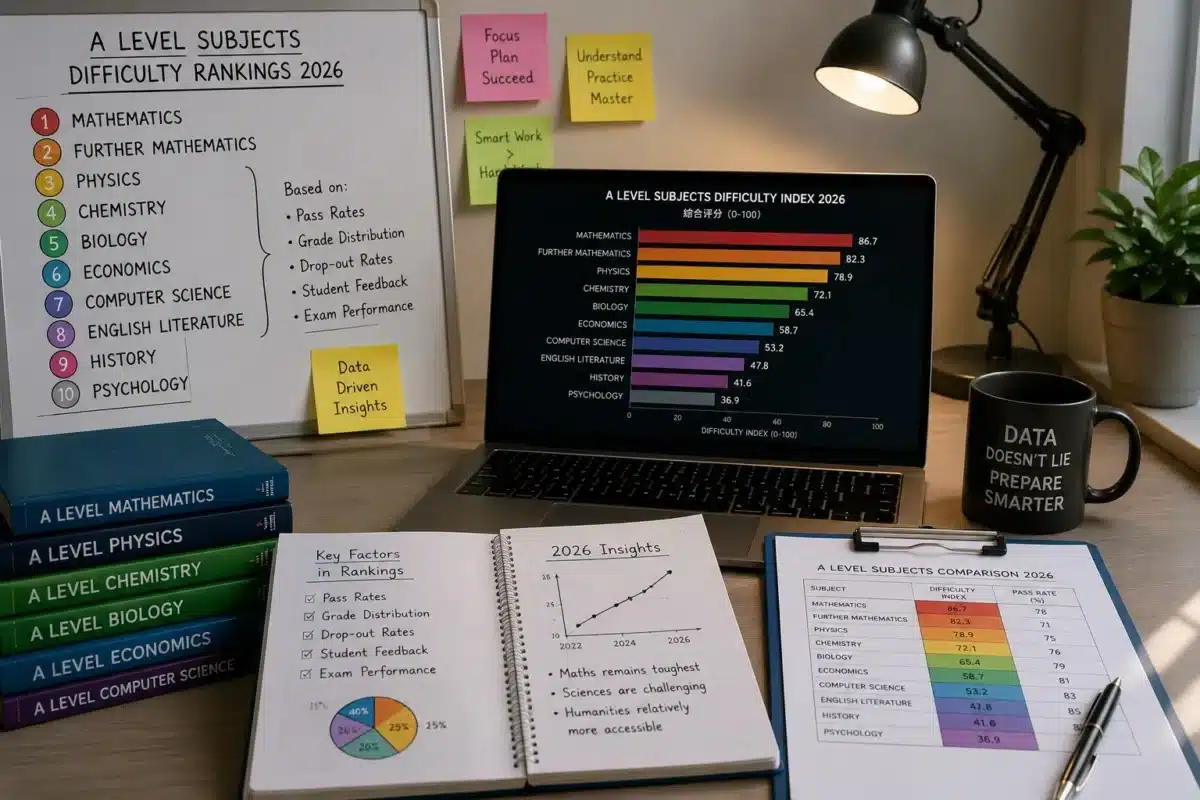
Everyone has an opinion about which A Levels are hardest. Ask a Maths student and they will tell you Further Maths is in a league of its own. Ask a humanities student and they will quietly suggest that anyone who has not written a 3,000-word History essay under timed conditions has no business calling anything else difficult. Ask a Biology student in the middle of memorising the entire nitrogen cycle at 11pm and they will not even answer the question. The problem with opinions about A Level difficulty is that they are almost always based on personal experience, which subjects felt hard to that particular person, in their particular school, with their particular teachers and strengths. That is not useless information, but it is not the full picture either. This guide goes further than opinion. It looks at what the data actually shows, grade distributions, fail rates, pass rates, and the structural features of each subject that make it objectively more or less demanding, alongside honest assessments from teachers, examiners, and the students who have sat these subjects at the highest level. The goal is not to discourage anyone from any subject. It is to give students and parents the clearest possible picture of what each A Level actually demands, so that subject choices are made with real information rather than myths and hearsay. Struggling with the hardest A Levels? Get expert support in Maths, Further Maths, Physics, Chemistry and more to boost your confidence and grades. GET A FREE TRIAL CLASS NOW How A Level Difficulty Is Actually Measured Before ranking anything, it is worth being clear about what “difficulty” means, because there are several ways to measure it, and they do not always point in the same direction. Grade distributions and A Level fail rates: the percentage of students who achieve each grade in a subject tells you something about how demanding it is relative to other subjects. A subject where fewer students achieve A and A* grades is not automatically harder — the student intake differs between subjects, but combined with other data, grade statistics provide useful context. A Level grade statistics: published annually by exam boards and Ofqual, these show the percentage of students achieving each grade in every subject. They allow comparisons across subjects and across years. Structural demands of the subject: how much content needs to be mastered, how complex the exam questions are, how much independent mathematical or analytical thinking is required, and how much the subject rewards genuine understanding versus careful memorisation. Student and teacher assessments, surveys of students and subject teachers consistently show similar patterns in perceived difficulty, which correlates reasonably well with grade distribution data. No single measure captures everything. This guide uses all of them. A Level Difficulty Ranking: The Full Picture The Hardest A Level Subjects by Grade Data and Structural Demand What the data consistently shows across multiple years of A Level grade statistics is a pattern that surprises some students and confirms what others already suspected. Here is the honest ranking, from most demanding to most accessible, with the reasoning for each position. Further Mathematics: The Hardest A Level by Almost Every Measure Further Mathematics sits at the top of every credible A Level difficulty ranking, and the data supports that position consistently. What makes it hardest: Further Maths extends A Level Maths into content that is significantly more abstract and mathematically demanding than anything in the standard A Level, complex numbers, matrices, further calculus, differential equations, and advanced proof. The pace is faster, the content is denser, and the mathematical fluency required is substantially higher than any other A Level subject. Who takes it: Further Maths is predominantly taken by students who are already strong mathematicians. The self-selection means the student intake is among the most mathematically able of any A Level cohort, which makes the grade distribution data particularly striking. Even among this group, the percentage achieving A and A* is lower than in most other subjects taken by a less-selected cohort. What the grade statistics show: Consistently lower A and A* rates than standard A Level Maths, even accounting for the high-ability intake. The percentage of students achieving top grades in Further Maths is lower than in humanities subjects taken by a much broader student population. The honest assessment: Further Maths is genuinely the hardest A Level for the vast majority of students who take it. It is also one of the most valuable for students applying to mathematics, engineering, physics, and computer science at competitive universities, which is exactly why students who find it hard keep going. Hardest A Level Maths: Standard A Level Mathematics Standard A Level Mathematics sits just below Further Maths in every difficulty ranking, and consistently shows among the lowest percentages of top grades relative to the number of students who take it. What makes it hard: The content volume is large, the pace is fast, and the mathematical fluency required, particularly in calculus, proof, and the mechanics and statistics applications. is significantly greater than anything at GCSE. The jump from GCSE grade 9 to A Level Maths is consistently underestimated by students who found GCSE easy, and the first year is often the hardest adjustment of any A Level subject. What the data shows: A Level Maths has one of the lower percentages of A and A* grades among the major A Level subjects, typically around 40 to 45% of entries achieving A or A* in recent years, which sounds high until you consider that the student intake is already significantly self-selected toward mathematical ability. Among all students who study at sixth form, the pass rate is high, but achieving the top grades is genuinely challenging. The honest assessment: A Level Maths is hard in a way that is consistent and predictable. Students who build strong algebraic foundations in Year 12 and develop genuine calculus fluency in Year 13 do well. Students who try to memorise methods without understanding them plateau at B or C regardless […]

Aug
Physics has a reputation that is partly deserved and partly myth. The deserved part: A Level Physics is genuinely demanding. It combines mathematical rigour with conceptual depth in a way that few other A Level subjects do, and the questions it asks are often unlike anything a student has encountered before, requiring them to apply principles to unfamiliar situations rather than recall familiar answers. If you’d rather work through these challenging areas with a specialist, our A Level Physics tutors build a targeted revision plan around your exact weak points. The myth part: that struggling with A Level Physics means you are not cut out for it. The students who find A Level Physics hardest are almost never the ones who lack the ability. They are almost always the ones whose revision approach has not caught up with what the subject actually requires. Reading notes and watching explanations feels like preparation. It is not, not for Physics, not at this level. This guide explains what actually works. The topics that carry most marks, the specific habits that earn them, and what separates students who achieve A and A* from those who understand the content but cannot show it when the exam paper arrives. If you’d rather work through these topics with a specialist, our A Level Physics tutors build a revision plan around exactly the gaps below. Struggling with A Level Physics? Get expert help with challenging topics, equations and exam technique to boost your grades. GET A FREE TRIAL CLASS NOW What A Level Physics Revision Needs to Look Like Before covering specific topics, it is worth being honest about why Physics revision fails for so many capable students, because the reason matters for what to do differently. Physics at A Level tests three things simultaneously, and most revision approaches only address one of them. Conceptual understanding: grasping what is actually happening physically in a situation. Why does a particle accelerate in an electric field? What does it mean for a wave to interfere destructively? Why does a gas expand when heated? Without genuine conceptual understanding, questions that present unfamiliar contexts produce blank pages. Mathematical fluency: the ability to select the right equation, rearrange it correctly, substitute values with correct units, and carry through multi-step calculations accurately under time pressure. Mathematical fluency in Physics is a practical skill that only develops through repeated practice — reading equations is not the same as using them. Exam technique: knowing what each question type is asking, what the mark scheme expects in written answers, how to structure a “show that” question, when to draw a diagram, how to handle data analysis questions. Exam technique in Physics is as learnable as the content itself, and as consequential for the final grade. A Level Physics revision that addresses all three simultaneously, through active problem-solving rather than passive content review, is what produces results. That is what this guide builds toward. AQA A Level Physics vs Edexcel A Level Physics The practical foundation of any A Level Physics revision plan is knowing exactly which board is being sat and building every element of revision around that board’s specification and papers. AQA A Level Physics is the most widely sat specification. It is assessed through three papers at the end of Year 13, Paper 1 covering mechanics, materials, and waves; Paper 2 covering electricity, further mechanics, thermal physics, fields, and nuclear physics; and Paper 3 which combines practical skills assessment with optional topic content. AQA questions are known for presenting unfamiliar contexts and requiring students to apply core principles rather than recall standard scenarios. Edexcel A Level Physics has a similar three-paper structure but with different optional topics and a slightly different balance between conceptual and mathematical assessment. Edexcel questions often provide more structured scaffolding in multi-step problems than AQA, guiding students through the method more explicitly. Both boards cover the same core content, the A Level Physics specification is regulated to ensure consistent standards, but the paper formats, question styles, and mark scheme language differ enough that mixed-board revision creates confusion rather than breadth. Download the correct specification. Use the correct past papers. Read the correct examiner reports. Every revision resource matters more when it is precisely matched to the actual exam. A Level Physics Topics: Complete Breakdown of the Core Content Mechanics: A Level Physics Foundation Mechanics covers kinematics, dynamics, Newton’s laws, momentum, work, energy, and power. It is the first major topic in most A Level Physics courses and the one that underpins the largest number of other topic areas, including circular motion, oscillations, and gravitational fields. Kinematics extends GCSE motion content significantly. The SUVAT equations are present but used in more complex scenarios, projectile motion, problems where multiple SUVAT equations need to be applied in sequence, and situations where the equations of motion need to be derived from first principles using calculus. Students who learned SUVAT as a set of formulas to apply directly at GCSE need to develop a deeper understanding of what each equation means physically. Newton’s Laws and Dynamics at A Level involve more complex force situations than GCSE, inclined planes, systems of connected particles, friction at multiple interfaces, and problems where forces need to be resolved into components before Newton’s second law can be applied. The ability to draw clear free body diagrams and set up equations systematically from them is a skill that comes from practice and is essential for mechanics questions. Momentum and Impulse covers conservation of momentum in more complex collision scenarios than GCSE, including two-dimensional momentum problems and the relationship between impulse and the area under a force-time graph. Momentum questions appear consistently across A Level Physics papers and reward students who understand the physics rather than just the formula. Energy, Work and Power at A Level involves more sophisticated energy analysis than GCSE, the work-energy theorem, the relationship between work done against friction and energy dissipation, and problems where multiple energy transformations need to be tracked through a system. Waves and Optics: […]

Aug
Biology is the A Level that tricks students in a very specific way. It feels manageable for most of Year 12. The content is interesting, the concepts connect to real life, and a student who paid attention in GCSE Science usually finds the early topics accessible. Then Year 13 arrives, homeostasis, genetics at a molecular level, ecosystems, the full complexity of the immune response, and the volume of material that needs to be held in memory, understood deeply, and applied precisely under exam conditions suddenly feels overwhelming. The students who handle that transition well are not the ones with the best memory or the strongest scientific instinct. They are the ones who revised differently, who built active recall habits early, who understood what A Level Biology mark schemes actually reward, and who used past papers as diagnostic tools rather than just practice exercises. This guide shows you exactly what that approach looks like. What A Level Biology Revision Really Requires Most A Level Biology students revise harder than they need to and smarter than they think, but in the wrong direction. Re-reading notes, annotating textbooks, and watching video explanations are all forms of passive revision. They feel productive because the content becomes familiar. But familiarity is not the same as retrieval, and A Level Biology exams test retrieval, not recognition. The subject also tests something deeper than recall. The mark scheme at A Level Biology rewards: Precise scientific language: “the enzyme’s active site changes shape” not “the enzyme stops working.” The difference between a mid-band and a top-band answer in Biology is almost always in the precision of the language rather than the accuracy of the underlying understanding. Mechanistic explanation: not just what happens, but how and why. The step-by-step explanation of how a nerve impulse propagates, how the complement system works, how transcription and translation produce a protein, these require the kind of detailed mechanistic understanding that surface-level revision does not build. Application to unfamiliar contexts: A Level Biology examiners regularly present scenarios that students have not seen before and ask them to apply their understanding. Students who have genuinely understood the principles can do this. Students who have memorised without understanding cannot. Revision that builds all three, precise language, mechanistic understanding, and application ability, looks different from most students’ default approach. This guide explains what it looks like in practice. AQA A Level Biology vs Edexcel A Level Biology, Start With the Right Specification Before any content revision begins, students need to know exactly which board they are sitting on, and every revision resource used should be aligned to that board specifically. AQA A Level Biology is the most widely sat A Level Biology specification. It is assessed through three papers at the end of Year 13, two papers covering the full specification content and one synoptic paper that draws connections across the entire course. AQA is known for application-style questions that present unfamiliar biological scenarios and ask students to apply their understanding. Edexcel A Level Biology has two specifications, Biology A (Salters-Nuffield) and Biology B. Both are assessed through three papers, but the structure and the balance between papers differ. Edexcel Biology A has a strong practical focus integrated throughout the specification, while Biology B follows a more traditional topic-based structure. Students should confirm which Edexcel specification their school follows before downloading materials. The mark scheme language, question formats, and the way synoptic connections are tested differ meaningfully between AQA and Edexcel. Revising from the wrong board’s past papers is not just unhelpful, it builds habits that do not match the actual exam. Use the correct specification document, correct past papers, and correct mark schemes from the start. A Level Biology Topics: Complete Breakdown by Area The A Level Biology specification is organised differently by each board, but the underlying content clusters are broadly consistent. Here is an honest breakdown of every major topic area, what it covers, how it is typically examined, and where students most commonly lose marks. Biological Molecules: A Level Biology Foundation Content Biological molecules is where the A Level Biology course begins and where foundational understanding is established. The topic covers carbohydrates, lipids, proteins, nucleic acids, water, and inorganic ions, and the relationships between structure and function that run through all of them. This is a topic where students frequently think they know more than they do. The mark scheme for biological molecules questions is specific about the language it accepts, “hydrogen bonds form between complementary base pairs” not “the bases join together”, and students whose GCSE revision built imprecise habits find that imprecision costing marks consistently. The key sub-topics that deserve most attention: Protein structure: primary, secondary, tertiary, and quaternary structure, and how each level of structure affects function Enzyme action: induced fit model, factors affecting enzyme activity, inhibition, and the precise language the mark scheme uses for each mechanism DNA and RNA structure: the specific differences between DNA and RNA and how those structural differences relate to function Water properties: the specific properties that make water suitable for biological roles, with precise reference to hydrogen bonding Cell Biology: A Level Biology Topics That Underpin Everything Cell biology covers cell structure, cell membranes, transport across membranes, cell division, and the cell cycle. These topics appear directly in exam questions and indirectly as the foundation for understanding tissues, organs, and systems later in the course. Cell membranes and transport is a topic where mechanism questions appear frequently. The specific mechanisms of osmosis, facilitated diffusion, active transport, and co-transport need to be understood at the level of the proteins involved — not just the direction of movement. Exam questions regularly ask students to explain why a specific transport mechanism is used in a specific context, which requires understanding the mechanism rather than just its name. Mitosis and meiosis appear in both direct questions: describe what happens at each stage, and in questions about the significance of each process for genetic variation and development. The differences between the two processes and the biological […]

Jul
Chemistry has a way of humbling students who thought they were good at science. You can leave your GCSE with an A* in Chemistry, walk into Year 12 feeling confident, and then spend the first half term quietly wondering whether you accidentally enrolled in a different subject. The content is denser. The questions go deeper. The mark scheme expects a level of precision that most students have never had to produce before. That experience is normal. It is also fixable. If you find the jump in difficulty overwhelming, working alongside a specialist A Level Chemistry tutor helps bridge the gap between GCSE foundations and A Level rigor. The students who do best in A Level Chemistry are not the ones who find it naturally easy. They are the ones who figured out early that this subject rewards a very specific kind of preparation, and who built that preparation into their revision before the exam season rather than discovering what they needed to do when it was too late. What A Level Chemistry Revision Actually Requires Before getting into topics and techniques, it helps to understand why A Level Chemistry revision fails for so many students who are working genuinely hard. The most common pattern: a student reads through notes, watches explanations, highlights content, feels reasonably prepared, and then opens a past paper and finds the questions are harder and more specific than anything their revision prepared them for. This happens because A Level Chemistry tests three distinct types of thinking simultaneously, and most revision approaches only address one or two of them. Factual recall: definitions, reagents, conditions, equations, mechanisms. The content that needs to be memorised precisely and retrieved accurately under exam pressure. Conceptual understanding: why reactions happen, what drives equilibria, how bonding affects properties, what trends in the periodic table mean at an atomic level. The understanding that allows knowledge to be applied to unfamiliar contexts. Exam technique: knowing what each question type is asking, what the mark scheme requires in written answers, how to structure explanations, when to use specific terminology. The skill of showing what you know in a form that earns marks. Students who revise only for recall can answer straightforward recall questions but struggle with application. Students who understand the concepts deeply but have not practised exam technique lose marks on questions they actually understand. Effective A Level Chemistry revision builds all three simultaneously, and the structure of revision time needs to reflect that. AQA A Level Chemistry vs Edexcel A Level Chemistry: Know Your Board First The practical starting point for any A Level Chemistry revision plan is knowing which board is being sat, and building every element of revision around that board’s specification, past papers, and mark scheme language. AQA A Level Chemistry and Edexcel A Level Chemistry cover the same core content, organic chemistry, physical chemistry, inorganic chemistry. Still, they structure it differently, assess it with different question formats, and reward slightly different things in written answers. AQA past papers and Edexcel past papers are not interchangeable for timed practice, and using the wrong board’s materials builds habits that do not match the actual exam. Download the current specification document for the correct board. Every topic in that document is fair game. Every topic outside it is not worth revision time regardless of how interesting it is or how thoroughly it was covered in class. A Level Chemistry Topics: Complete Breakdown by Area The A Level Chemistry specification covers three broad areas: Physical Chemistry, Inorganic Chemistry, and Organic Chemistry. Understanding what each area demands, and where the most marks are concentrated, shapes how revision time should be allocated. Physical Chemistry Topics: A Level Chemistry Foundation Physical chemistry is the most mathematically demanding area of A Level Chemistry and the one where students who are comfortable with numbers have a genuine advantage. The major topics are: Atomic Structure and Bonding builds on GCSE foundations but goes significantly deeper, electron configuration in subshells, ionisation energies and trends, the shapes of molecules using VSEPR theory, and the detailed relationship between bonding type and physical properties. This content underpins almost everything else in the specification and needs to be genuinely understood rather than superficially memorised. Energetics covers enthalpy changes, Hess’s Law, bond enthalpies, and in A2 moves into lattice enthalpy, entropy, and Gibbs free energy. Calculation questions in energetics are common and reliable marks for students who have practised the methods carefully. Conceptual questions about why certain reactions are or are not feasible require understanding of entropy and Gibbs free energy that goes beyond GCSE. Kinetics covers rate of reaction at a deeper level than GCSE, rate equations, orders of reaction, rate constants, and the Arrhenius equation. Rate equation questions appear frequently and reward students who have practised interpreting experimental data to determine orders of reaction, a skill that requires deliberate practice rather than just content knowledge. Equilibria covers dynamic equilibrium, Le Chatelier’s principle (extended from GCSE), and the equilibrium constant Kc and Kp. Equilibrium questions are among the most consistently tested in A Level Chemistry and among the most consistently mishandled, students who understand Le Chatelier’s principle qualitatively often struggle with quantitative equilibrium calculations, which require a different level of preparation. Acids and Bases at A Level introduces pH calculations, weak acids and bases, buffer solutions, and titration curves. This is a topic where precise calculation methodology matters enormously, a small error in the setup of a pH calculation costs the method marks that would otherwise be available even with arithmetic errors. Practising the calculation setups rather than just understanding the concepts is essential. Electrochemistry covers electrode potentials, the electrochemical series, and predicting the feasibility of reactions using standard electrode potentials. This is a topic that many students find confusing initially, the sign conventions are precise and the reasoning involved is more abstract than most physical chemistry topics, but it becomes much more manageable with structured practice. Inorganic Chemistry Topics, A Level Chemistry Inorganic chemistry covers the chemistry of elements across the periodic table […]

Jul
Most students who choose A Level Maths know it is going to be harder than GCSE. What they underestimate is how differently it needs to be approached. GCSE Maths rewards students who have learned methods and can apply them reliably to familiar question types. A Level Maths rewards something different, the ability to think mathematically, to connect ideas across different topic areas, to construct multi-step solutions to problems that do not look like anything practised before, and to do all of this fluently under timed exam conditions. That shift in what the subject demands catches a lot of capable students off guard. Students who achieved grade 8 or 9 at GCSE, who never had to work particularly hard at Maths before, sometimes find A Level Maths genuinely difficult for the first time. Not because they lack the ability, but because the subject has changed in ways they were not prepared for. This guide explains what A Level Maths actually involves, how to approach the topics that cause the most difficulty, what the exams require, and what separates students who get an A+ from those who plateau somewhere below it. What Is A Level Maths: How It Differs From GCSE A Level Mathematics: The Structure of the Qualification A Level Maths is a two-year qualification, typically studied in Years 12 and 13 (Lower and Upper Sixth). It is examined entirely at the end of Year 13, there are no modular exams or coursework components, which means two years of content is assessed across a series of papers sat over a few weeks in the summer of Year 13. All A Level Maths specifications include two core components: Pure Mathematics: the largest component, covering the foundational mathematical content that underpins the rest of the qualification. Pure Maths typically accounts for two thirds of the total marks. It includes topics that extend significantly from GCSE, algebra, functions, calculus, trigonometry, vectors, and proof, plus content that is entirely new, including exponentials and logarithms, integration, and more advanced algebraic manipulation. Applied Mathematics: the remaining third of the specification, divided between Statistics and mechanics. All A Level Maths students study both Statistics and Mechanics, though the balance and depth vary slightly between exam boards. Understanding this structure from the start shapes how revision time should be allocated. and helps students avoid the common pattern of over-investing in the applied content because it feels more accessible while under-revising the pure content where the majority of marks sit. A Level Maths Difficulty: Why the Jump From GCSE Is Bigger Than Expected The difficulty jump from GCSE to A Level Maths is one of the most consistently underestimated transitions in secondary education. Several things change simultaneously: Content volume increases dramatically. The A Level Maths specification covers significantly more material than GCSE, introduced at a faster pace, with less repetition and consolidation time built into the teaching sequence. Questions require multi-step reasoning. GCSE questions often test one skill in a relatively direct way. A Level Maths questions routinely require combining ideas from different topic areas, using results from one part of a question in the next, and constructing solutions that involve several steps, none of which are signposted by the question itself. Algebraic fluency is assumed. At A Level, time cannot be spent working out how to manipulate expressions or solve equations, those skills need to be automatic. Students who arrive at A Level with shaky algebraic foundations find the content much harder than it needs to be, because every new topic is being processed through an uncertain foundation. Independent study becomes essential. GCSE content is generally taught and retaught until most students understand it. A Level Maths moves faster and expects students to consolidate understanding independently between lessons, which requires a self-directed revision habit that many students have not needed to develop before. A Level Maths Topics: Complete Breakdown by Area Pure Mathematics Topics: The Core of A Level Maths Pure Maths is where the majority of marks are available and where revision effort has the highest return. Here is a breakdown of the major pure topics and what each requires: Algebra and Functions builds directly from GCSE algebra but goes significantly further. Polynomial division, the factor theorem, partial fractions, and functions including composite and inverse functions are all introduced in Year 12. Students who are fluent algebraic manipulators find these topics manageable. Students with GCSE algebraic gaps find them compounding, each new topic requires the previous ones to be secure. Coordinate Geometry covers straight lines, circles, and the use of parametric equations to describe curves. Circle questions at A Level are more complex than at GCSE and frequently combine with algebra in multi-step problems. Coordinate geometry questions appear consistently across all A Level papers and are a reliable source of marks for students who have practised them thoroughly. Sequences and Series introduces arithmetic and geometric sequences at greater depth than GCSE, plus the binomial expansion, a topic that appears regularly in A Level papers and rewards students who have learned it precisely. The sigma notation used in sequences also appears in Statistics, making this a topic with cross-topic value. Trigonometry expands dramatically at A Level. Radians, reciprocal trigonometric functions, inverse trig functions, compound angle formulae, double angle formulae, and the R-addition formulae all build on GCSE trigonometry in ways that most students find challenging initially. Trigonometry is one of the topics where A Level Maths feels genuinely hard, but it responds very well to structured practice because the patterns are consistent once the underlying identities are secure. Exponentials and Logarithms is entirely new at A Level, there is no GCSE equivalent of the same depth. Understanding exponential growth and decay, the natural logarithm, and the laws of logarithms are all introduced in Year 12. These topics also connect to calculus, making them important to understand properly rather than memorise superficially. Calculus, Differentiation and Integration is the most significant new content at A Level and the topic area that carries the most marks across most specifications. Differentiation covers […]