

Quick Answer: The IB curriculum is an international education framework with four programmes. Its best known one, the Diploma Programme (ages 16 to 19), has six subject groups plus a core of Theory of Knowledge, an Extended Essay and CAS. Students take three subjects at Higher Level and three at Standard Level, and are scored out of 45 points. A parent once told me that explaining the IB to friends felt harder than learning it. There are groups, levels, a core, internal assessments and a points system. It sounds like a lot before you see how the pieces fit. Here is the good news. Once you see the structure, the IB curriculum is easy to follow. This guide explains it in plain English, so you know what your child will study, how they will be marked and how to choose subjects with confidence. What Is the IB Curriculum? The International Baccalaureate (IB) is a non-profit organisation that runs education programmes in thousands of schools across more than 150 countries. The IB curriculum focuses on more than exam facts. It asks students to think critically, research independently, write clearly and understand different points of view. Universities around the world accept IB results, which is one reason many families choose it. Students who finish the Diploma are often described as well prepared for university study, because the course trains research and time management skills early. The Four IB Programmes The IB programme is not just one course. It has four stages, and a student can follow them from early childhood to age 19. Programme Age group What it offers Primary Years Programme (PYP) 3 to 12 Learning through enquiry and projects Middle Years Programme (MYP) 11 to 16 Broad subjects linked to real life Diploma Programme (DP) 16 to 19 The best known pre-university course Career-related Programme (CP) 16 to 19 IB study mixed with career training Most families searching for the IB mean the Diploma Programme, so the rest of this guide focuses on it. IB Curriculum Structure: The Six Subject Groups The Diploma Programme has six subject groups. A student normally picks one subject from each group, which keeps their education broad. Here is what the groups contain. Group Area Example subjects 1 Studies in language and literature English A, Literature, other first languages 2 Language acquisition French, Spanish, Mandarin, English B 3 Individuals and societies History, Economics, Geography, Psychology, Business 4 Sciences Biology, Chemistry, Physics, Computer Science 5 Mathematics Analysis and Approaches, Applications and Interpretation 6 The arts Visual Arts, Music, Theatre (or a second subject from groups 1 to 4) Subject lists can differ from school to school. Not every school offers every course, so always check what your own school provides. Higher Level vs Standard Level Each student takes three subjects at Higher Level (HL) and three at Standard Level (SL). Some students take four HL subjects, but this is much heavier. Higher Level: about 240 teaching hours, deeper content, more demanding assessment Standard Level: about 150 teaching hours, similar skills but less depth Your HL subjects should match your future degree. A future engineer might choose HL Maths and HL Physics. A future lawyer might choose HL History and HL English. The IB Maths Choice Maths has two courses at both levels. Analysis and Approaches suits students who enjoy algebra, calculus and proof, often for science and engineering. Applications and Interpretation suits students who prefer data, modelling and technology. Check your target university’s requirements before choosing. The IB Core: What Every Student Must Complete On top of the six subjects, every Diploma student completes three core parts. Theory of Knowledge (TOK): a course about how we know what we know, assessed with an essay and an exhibition Extended Essay (EE): an independent research paper of up to 4,000 words on a topic the student chooses Creativity, Activity, Service (CAS): experiences outside the classroom, such as sport, art and volunteering Many students find the core as demanding as a subject. Start planning the Extended Essay early, because leaving it to the last minute is one of the most common IB mistakes. How the IB Curriculum Is Assessed and Scored Most subjects use two kinds of assessment: external exams at the end of the course, and internal assessments marked by the teacher and checked by the IB. Internal assessments might be a lab report, a presentation, an essay or a portfolio. Each subject is scored from 1 to 7. With six subjects, that gives up to 42 points. The core can add up to 3 bonus points, so the maximum total is 45. To earn the Diploma, a student generally needs at least 24 points and must meet the other requirements, including the core. Many competitive universities ask for much higher scores, so check each course’s offer. Choosing Subjects in the IB Curriculum Picking subjects is a big decision. Follow this simple method. Start with the degree or career you might want. Check the entry requirements of two or three universities. Choose HL subjects that fit those requirements. Add SL subjects that balance your workload. Think honestly about your strengths and interests. If you are comparing the IB with other routes, our guide on how to choose A Level subjects shows how to think about options, and our overview of what the IGCSE is explains the course many students take before starting the Diploma. IB Syllabus: Where to Find Exactly What Is Examined Each subject has an official subject guide, which is the IB syllabus for that course. It lists the topics, the assessment format, the command terms and the marking criteria. Ask your teacher for the current version, and use it as a checklist. Because the syllabus can change between teaching cycles, always make sure your notes and past papers match the version your school follows. Tips for Success in the IB Start early and keep a weekly plan, because the workload is steady Treat the internal assessments as real marks, not extras Practise past paper […]
Monthly Archives: November 2026

Nov
Quick Answer: To get a grade 9 GCSE in Maths, you must sit the Higher tier and score roughly 86% to 91% of the total marks, based on 2025 boundaries. Master the Higher-only topics, practise past papers under timed conditions, and fix every lost mark by topic. About 3.2% of students in England reached a grade 9 in Maths in 2025. Almost every student who aims for a grade 9 in Maths hears the same advice: “do more past papers.” It is not wrong, but it is not the full story. Plenty of students do dozens of papers and still sit stuck on an 8. The difference is rarely talent. It is how they practise, and what they do with the marks they lose. This guide shows what a grade 9 GCSE actually takes, using real numbers, and gives you a plan you can start this week. What Does a Grade 9 GCSE Maths Result Mean? Grade 9 is the highest grade in the 9 to 1 system. It sits above the old A*, and it was created to separate the very best students from everyone else. It is also rare. In 2025, about 3.2% of GCSE Maths entries in England got a grade 9. That is fewer than one student in thirty. The rate has stayed close to that for the last few years. One rule matters more than any revision tip: you can only get a grade 9 on the Higher tier. Foundation tier stops at grade 5. If you are aiming for the top, make sure your school enters you for Higher. How Many Marks Do You Need for a Grade 9 GCSE? Grade boundaries move every year, because they depend on how hard the papers were. Here are the Higher tier boundaries for 2025: Exam board Grade 9 mark Total marks Approx. percentage AQA 219 240 91% Edexcel 217 240 90% OCR 258 300 86% So a grade 9 GCSE usually means getting around nine marks in every ten. You can afford to lose very few marks, which is why careless errors matter so much at this level. Boundaries change each year, so treat these numbers as a target range and check your own board’s latest figures. What Topics Do You Need for a Grade 9 GCSE? The Higher paper includes every Foundation topic, plus harder content that only appears at the top end. If you want a grade 9, you cannot skip the harder material. Higher-tier topics worth special attention: Algebraic proof Surds and rationalising the denominator Circle theorems and circle equations Functions, including composite and inverse Iteration and algebraic fractions Trigonometry in non-right-angled triangles Vectors and geometric proof Gradients of curves and rates of change Probability with conditional outcomes Questions on these topics are usually placed near the end of each paper. They often carry four to six marks each and need several steps. That is where grade 9 students pull ahead. How to Get a Grade 9 GCSE in Maths: 6 Steps Step 1: Check your starting point Do one recent past paper under timed conditions. Do not look at your notes. Mark it with the official mark scheme. Your score tells you how far you are from the boundary and where the gap is. Step 2: Make your foundations automatic Many 8 students lose marks on easy questions. Fractions, percentages, ratio and basic algebra should feel automatic. Any mistake here is a mark you cannot afford. Step 3: Learn the hard topics properly Take one Higher-only topic at a time. Watch or read one clear explanation, then do ten to fifteen questions without help. Keep a short notebook of rules and the mistakes you made. For ideas on the best study methods, our guide on how to revise effectively explains why testing yourself beats rereading. Step 4: Practise by topic, then by paper Start with topic questions so you can fix weak areas quickly. Once you feel stronger, move to full papers under timed conditions. Do the non-calculator paper separately, because many students rely on their calculator too much. Step 5: Track every lost mark After each paper, write down why you lost each mark. Was it a knowledge gap, a careless slip, poor method or running out of time? Patterns show up quickly. If you keep losing marks on algebra, you now know exactly what to practise. Step 6: Practise problem solving Grade 9 questions often do not tell you which method to use. Practise “show that” questions, proof questions and unfamiliar problems. When stuck, write down what you know, draw a diagram and try the first step you can see. A Simple Study Plan for a Grade 9 GCSE You do not need a huge timetable. Short and regular beats long and rare. If you want help building one, see our guide to GCSE Revision Tips That Actually Work. When What to do Time Three weekdays One Higher topic, questions only 45 minutes One weekday Mixed review of old topics 30 minutes Saturday One timed paper or half paper 90 minutes Sunday Mark it, log errors, fix them 60 minutes Start this about six to nine months before your exams, so you can revisit each topic several times. Common Mistakes Students Make When Aiming for a Grade 9 Doing many past papers but never fixing the mistakes Skipping topics they dislike Relying on the calculator and ignoring the non-calculator paper Not showing working, which loses method marks Rushing early questions and making careless errors Leaving blanks instead of attempting multi-mark problems If you are not sure how your current grade compares with your target, our guide on what a good GCSE grade means explains the full 9 to 1 scale. Do You Need a Tutor to Get a Grade 9? Not always. Many students reach grade 9 with good resources, past papers and steady practice. A tutor helps most when you are stuck on a score for weeks, keep making the same errors, or have large gaps in Higher […]

Nov
Quick Answer: Yes, A Level Physics is hard for most students, mainly because of the jump in maths and the abstract ideas. But it is very learnable. Students who practise problems daily, understand concepts instead of memorising, and use past papers tend to do well. It is harder than GCSE, yet it rewards steady effort more than natural talent. When I ask students “is A Level Physics hard?”, I usually get one of two answers. Some say it is the hardest subject they have ever taken. Others say it clicked once they found the right way to study. Both are true. A-Level Physics is a demanding subject, but the difficulty comes from a few specific places, and each one can be fixed. This guide tells you honestly what makes it hard, which topics catch people out, and how to make it easier. Is A-level physics hard? For most students, yes. The step up from GCSE is big, and it surprises people who found GCSE Physics easy. Here is why it feels harder: More maths. You use algebra, trigonometry, logarithms and sometimes calculus ideas. Abstract ideas. Fields, waves and quantum physics are hard to picture. Multi-step problems. Questions rarely give you one neat equation to use. Faster pace. Teachers cover a lot of content quickly. Less hand-holding. You must practise alone, not only in lessons. That said, “hard” does not mean “impossible”. Thousands of students get A and A* every year, and most of them are not geniuses. How Hard Is A Level Physics Compared to Other Subjects? Physics is usually ranked among the harder A Levels, along with Maths, Further Maths and Chemistry. Here is a simple comparison of what each one demands: Subject Main challenge Maths level Physics Abstract ideas plus problem solving High Maths Pure reasoning and speed Very high Chemistry Large content plus calculations Medium to high Biology Large amount of content to remember Low to medium Grade statistics are published every year by exam boards and Ofqual, so check the latest figures for the real percentages. What they usually show is that Physics sits in the middle of the pack for top grades. It is hard, but fair. If you are weighing up your options, our guide to Hardest A Level Subjects Ranked looks at the whole picture. Why Is A-Level Physics Hard? The Real Reasons The jump from GCSE is bigger than it looks GCSE Physics gives you most equations on a sheet and keeps the maths simple. At A-Level, you need to choose the right equation, rearrange it, and often combine two or three. Many students lose marks on method, not on understanding. Maths and physics must work together If your maths is shaky, physics feels harder than it really is. Students taking A-Level Maths alongside Physics often find the two help each other. If you are not taking Maths, spend extra time practising algebra and rearranging equations. Concepts you cannot see You cannot see an electric field or a wave function. Understanding them means building a mental picture from diagrams and examples. This takes time, and it is normal to feel stuck at first. Exams test application, not recall You will get questions you have never seen before. The exam checks whether you can apply a principle to a new situation. That is why memorising notes is not enough. What Are the Hardest Topics in A-Level Physics? Students often name these topics as the toughest, but we have a solution for you to study A level physics with these best tutors in the world.: Fields. Gravitational, electric and magnetic fields use similar ideas, which confuses many people. Simple harmonic motion. It mixes graphs, equations and energy. Circular motion. You must work out which force provides the centripetal force. Quantum and particle physics. The ideas feel strange and unfamiliar. Capacitors and exponential decay. They need logarithms and careful graph work. Practical skills and data analysis. These are marked in written exam questions too. The good news is that topics usually feel easier after you have done about 15 to 20 questions on them. Struggle at the start is normal. How to Make A-Level Physics Easier Practise problems, do not just read notes Physics is a doing subject. After each lesson, try three or four questions without looking at your notes. When you get stuck, that is where learning happens. Our guide on how to revise effectively explains why testing yourself beats rereading. Learn the idea behind every equation Ask “what is this equation telling me?” instead of only memorising it. If you know that force equals the rate of change of momentum, you can handle many different questions. Draw diagrams for every problem A quick sketch of forces, circuits or waves often makes the solution clear. Examiners also give marks for correct diagrams. Fix your maths early Practise rearranging equations, working with powers of ten, and using your calculator properly. A few weeks of focused practice makes a huge difference. Use past papers properly Do them under timed conditions, mark them with the official mark scheme, and note down every mistake. Our guide to A Level Past Papers: The Ultimate Revision Strategy shows a step by step method. Ask for help early If a topic does not make sense after a week, ask your teacher or find a tutor. Small gaps in Year 12 become big problems in Year 13. Is A-Level Physics Hard Without A-Level Maths? It is harder, but not impossible. Physics needs a good level of maths, and many sixth forms ask for at least a grade 6 or 7 at GCSE Maths before you can take it. If you skip A-Level Maths, practise the maths skills inside physics regularly and ask your teacher which topics use the most algebra. Is A-Level Physics Worth It? If you enjoy problem solving, it is very worth it. A-Level Physics opens the door to engineering, physics, computer science, architecture and many other degrees. Universities respect it because it shows strong thinking skills. If […]
Nov
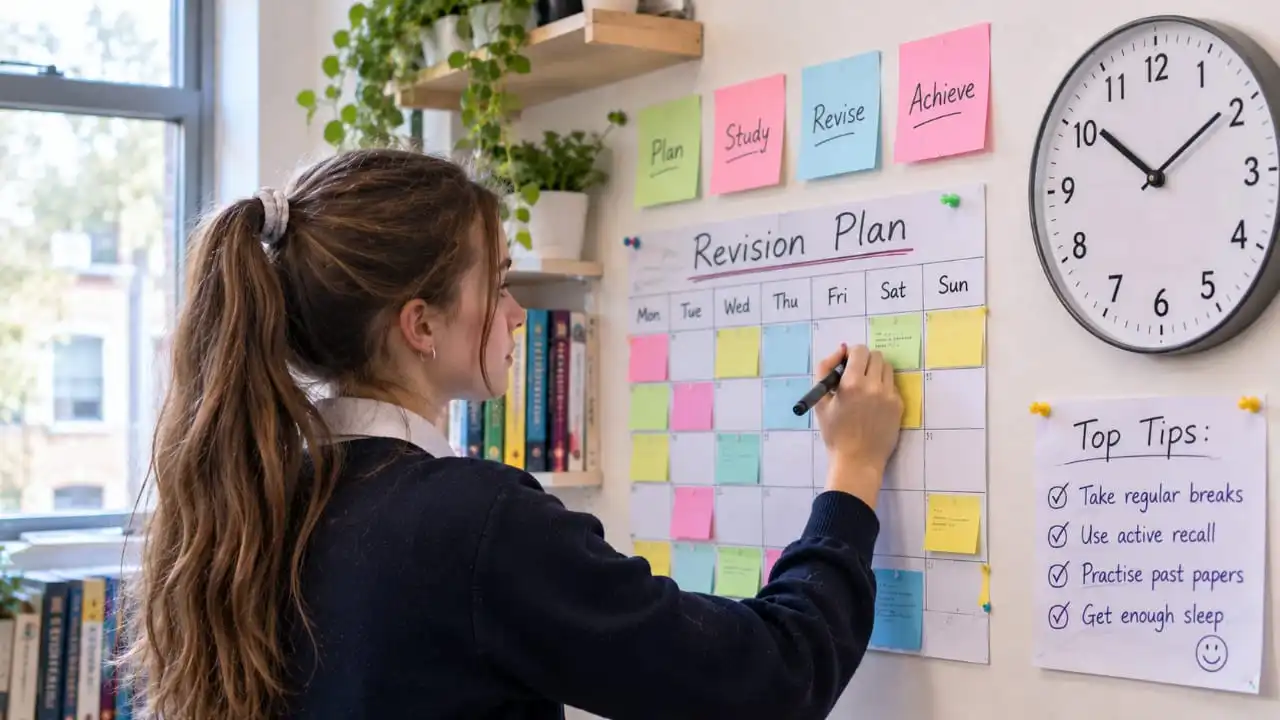
Quick Answer: To make a revision timetable, list your exams and their dates, rate each subject by how confident you feel, then block short study sessions into the time you really have. Give weaker subjects more slots, mix subjects each day, add breaks and one free day, and review the plan every week so it stays realistic. I once watched a friend spend an entire Sunday making a beautiful colour-coded timetable. It had every subject, every hour, every break. By Wednesday he had stopped following it, and by the weekend it was lying under a pile of papers. Sound familiar? Most students don’t fail at revision because they lack effort. They fail because their plan was never realistic. A revision timetable only works if you can follow it on a bad day, not just a perfect one. This guide shows you how to build one that fits your real life, with simple steps you can finish in under an hour. Why Does Your Revision Timetable Keep Failing? Before you build a new plan, it helps to know why the last one fell apart. Here are the usual reasons: It was too packed, with no breaks or free time It ignored school, sport, family and sleep Every subject got the same time, even the ones you find hard Tasks were vague, like “revise Chemistry” for three hours There was no space to catch up after a missed day A good revision timetable is not about squeezing in the most hours. It is about using the hours you have in a smart way. How to Make a Revision Timetable in 6 Steps Step 1: Write down your exams and dates List every exam with its date, subject and paper. If you are sitting GCSE, IGCSE or A Level, your school or exam board will give you the dates. Put them on one page so you can see how much time you have before each one. Step 2: Count your real free time Mark the things you can’t move: school, travel, meals, sport, family time and sleep. Whatever is left is your study time. Be honest here. If you are tired after football on Tuesdays, don’t plan a heavy session that night. Step 3: Rate every subject Give each subject a score from 1 to 3. A 1 means you feel confident, a 2 means you feel okay, and a 3 means you feel lost. Weak subjects with early exams get the most time. Strong subjects still stay in the plan, just with fewer sessions. Step 4: Break each subject into topics “Revise Biology” is too big to start. “Do 20 minutes of active recall on enzymes” is easy to start. Copy the topic list from your exam board’s specification and tick each one off as you go. This also shows you how much is left, which makes the work feel less scary. Step 5: Build short study blocks Aim for sessions of 30 to 50 minutes with a short break after each. Mix subjects across the day, because switching topics helps memory and keeps you fresh. Put the hardest subject early in the day, when you have the most energy. Step 6: Add breaks, a free day and a buffer Plan at least one proper day off each week. Also leave one or two empty slots as a buffer, so a missed session doesn’t wreck the whole week. Your revision timetable should bend without breaking. A Simple Revision Timetable Template You Can Copy Here is a basic weekly layout. Change the subjects and times to suit you. Day After school (1 hour) Evening (45 minutes) Monday Maths, past paper questions Biology, active recall Tuesday Chemistry, topic notes English, essay practice Wednesday Physics, equations Rest or light reading Thursday Maths, weak topics History, timeline recall Friday English, quote learning Free time Saturday Two subjects, timed paper Review the week Sunday Day off Plan next week (10 minutes) This is a revision timetable template, not a rule. If you are doing A Levels, you may have fewer subjects but longer sessions. If you have GCSEs, you may have more subjects and shorter sessions. What Should a Good Revision Timetable Include? A strong plan has five parts: Clear tasks. Write what you will do, not just the subject. Active methods. Use quizzing and past papers, not only rereading. Our guide on how to revise effectively explains the methods that work best. Spaced review. Come back to older topics every week or two so they don’t fade. Rest. Sleep, meals and breaks are part of the plan. Flexibility. A weekly check lets you move things around. How Early Should You Start Your Revision Timetable? For summer exams, start between January and February, which gives you three to four months. Starting earlier lets you use gentle, steady sessions rather than panic cramming. If you are closer to the exams than that, don’t worry. Focus on the biggest topics first, use past papers, and cut anything that doesn’t earn marks. Revision Timetable Tips for Students Who Struggle to Stick to It Here are some study timetable tips that really help: Start with just 20 minutes a day for the first week, then build up Put your timetable somewhere you will see it, like your desk or phone lock screen Study in the same place at the same time each day, so it becomes a habit Phone away, notifications off, during every block Tick off each session. It feels good and keeps you going Reward yourself after a full week If you miss a session, don’t scrap the plan. Just move it to your buffer slot and carry on. Common Mistakes When Making a Revision Timetable The same few mistakes show up again and again: Planning ten hours a day, then quitting after two days Only revising your favourite subjects Leaving out weekends or social time completely Never updating the plan when things change Making the timetable so pretty that you never use it A simple, messy plan […]