

Quick Answer: What is IGCSE? IGCSE stands for International General Certificate of Secondary Education. It is a two-year qualification for students aged 14 to 16, taken at international and independent schools worldwide. It is graded A* to G (Cambridge) or 9 to 1 (Edexcel), is accepted by universities as equivalent to GCSE, and leads on to A Levels or the IB Diploma. If your child’s school has mentioned the IGCSE, you have probably done what most parents do: nodded politely, then searched for what it actually means that evening. You are in good company. The IGCSE is mentioned constantly in school information evenings, yet it is rarely explained from scratch. So here is the explanation, in plain English, covering what the qualification is, what your child will study, how it is graded and what it leads to. What Is IGCSE and What Does the Name Mean? IGCSE stands for International General Certificate of Secondary Education. It is an internationally recognised qualification for students typically aged 14 to 16, usually studied over two years in Years 10 and 11. The “International” part matters. The IGCSE was designed for students outside the mainstream UK state system, so the content and exam questions are written to make sense to students from many countries and backgrounds, rather than assuming a UK context. IGCSE Meaning in Simple Terms Think of the IGCSE as the international version of the GCSE. Students choose a set of subjects, study them for two years, and sit external exams at the end. Those results become the foundation for everything that follows, including sixth form, A Levels, the IB Diploma and, later, university applications. Who Offers the IGCSE? Two main organisations offer the qualification: Cambridge (CAIE). Cambridge IGCSE is the most widely taken version worldwide. It is graded A* to G. Pearson Edexcel. The Edexcel International GCSE uses the 9 to 1 numerical scale, the same as the standard GCSE. Which one your child takes depends on the school. For a closer look at how the two differ, see our guide to Cambridge vs Edexcel IGCSE. How Does the IGCSE Work? Most students study the IGCSE across Years 10 and 11, then sit written exams at the end of the course. Some subjects also include coursework, oral exams or practical components. Exams usually take place in two sessions each year: May/June and October/November. Most full-time students sit in May/June, with the autumn session used for resits or early entries. Core and Extended Tiers In some Cambridge subjects, especially Maths and the sciences, students are entered for either a Core or an Extended tier. Core caps the highest grade available at a C, while Extended opens the full A* to G range. Students aiming for the top grades need Extended entry, so it is worth asking the school early how entry decisions are made. IGCSE Subjects: What Can Students Study? One of the IGCSE’s strengths is its breadth. Cambridge alone offers more than 70 subjects, grouped broadly into: Languages: English as a First or Second Language, plus French, Spanish, Chinese, Arabic and many more Humanities: History, Geography, Economics, Business Studies, Sociology Sciences: Biology, Chemistry, Physics and Combined Science Mathematics: Mathematics and Additional Mathematics Creative and technical: Computer Science, Art and Design, Music, Drama, Physical Education Most students take between seven and ten subjects. English and Maths are almost always compulsory, and most schools expect at least one science. The breadth lets students keep options open before narrowing down at A Level. How Many IGCSE Subjects Should My Child Take? Seven to nine is a sensible range for most students. Fewer than seven can look thin when applying to competitive sixth forms, while more than ten tends to stretch revision time and lower grades. Strong grades in fewer subjects are worth more than average grades in many. How Is the IGCSE Graded? Board Grading Scale Top Grade Cambridge IGCSE A* to G A* Edexcel International GCSE 9 to 1 9 Both are widely understood by universities and sixth forms. A grade C on the Cambridge scale roughly corresponds to a grade 4 on the 9 to 1 scale, which is the usual “standard pass” benchmark. Exam boards adjust grade boundaries each year depending on paper difficulty, so aim for solid understanding rather than a fixed percentage. IGCSE vs GCSE: What Is the Difference? The two qualifications sit at the same level and are treated as equivalent by universities. The main differences are: Audience. IGCSE is designed for international and independent school students. GCSE is the standard qualification in UK state schools. Assessment style. Some IGCSE subjects keep more coursework or practical elements, while GCSEs have moved heavily toward final exams. Grading. Cambridge uses letters, GCSE uses numbers. Availability. IGCSEs are not typically offered in mainstream state schools. In practice, your child’s school decides which route they take. What matters for university and sixth form is the grades achieved. What Happens After the IGCSE? The IGCSE is a stepping stone, not a final destination. Most students move on to one of two pathways: A Levels: two years of more specialised study in three or four subjects IB Diploma: a broader two-year programme covering six subjects plus a core Strong IGCSE results, particularly in English and Maths, keep both routes open and help with entry to competitive sixth forms. If your child is thinking ahead, our guide to how to choose A Level subjects shows how IGCSE choices connect to later options. How Parents Can Support Their Child Through the IGCSE You do not need to be a subject expert. A few practical habits help most: Know the board and subjects. Ask the school which board each subject uses, so past papers and resources match. Encourage early, steady revision. The IGCSE rewards consistent work across two years rather than last-minute cramming. Use past papers. They are the most effective revision tool, ideally done under timed conditions. Spot gaps early. If a subject feels shaky in Year 10, address it before it compounds in Year […]
Category Archives: Exam Boards & Qualifications
Not sure which exam board your child should take? These guides explain AQA, Edexcel, OCR and Cambridge in plain English. Compare Cambridge and Edexcel IGCSE, see how AQA and Edexcel differ by subject, learn what IGCSE means, and understand the difference between IGCSE and GCSE and between AS and A Level. Need help preparing for a specific board? <a href=”https://thetutorsglobe.com/contact-us/”>Talk to us about a free trial</a> or see <a href=”https://thetutorsglobe.com/how-tutor-globe-works/”>how our tutoring works</a>.
Exam Boards & Qualifications
AQA vs Edexcel: Differences by Subject (Maths, English, Science and More)
Oct
Quick Answer: AQA vs Edexcel is not a question of which board is harder. Both are regulated by Ofqual and award grades to the same standard. The real differences are in question style, paper structure, mark scheme wording and which topics are emphasised in each subject. AQA tends to use more open-ended questions, while Edexcel often breaks problems into guided steps. At some point in Year 10, almost every student hears a version of the same sentence: “Make sure you use the right past papers for your board.” Then comes the follow-up nobody answers properly. What is the actual difference between AQA and Edexcel? Is one easier? Does it matter if your child has been practising with the wrong one for three months? It does matter, though less dramatically than some people claim. Here is a straight, subject-by-subject answer, based on how the two boards actually assess students rather than on playground rumours. What Is the Difference Between AQA and Edexcel? AQA and Edexcel are both major exam boards in England, and both offer GCSEs and A Levels across nearly every subject. Edexcel is owned by Pearson. AQA is a charity-run organisation. Ofqual regulates both, so a grade 6 from one carries the same weight as a grade 6 from the other. The difference between AQA and Edexcel lives in the details: How questions are worded and structured How papers are split across topics What the mark schemes reward in written answers Which texts, topics and options each specification offers None of this changes the standard. It changes the experience of sitting the exam. A student who is comfortable with one style can lose marks on the other simply because the question looks unfamiliar, even when the knowledge is there. Is AQA or Edexcel Harder? Neither is consistently harder. Students who prefer working out their own method often feel at home with AQA’s open-ended style. Students who like clear guidance through a problem often prefer Edexcel’s structured sub-parts. Which one feels harder usually says more about the student than about the board. AQA vs Edexcel Maths: What Is Different? AQA vs Edexcel Maths is the comparison most parents search for first, and honestly the two are very similar on paper. Both GCSE Maths specifications have three papers, with one non-calculator paper and two calculator papers, and both cover the same national curriculum content. The differences students notice are mostly about feel: Question progression. Papers from both boards move from easier to harder questions, but students often describe Edexcel papers as more clearly signposted, with multi-step problems split into labelled parts. Problem-solving questions. AQA tends to place more unstructured, “work out your own method” questions in the middle and later parts of papers. Mark scheme habits. Both reward method marks, but the way working needs to be set out can differ slightly between boards, so practising with the correct mark scheme helps. At A Level, the picture is similar. Both boards examine Pure, Statistics and Mechanics, but they use different large data sets for the statistics content, and students should work from their own board’s data set. Whichever board it is, the habit that earns the most Maths marks is writing out every step. That matters far more than the board logo on the front of the paper. AQA vs Edexcel English: What Is Different? AQA vs Edexcel English is where the boards feel least alike, even though they test the same skills of reading, analysis and writing. GCSE English Language AQA’s two papers are built around a recognisable pattern: Paper 1 covers creative reading and writing, and Paper 2 covers viewpoints and perspectives in non-fiction. The question types repeat from year to year, which makes the format very learnable. Edexcel also splits into fiction and imaginative writing on one paper and non-fiction and transactional writing on the other, but the question wording, the texts used and the mark allocation across the two papers differ from AQA. The weighting between papers is not identical, so check the specification for your exact breakdown rather than assuming it matches AQA. Students switching boards, or using the wrong board’s papers for practice, often lose marks on how a question is phrased rather than on the skill itself. For more on building the skills both boards reward, see our guide to GCSE English Language Tips: How to Score High in All Four Papers. GCSE English Literature Both boards use closed-book exams on set texts, but the text choices and question formats differ. Your child’s school picks the texts, so the practical advice is simple: practise essay questions from your own board and your own set texts. AQA vs Edexcel Science: What Is Different? AQA vs Edexcel Science is worth looking at carefully, because the Combined Science route and the separate sciences each have their own specification names and structures. Combined Science. AQA calls it Trilogy. Edexcel’s is simply Combined Science. Both produce two grades. Separate sciences. Both boards offer Biology, Chemistry and Physics as three separate GCSEs. Paper splits. The way topics are divided across papers differs. In AQA Physics, for example, the topics are split into two blocks across Paper 1 and Paper 2. Edexcel splits them differently, so the same topic may fall on a different paper. Required practicals. Both boards assess required practicals through written exam questions, but the specific list and wording differ. Equation sheets. Both provide some equations in the exam and expect students to memorise others, but the two lists are not identical. This catches students out more often than any other board difference. If you are sitting AQA Physics, our guide to the AQA GCSE Physics Equation Sheet lays out exactly which equations are given and which must be memorised. For science, mixing the boards matters more than in Maths. Mark scheme wording is precise, and the terminology that earns a mark on one board’s paper can differ from the other. Quick Comparison Table: AQA vs Edexcel by Subject Subject AQA Edexcel Practical Difference Maths Three papers, […]
Oct
Quick Answer: The main UK exam boards are AQA, Edexcel (Pearson), OCR, and Cambridge Assessment International Education (CAIE). AQA and Edexcel are the most widely used in state schools for GCSE and A Level. OCR is common in independent schools and vocational qualifications. Cambridge primarily serves international and independent school students through IGCSE and A Level qualifications. If you have ever sat in a parents’ evening and heard “AQA” mentioned three times without anyone stopping to explain what it actually means, you are not alone. Most parents and students encounter exam board names constantly throughout secondary school without ever being given a clear explanation of what each board is, why schools use different ones, or what practical difference it makes to revision and exam preparation. This guide explains all of that. What each UK exam board is, what qualifications they offer, how they differ from each other, and, most practically, what the difference in board means for your child’s revision and exam preparation. What Are Exam Boards and Why Do They Matter? Exam boards are the organisations responsible for designing GCSE, A Level, and other secondary qualifications, setting the specification content, writing the exam papers, marking the responses, and awarding the final grades. In England, exam boards operate under the regulatory oversight of Ofqual, which ensures that qualifications across different boards are comparable in standard and rigour. This means a grade 7 in AQA GCSE Mathematics and a grade 7 in Edexcel GCSE Mathematics represent the same level of achievement, even though the papers are written differently. What the board determines is not the standard of the grade but the specific content covered, the format of the exam papers, the style of questions, the mark scheme language, and the particular topics emphasised within the specification. These differences are real, and they matter for revision, which is why knowing which board your child’s school uses is more important than most parents realise. What Does AQA Stand For? AQA stands for Assessment and Qualifications Alliance. It is the largest exam board in England by entries and the most widely used board for GCSE and A Level qualifications in state schools. AQA was formed in 2000 through the merger of three earlier examining bodies and now processes millions of exam entries each year across hundreds of subjects. AQA Exam Board: What You Need to Know AQA is the board most students in English state schools will encounter. It offers GCSE and A Level qualifications across the full range of subjects, Mathematics, sciences, English language and literature, humanities, modern languages, arts, and more. What Makes AQA Different from Other Exam Boards? AQA papers tend toward more open-ended questions in extended writing sections, particularly in Humanities and Sciences, where students are expected to determine their own approach and method rather than being guided through structured sub-parts. This rewards students who have developed genuine analytical thinking rather than those who follow question scaffolding. AQA mark schemes are detailed and specific about the language required in written answers, particularly in Science subjects where precise scientific terminology earns marks that approximate language does not. Students revising for AQA papers need to practise writing answers in the language the mark scheme rewards, not just in language that conveys the right general idea. AQA also publishes detailed examiner reports after every sitting, freely available on their website, which describe exactly what distinguished high-scoring responses from mid-band ones. These reports are among the most useful revision resources available and are significantly underused by most students. Which Subjects Is AQA Best Known For? AQA has particularly strong uptake in: GCSE Maths and A Level Mathematics: including Further Mathematics GCSE Biology, GCSE Chemistry, and GCSE Physics: as both separate science and GCSE Science Combined Trilogy GCSE English Language and Literature GCSE History and GCSE Geography GCSE and GCSE French / Modern Languages Edexcel Exam Board: What You Need to Know Edexcel is owned by Pearson, one of the largest education companies in the world, and is the second most widely used exam board in England. Edexcel offers both GCSE and A Level qualifications, as well as the Edexcel International GCSE, which is used in independent schools and international school settings where Cambridge IGCSE is not the chosen qualification. How Does Edexcel Differ from AQA? Edexcel exam papers tend to provide more structured scaffolding within multi-step questions, breaking extended problems into labelled sub-parts that guide students through the method more explicitly. For students who find AQA’s more open-ended question style difficult, Edexcel’s approach can feel more manageable. For students who prefer to construct their own approach, the structure can sometimes feel constraining. Edexcel uses a 9 to 1 numerical grading scale for GCSE, the same as AQA and OCR, but its International GCSE uses the same scale as well, unlike Cambridge IGCSE which uses an A* to G lettered scale. This makes Edexcel International GCSE results more immediately comparable to standard GCSE results for families familiar with the numerical system. Edexcel’s mark schemes tend to be more prescriptive about expected method steps in calculation questions, which means showing working in a specific way matters more in some Edexcel papers than in the equivalent AQA paper. Students switching between boards mid-course occasionally find this adjustment more significant than they expected. Which Subjects Is Edexcel Best Known For? Edexcel has strong uptake in: GCSE and A Level Mathematics: including the Edexcel Mathematics Emporium as a widely used resource GCSE Economics and GCSE Business Studies GCSE Computer Science and Information Technology GCSE English Language and Literature Edexcel International GCSE: particularly in independent schools BTEC vocational qualifications: Edexcel administers the BTEC suite of qualifications alongside its academic offerings OCR Exam Board: What You Need to Know OCR, Oxford, Cambridge and RSA Examinations, is the third major GCSE and A Level exam board in England. It is owned by Cambridge Assessment, the same parent organisation as Cambridge Assessment International Education (CAIE), though OCR and CAIE operate as distinct organisations offering different qualifications. OCR has historically had stronger uptake […]
Sep
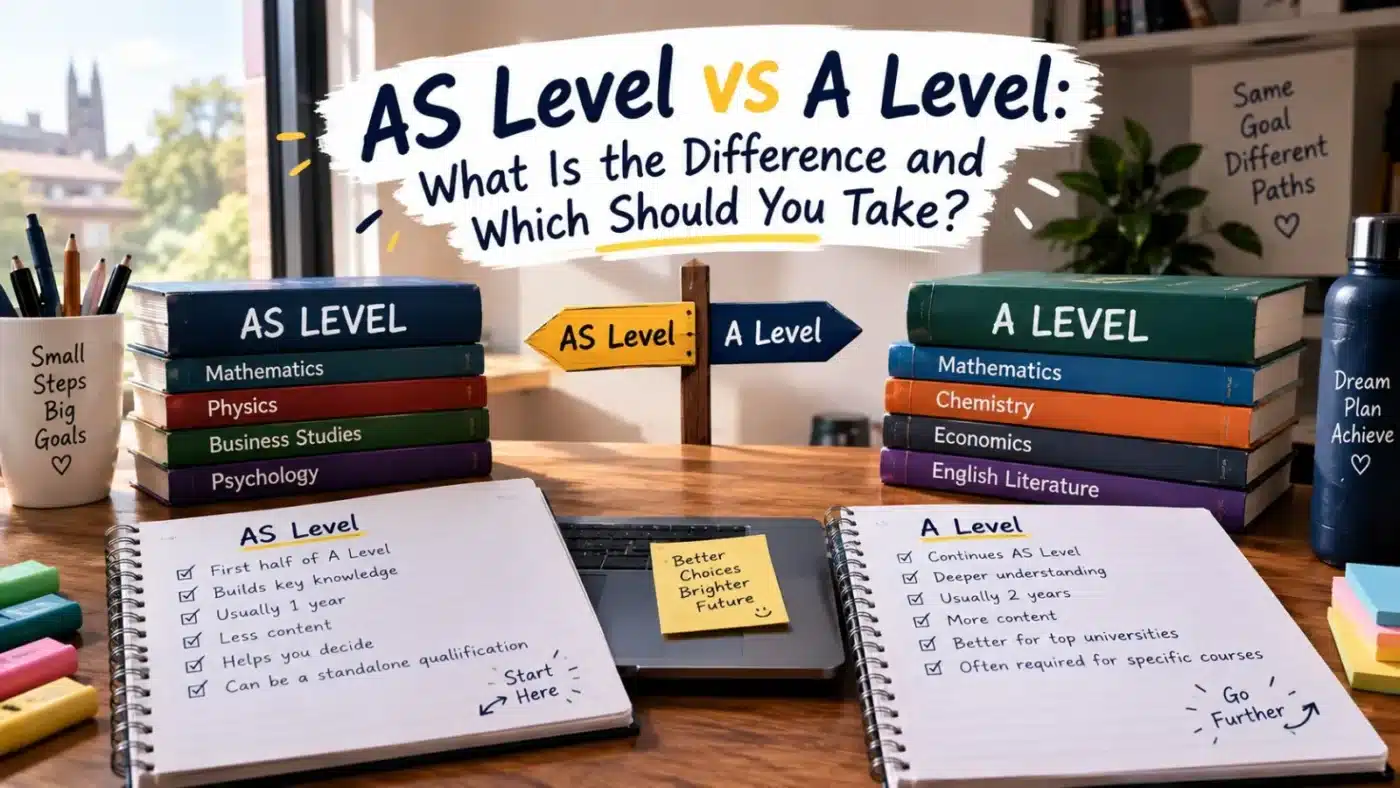
Quick Answer: AS Level is a standalone one-year qualification worth half an A Level, while A Level is a two-year qualification assessed entirely at the end of Year 13. Most students in 2026 take full A Levels rather than AS Levels, as AS results no longer count toward final A Level grades and carry limited weight in UCAS applications. If you have heard both terms thrown around in school and nobody has properly explained the difference, you are not alone. AS Level and A Level sound like they should be part of the same thing, and historically they were. But a series of qualification reforms changed the relationship between them significantly, and the advice students receive about whether to take AS Levels varies so much between schools that many families genuinely do not know what applies to their situation. This guide explains clearly what each qualification is, how they differ, whether AS Levels still matter for university applications, and how to decide which path makes sense for your child. What Is an AS Level? AS Level Explained An AS Level (Advanced Subsidiary Level) is a standalone qualification that covers the first year of A Level content. It is assessed at the end of Year 12 through examinations, and results are awarded on the same A to E grading scale used for A Levels. Before 2015, AS Levels were the first half of a full A Level, students took AS exams at the end of Year 12, and those results contributed 50% of the final A Level grade. Since qualification reforms took effect from 2017 onward, this is no longer the case. AS Levels are now entirely separate from A Levels, and AS results do not count toward A Level grades in any way. An AS Level is roughly equivalent to half an A Level in terms of content and assessment, but it is a complete qualification in its own right, not a stepping stone to a full A Level. AS Level Meaning: What the Qualification Actually Represents In 2026, an AS Level represents: One year of study in a subject at advanced level External examination at the end of Year 12 A standalone qualification graded A to E Approximately 40% of the content of a full A Level (the content covered in Year 12 of the full A Level course) It does not represent the first half of an A Level grade, and it does not automatically progress into a full A Level, though students can continue to A Level in the same subject if their school offers it. What Is the Difference Between AS Level and A Level? AS Level vs A Level: Side by Side Comparison Feature AS Level A Level Duration 1 year (Year 12) 2 years (Years 12 and 13) Assessment Exams at end of Year 12 All exams at end of Year 13 Grading scale A to E A* to E Contributes to A Level grade No, separate qualification Yes, this is the A Level UCAS points Yes, lower than A Level Yes, full tariff points University entry requirement Rarely accepted as substitute Standard requirement Availability Offered by some schools Universal The most important practical difference is that A Level exams are sat entirely at the end of Year 13, covering two full years of content. AS Level exams are sat at the end of Year 12, covering only Year 12 content. A student who takes an AS Level and then continues to A Level in the same subject will sit two separate sets of exams, the AS at the end of Year 12, and the full A Level at the end of Year 13, but neither result affects the other. A Level vs AS Level UK: How the Reform Changed Things Before the Ofqual reforms introduced between 2015 and 2017, the AS Level was formally the first half of an A Level. Students typically took four subjects to AS Level in Year 12, dropped one, and continued three subjects to full A Level in Year 13. The AS result contributed 40 to 50% of the final A Level grade depending on the subject. Since the reform, A Levels are linear, assessed entirely at the end of the two-year course with no contribution from Year 12 performance. The AS Level became a separate qualification that happens to cover similar Year 12 content but carries no weight in the A Level grade. This change fundamentally altered how schools approach Year 12. Most schools in 2026 no longer enter students for AS Level examinations as a matter of course, the additional exam burden in Year 12 without any grade benefit to the A Level has made AS Levels largely redundant in many school settings. Do AS Levels Count for UCAS Points? Yes, AS Levels do generate UCAS tariff points, but significantly fewer than full A Levels. AS Level UCAS Points: What They Are Worth AS Level Grade UCAS Points A 20 B 16 C 12 D 8 E 4 For comparison, a full A Level grade A* generates 56 UCAS points, and a grade A generates 48. An AS Level grade A generates 20, less than half the points of a full A Level grade A. Do AS Levels Count Toward University Applications? This depends entirely on the university and the course. The honest answer in 2026 is: for most competitive university applications, AS Level results carry limited weight and are rarely a decisive factor. Most universities set their entry requirements in terms of full A Level grades. An AS Level result may provide some contextual information, it can show how a student performed in a subject early in their sixth form career, but it does not substitute for a full A Level in the same subject and is not a requirement for most degree programmes. The exception is a small number of universities and programmes that still list AS Levels in their admissions criteria or that use AS results as part of contextual consideration for […]

May
There is a question that comes up in almost every international school parent group at some point, usually from a family who is new to the system or choosing between schools. Does it matter which exam board my child sits? Is Cambridge better than Edexcel? And what is the actual difference between them? Most people asking this question get one of two responses. Either a confident “Cambridge is more respected” from someone who sat it themselves twenty years ago, or a vague “they are basically the same” from someone who has not looked into it properly. Neither answer is quite right. The truth is more specific and more useful than either. Cambridge and Edexcel IGCSE are both legitimate, well-recognised qualifications at the same academic level, but they assess differently, suit different types of learners, and are more or less appropriate depending on what a student plans to do next. Understanding those differences properly is what this guide is for. Choosing between Cambridge and Edexcel IGCSE? Get expert guidance to find the right fit for your child! GET A FREE TRIAL CLASS NOW What Is the Difference Between Cambridge and Edexcel IGCSE? Before comparing the two boards, it helps to understand what each one actually is and where it comes from. Cambridge IGCSE is developed by Cambridge Assessment International Education, a department of the University of Cambridge. It is the most widely taken international qualification at secondary level globally, available in over 160 countries and offered at thousands of international and independent schools worldwide. Cambridge IGCSE grades run on an A* to G lettered scale. Pearson Edexcel IGCSE is developed by Pearson, one of the largest education companies in the world. Edexcel is the dominant exam board in the UK for standard GCSEs, and its International GCSE was developed to bring that domestic experience to an international school setting. Edexcel IGCSE uses the 9 to 1 numerical grading scale, the same as the standard GCSE. Both are externally examined, internationally recognised, and accepted by universities as equivalent to each other and to the standard GCSE. The differences between them are in paper structure, assessment style, grading scale, and which school communities tend to use each one. CIE vs Edexcel IGCSE, The Core Differences Explained This is where most comparison guides go vague. Here is a clear, honest breakdown of how the two boards actually differ. Grading Scale: Cambridge A* to G vs Edexcel 9 to 1 The most immediately visible difference between the two boards is how grades are expressed. Cambridge IGCSE uses the traditional A* to G lettered scale. A* is the highest grade, followed by A, B, C, D, E, F, and G, with U for ungraded. This is the same scale that GCSEs used before the UK Government moved to the numerical system in 2017. Edexcel International GCSE uses the 9 to 1 numerical scale. 9 is the highest grade, broadly equivalent to an A*, and 4 is broadly equivalent to a C. This alignment makes Edexcel IGCSE results more immediately comparable to standard GCSE results for families and institutions familiar with the domestic UK system. For most universities and sixth forms, the conversion between the two scales is well understood and does not disadvantage students on either board. But for families with children in mixed-board situations, or who are moving between international and domestic school systems, the Edexcel numerical scale can simplify grade comparisons. Paper Structure: How Cambridge CAIE IGCSE and Pearson Edexcel IGCSE Differ Paper structure varies meaningfully between the two boards, and this is where the practical impact on students is most significant. Cambridge IGCSE tends to use a tiered entry system in some subjects, Core and Extended, where the tier a student is entered for determines which grade range is available to them. In Mathematics, for example, Core entry limits grades to C at best, while Extended entry opens the full A* to G range. This tiering means schools and students need to make active decisions about which level of entry is appropriate. Edexcel International GCSE generally uses a single-tier entry system across most subjects, meaning all students sit the same papers and the full grade range is available to everyone. This removes the tiering decision but means papers need to accommodate a wide range of ability within a single set of questions. In terms of question style, Cambridge papers tend toward more open-ended questions that require students to determine their own method and approach. Edexcel papers often break multi-step questions into more structured sub-parts, guiding students through the method more explicitly. Neither approach is harder in absolute terms, but they suit different revision habits and different types of learners. Assessment Components: IGCSE Exam Boards and Coursework Both boards have moved toward more examination-based assessment in recent years, reducing the coursework component in many subjects. However, some subjects on both boards still include coursework, oral assessment, or practical components alongside written papers. The specific components vary by subject rather than by board overall. Families should check the assessment structure for each specific subject their child is taking, not assume that one board is more or less coursework-heavy across the board. Which IGCSE Board Is Better, Cambridge or Edexcel? This is the question everyone is really asking, and the honest answer is: neither is universally better. The right board depends on the student, the school, and what comes next. When Cambridge IGCSE Is the Better Choice Cambridge IGCSE tends to be the stronger choice in these situations: The student is at an international school with a strong Cambridge tradition. Teachers trained in Cambridge materials, past papers built around Cambridge specifications, and a school community familiar with Cambridge expectations all create an environment where Cambridge IGCSE students are well supported. The student plans to continue with Cambridge A-Levels. The Cambridge pathway, IGCSE into A-Level, is a well-established progression, and students who have learned to navigate Cambridge question styles and mark schemes are better prepared for what A-Level Cambridge papers demand. The student will apply […]

Apr
Every parent hits this moment eventually. You are sitting at a school information evening, or scrolling through admission requirements late at night, and someone mentions “IGCSE” and “GCSE” in the same breath like they are interchangeable. But something tells you they are not quite the same thing, and nobody is explaining the actual difference clearly. Here is that explanation. Written for parents who want a straight answer, not an education policy document. What Is the Difference Between IGCSE and GCSE? Both qualifications are designed for students aged around 14 to 16. Both are externally examined. Both are widely accepted by schools and universities. But they come from different worlds. The GCSE is the standard qualification in mainstream state schools. It has been the backbone of secondary education for decades, and most families in the state system will encounter it as the default, not a choice. The Cambridge IGCSE was built specifically for students studying outside that system, in international schools, independent schools, and British curriculum schools around the world. The “International” in the name is not just branding. The syllabus, the exam questions, and the assessment approach were all designed with a global student body in mind, not one particular national context. There is also the Edexcel International GCSE, which is less common but worth knowing about. Edexcel uses a 9 to 1 numerical grading scale, the same as the standard GCSE, while Cambridge uses A* to G. Different scale, same level. For most families, the choice between the two is not actually a choice at all. It comes down to which school your child attends and what that school offers. IGCSE Difficulty, Is One Actually Harder Than the Other? This is what parents really want to know, and the truthful answer is more nuanced than most people expect. Neither qualification is consistently harder than the other across the board. What differs is the type of challenge, not the academic level. In Maths, the Cambridge IGCSE tends to cover a wider range of topics than the standard GCSE, and the Additional Mathematics paper goes significantly further, into territory that overlaps with early A-Level work. Whether working with an IGCSE Maths tutor or a GCSE Maths tutor, students who cover Additional Maths or extension topics arrive at A-Level noticeably better prepared than those who did not. In English, the assessment style is where you notice the real difference. GCSE English leans toward creative writing and reading comprehension tasks set in a familiar cultural context. Cambridge IGCSE English as a First Language focuses more on directed writing, summary skills, and structured composition, a slightly different set of demands, not necessarily harder ones. In the Sciences, content coverage is broadly similar. The bigger difference is that Cambridge IGCSE still includes a practical assessment component in most science subjects, while the GCSE has moved almost entirely to written papers. Some students find the practical element more manageable. Others find it adds pressure. The bottom line: if your child is a strong exam-day performer, either qualification suits them. If they tend to do better with a mix of coursework and exams, the Cambridge IGCSE structure generally works more in their favour. IGCSE Recognition, Do Universities and Sixth Forms Actually Care? Short answer: no, not in the way you might worry about. Universities treat IGCSE and GCSE results as equivalent. An A* in Cambridge IGCSE Maths carries the same weight as a 9 in GCSE Maths in the eyes of admissions teams. The grade is what matters, not which version of the qualification produced it. Where it is worth paying attention is in grade conversion. Because Cambridge IGCSE uses letters and GCSE uses numbers, some institutions publish conversion guidance. Broadly: A* equals 9, A sits around 7 to 8, B maps to around 6, C to 4 or 5. This rarely causes real problems, but it is useful context if your child is applying somewhere that lists requirements in the numerical scale. Sixth forms and colleges that regularly admit international school students, which is most selective ones, are completely familiar with both systems. It is not something that needs to be explained or justified on an application. Cambridge vs Edexcel, Does the Board Matter? More than most people realise, yes. Cambridge and Edexcel assess the same subjects in meaningfully different ways. The paper structures differ. The mark scheme language differs. What examiners reward in a written answer differs. A student revising from Cambridge past papers is not automatically well-prepared for an Edexcel exam in the same subject, even if the underlying content is similar. This is something Tutor Globe takes seriously. The platform lets you filter tutors by exam board, not just subject, which matters because a tutor who knows Cambridge IGCSE Chemistry inside out may not be the right fit for a student sitting the Edexcel version of the same course. Getting that match right is one of the small things that makes a real difference to results. IGCSE Subjects, What Should Students Actually Choose? Subject selection at this stage is one of the most consequential decisions a 14-year-old will make, usually with very limited information about what they actually want from the next ten years of their life. A few things are worth keeping in mind regardless of which qualification your child is sitting: English and Maths are non-negotiable in terms of the attention they deserve. Almost every pathway beyond this stage, A-Level programmes, university applications, competitive sixth forms, expects strong performance in both. If revision time is limited, these two subjects should get the largest share of it. Beyond the core, the best approach is to keep options open. Dropping sciences entirely at this stage, or avoiding humanities completely, closes doors before a student is old enough to be certain about their direction. A broad mix now means more genuine choice later. For students who think they might want to continue with Maths, Physics, Economics, or Computer Science at A-Level, Cambridge IGCSE Additional Mathematics is worth serious consideration. It is more demanding […]