
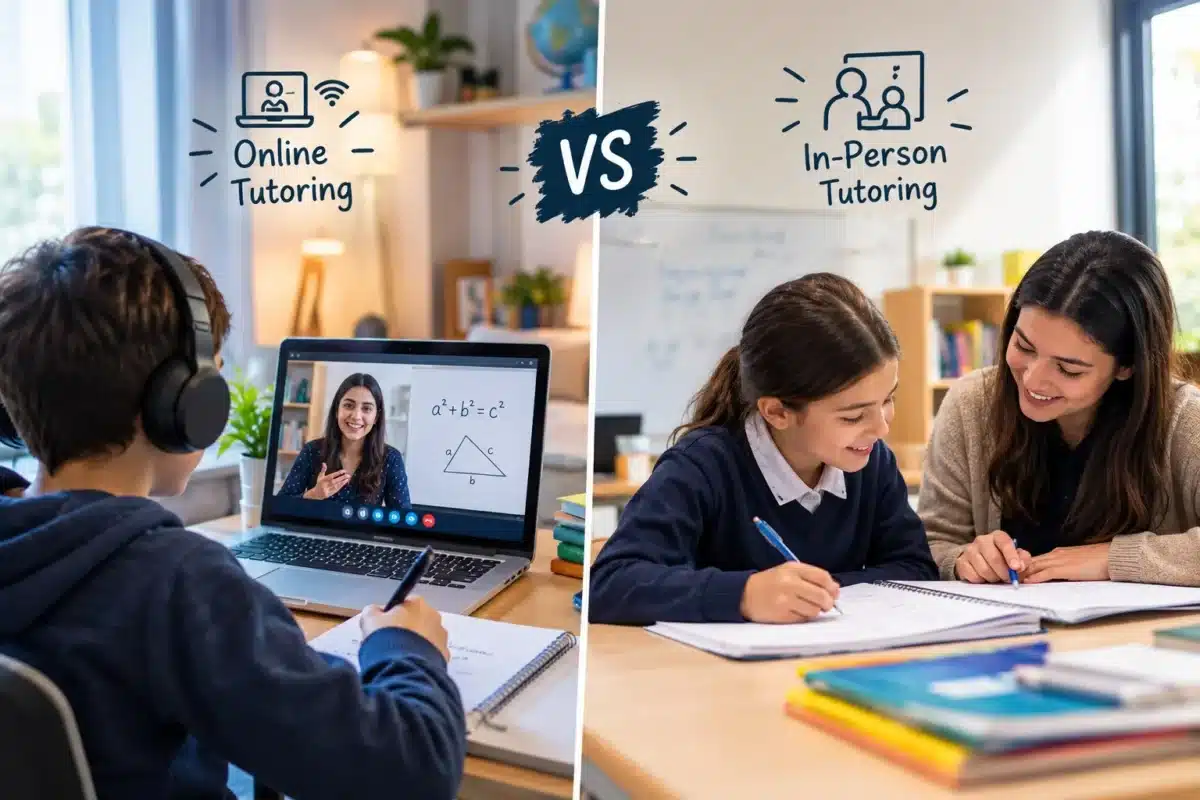
Quick Answer: Neither online tutoring nor in-person tutoring is universally better, the right choice depends on your child’s age, learning style, subject, and practical circumstances. Online tutoring offers greater flexibility and access to specialist tutors worldwide. In-person tutoring suits younger children or those who struggle to focus on screen. Most families find one format works significantly better than the other once they try both.
There was a time when this question barely existed. If your child needed a tutor, you found someone local, they came to the house or you drove to their centre, and that was tutoring.
That world has changed substantially. Online tutoring has grown from a pandemic-era workaround into a genuinely preferred option for millions of families, not because in-person tutoring stopped working, but because the quality and convenience of virtual tutoring has improved to the point where the comparison is real and worth making honestly.
This guide does that. Not a promotional case for one format over the other, but an honest breakdown of what each actually offers, where each falls short, and how to decide which works best for your specific child and situation.
What Is the Difference Between Online Tutoring and In-Person Tutoring?
Online tutoring takes place remotely, typically over a video call platform such as Zoom, Google Meet, or a platform-specific tool built into a tutoring service. The tutor and student connect through screens, sharing work via digital whiteboards, document sharing, or screen sharing. Sessions are scheduled flexibly and require only a device and internet connection.
In-person tutoring happens face to face, either at the student’s home, the tutor’s home or office, or a tutoring centre. The tutor and student are physically present in the same space, working on paper or a shared physical surface.
Both formats can be delivered by individual private tutors or through tutoring organisations. Both can be scheduled weekly, intensively, or on-demand. The format affects the logistics and the learning environment, it does not determine the quality of the teaching, which depends on the tutor regardless of where the session takes place.
Benefits of Online Tutoring: What It Does Better
Access to Specialist Tutors Without Geographic Limits
The most significant practical advantage of online tutoring is that geography is irrelevant. A family in a rural area with no local tutors experienced in A Level Further Mathematics can access a specialist with ten years of experience teaching that exact subject. A student preparing for a highly specific exam, IB, IGCSE, Oxbridge entrance, can find a tutor who has worked with that specific qualification repeatedly, regardless of where either party lives.
This matters most for niche subjects, specific exam boards, and students at the extremes of the ability range, either significantly behind and needing specialist SEN experience, or significantly ahead and needing a tutor who can stretch rather than just support.
Flexibility and Scheduling Convenience
Online tutoring sessions can be scheduled more flexibly than in-person sessions because there is no travel time involved for either party. A tutor who lives an hour away is not available for a 45-minute evening session in practice. The same tutor working online can schedule that session without any practical barrier.
This flexibility makes consistent weekly sessions more achievable for busy families, which matters because consistency is what produces learning improvement over time. A tutoring arrangement that works logistically is more likely to continue and compound than one that requires significant effort from both sides.
A Wider Range of Available Tutors at Different Price Points
Because online tutoring opens the market nationally and internationally, there is more competition and more variety in what is available at different price points. Families who find local in-person tutors too expensive often find equivalent or better quality tutoring available online at a lower rate, because the tutor pool is larger and the supply of tutors in any given subject is higher.
Tutor Globe, for example, provides access to verified subject specialists across a wide range of A Level, IGCSE, and GCSE subjects, with board-specific matching that would simply not be achievable through a local search.
Recorded Sessions and Digital Resources
Many online tutoring platforms allow sessions to be recorded, giving students the ability to review explanations they did not fully absorb in real time. Digital whiteboards save automatically, and resources shared during sessions are easily archived. These features have no straightforward equivalent in in-person tutoring, where the whiteboard is wiped and the session exists only in the student’s memory and notes.
Advantages of Private In-Person Tutoring: Where It Still Wins
Physical Presence for Younger or Less Focused Students
For children under approximately ten years old, in-person tutoring is generally more effective. Younger children find it harder to maintain focus through a screen, are more easily distracted by the home environment when a tutor is not physically present, and benefit from the social and behavioural cues that physical co-presence provides, a tutor who can gently redirect attention, notice when a child is confused without saying so, and maintain engagement through proximity.
This advantage diminishes as students get older. Most secondary school students adapt to online tutoring within a few sessions and do not find the format a barrier to learning.
Hands-On Subjects and Practical Work
Some subjects involve physical materials, art, music, some science practical skills, where in-person tutoring provides opportunities that online sessions cannot fully replicate. A music tutor who can physically demonstrate technique on a shared instrument, or an art tutor who can look over a student’s shoulder at their actual work, provides a different type of feedback than is achievable remotely.
For purely academic subjects, Mathematics, Sciences, Humanities, Languages, this distinction largely disappears. A digital whiteboard and screen sharing provide a fully functional working environment for the vast majority of academic tutoring needs.
Students Who Struggle With Technology or Internet Connectivity
Online tutoring requires a reliable internet connection, a device with a functioning camera and microphone, and a student who is comfortable navigating a digital environment. Where these conditions are not met, due to unreliable connectivity, an unsuitable device, or a student who finds the technical setup a barrier, in-person tutoring removes those friction points entirely.
This is a practical consideration rather than a fundamental limitation of online tutoring, but it is worth accounting for honestly before committing to a format.
The Social and Motivational Value of Physical Presence
Some students, particularly those who are already disengaged or whose motivation is a significant factor in their underperformance, respond better to the accountability of someone physically present in the room. A tutor who arrives at the house creates a session that is harder to cancel mentally than one that involves opening a laptop. For students whose primary barrier is motivation rather than understanding, that physical presence can matter.
Online Tutoring vs In-Person: Side by Side Comparison
Factor | Online Tutoring | In-Person Tutoring |
Access to specialists | Global, any subject, any board | Limited to local availability |
Scheduling flexibility | High, no travel required | Lower, travel time limits options |
Cost | Often lower, larger tutor pool | Often higher, travel time reflected in rates |
Suitability for young children | Lower, screen focus harder under age 10 | Higher, physical presence supports focus |
Session recording | Often available | Not typically available |
Technology dependency | Yes, device and internet required | No |
Tutor specialisation | High, board and subject specific matching | Variable, depends on local availability |
Practical subjects | Limited for hands-on work | Better for physical demonstration |
Consistency | Higher, logistics are easier | Lower, travel creates cancellation risk |
Environmental control | Variable, home distractions possible | Variable, depends on venue |
Virtual Tutoring vs Home Tutoring: Is There a Difference?
The terms are sometimes used interchangeably, but there is a meaningful distinction worth clarifying.
Home tutoring traditionally refers to a tutor who comes to the student’s home, a specific form of in-person tutoring where the learning environment is the student’s own house rather than a tutoring centre or the tutor’s premises.
Virtual tutoring refers to online tutoring regardless of where each party is physically locate, a tutor in one city working with a student in another, both in their respective homes, over a video platform.
Remote tutoring comparison often conflates these terms, but families considering options should be clear about which they are evaluating. Home tutoring has specific advantages, familiar environment for the student, no travel required from the student’s side, but it shares the geographic limitation of all in-person tutoring, which online formats do not.
One to One Tutoring: Online vs In-Person for Different Age Groups
Primary School Students (Ages 5–11)
For primary school students, in-person tutoring is generally the more effective format. The ability to maintain focus through a screen for 45 to 60 minutes is a skill that most children develop gradually through upper primary school, and younger children often find in-person sessions more engaging and productive.
Where in-person tutoring is not available or practical, due to geography, cost, or convenience — online tutoring can work for primary students with a parent present in the early sessions to help manage the technology and maintain focus. Sessions of 30 to 45 minutes rather than a full hour are more manageable for younger learners online.
Secondary School Students (Ages 11–16)
Most secondary school students adapt readily to online tutoring. By early secondary school, students are typically comfortable with digital platforms from school use, have longer attention spans, and can manage the self-direction that online sessions require.
For GCSE students in particular, the access to specialist board-specific tutors that online tutoring provides is a significant advantage, particularly for students targeting specific grade thresholds where the tutor’s knowledge of the exact mark scheme and paper format matters considerably.
Sixth Form and A Level Students (Ages 16–18)
Online tutoring is often the preferred format for A Level students. The subject specialisation available online, board-specific, topic-specific, qualification-specific, is genuinely difficult to match locally for many A Level subjects. A Level Further Mathematics, specific optional topics in A Level Chemistry, or Oxbridge admissions preparation are all areas where the national pool of online tutors substantially exceeds what local availability can typically provide.
A Level students are also the age group most naturally suited to online learning environments, having developed the self-direction and screen focus that effective online sessions require.
Online Learning Benefits: What the Evidence Shows
Research on the effectiveness of online versus in-person tutoring suggests that for most students in most subjects, learning outcomes are comparable when:
- The tutor is qualified and experienced regardless of format
- Sessions are consistent and regular
- The student has adequate technology and internet access
- The learning environment, at home online or at home/centre in-person, is reasonably free from distraction
The format itself is not the primary determinant of outcomes. The quality of the tutor, the regularity of sessions, and the match between the tutor’s expertise and the student’s specific needs matter significantly more than whether the session happens on screen or in person.
What online tutoring does affect meaningfully is access, to more tutors, more specialist knowledge, more scheduling flexibility, and often lower cost. These factors do not determine whether tutoring works, but they do determine whether the best available match between student and tutor is achievable.
Home Tutor vs Online Tutor: Which Costs More?
How Tutoring Costs Compare Between Formats
Online tutoring is generally less expensive than equivalent in-person tutoring for two reasons. First, tutors who work online do not need to factor travel time and cost into their rates, which typically reduces the price per hour. Second, the online market is larger and more competitive, the supply of tutors available for any given subject is higher, which keeps rates more competitive.
The difference varies significantly by subject, level, and location. In cities with high local demand for tutors, where in-person tutors can fill their schedule easily without adjusting rates, the price difference may be smaller. In areas where local specialist tutors are scarce, online tutoring may be the only affordable option for specialist subjects.
A rough indicative comparison for secondary school tutoring:
Level | Typical In-Person Rate | Typical Online Rate |
GCSE subjects | £40–£70 per hour | £30–£55 per hour |
A Level subjects | £50–£90 per hour | £40–£75 per hour |
Specialist/niche subjects | £70–£120+ per hour | £50–£90 per hour |
Rates vary significantly by tutor experience, subject, and location. These are indicative ranges rather than fixed prices.
How to Choose Between Online and In-Person Tutoring
Questions to Ask Before Deciding
Before committing to a format, these questions help identify which is likely to work better for a specific child:
- How old is the child? Under ten, in-person is generally preferable. Secondary school and above, either format typically works.
- What subject does the tutoring cover? Academic subjects work fully online. Practical or performance subjects may benefit from in-person.
- Is a specialist tutor available locally? If the subject is niche or the exam board is specific, online almost always provides better matching.
- What is the technology situation at home? Reliable internet and a suitable device are necessary for online tutoring to work smoothly.
- Does the child respond to physical presence or does it not matter? For some students, the accountability of a tutor in the room is motivationally significant.
- What are the scheduling constraints? If consistent weekly sessions are difficult to maintain, online’s flexibility may be the deciding factor.
Key Takeaways: Online Tutoring vs In-Person
- Neither format is universally superior, the right choice depends on the child’s age, subject, local tutor availability, and practical circumstances
- Online tutoring provides access to specialist tutors that geography would otherwise prevent, which matters most for niche subjects and specific exam boards
- In-person tutoring generally works better for younger children and subjects with significant practical or hands-on components
- Online tutoring is typically less expensive than equivalent in-person tutoring due to larger supply and no travel cost
- Learning outcomes are comparable between formats when the tutor is qualified and sessions are consistent, the tutor quality matters more than the format
- Most secondary school students adapt readily to online tutoring within a few sessions
- The scheduling flexibility of online tutoring makes consistent sessions more achievable for busy families, which compounds learning benefits over time
How Tutor Globe Connects Students With the Right Tutor in Either Format
Whether online or in-person tutoring is the right fit, finding the right tutor is what matters most, and that means matching on subject, exam board, level, and teaching style, not just on format or proximity.
Tutor Globe provides access to verified subject specialists across GCSE, IGCSE, A Level, and beyond, with filtering specific enough to find a tutor who knows the exact papers, mark schemes, and qualification requirements being sat. For families who have determined that online tutoring is the right format, the range of specialists available through Tutor Globe substantially exceeds what local search could typically provide.
The platform also makes it straightforward to trial a tutor before committing, which is the most reliable way to find out whether a particular tutor’s approach works for a particular student, regardless of format.
A trial session is the most practical starting point. The first session usually makes it clear whether the match is right, whether the format is working, and what a realistic plan toward the target grade looks like.
Frequently Asked Questions: Online vs In-Person Tutoring
Is online tutoring as effective as in-person tutoring?
For most students in most subjects, yes. Research consistently shows that learning outcomes are comparable between formats when the tutor is qualified and sessions are regular. The format affects logistics and access more than it affects whether tutoring works, the tutor quality and session consistency matter significantly more.
What age is online tutoring suitable for?
Most children aged ten and above manage online tutoring effectively. Younger children generally benefit from in-person tutoring due to shorter attention spans and the difficulty of maintaining screen focus. For children under ten, in-person tutoring is usually preferable unless geography or circumstances make it impractical.
Is online tutoring cheaper than in-person?
Generally yes. Online tutors do not need to account for travel time in their rates, and the larger online tutor pool creates more competitive pricing. The difference varies by subject, level, and location, but families comparing equivalent quality tutoring will typically find online options somewhat less expensive.
What equipment does a child need for online tutoring?
A laptop, tablet, or desktop computer with a working camera and microphone, and a reliable internet connection. For subjects involving written working, Mathematics, Sciences, a drawing tablet or stylus is useful but not essential. Many tutors use shared digital whiteboards that work through a web browser without additional software.
Can online tutoring work for exam preparation?
Very effectively, particularly because online tutoring allows access to tutors who specialise in specific exam boards and qualifications. For GCSE, IGCSE, and A Level exam preparation, board-specific expertise is often more important than format, and online tutoring provides access to a much wider pool of board-specific specialists than local tutoring typically can.
What is the difference between virtual tutoring and home tutoring?
Home tutoring refers specifically to a tutor who visits the student’s home, a form of in-person tutoring. Virtual tutoring refers to online tutoring over video. The terms are sometimes used interchangeably but describe different formats. Home tutoring provides the familiarity of the student’s own environment with physical presence; virtual tutoring provides scheduling flexibility and access to a wider tutor pool.
How do I know if my child needs online or in-person tutoring?
The clearest indicators for in-person, child is under ten, subject has significant practical components, technology or internet access is unreliable, or motivation is a significant barrier that physical accountability would help. The clearest indicators for online: subject requires a specialist not available locally, scheduling flexibility is important, cost is a factor, or the child is secondary school age and comfortable with digital tools.
Final Thoughts
The online vs in-person debate is worth having, but it is worth keeping in perspective. The format determines where the session happens and how convenient it is to arrange. It does not determine whether the tutor knows the subject, whether the teaching approach suits the student, or whether the sessions are regular enough to make a difference.
Those factors, tutor quality, subject match, board-specific knowledge, session consistency, are what produce learning improvement. And they are available in both formats, for students of most ages and most subjects.
The best advice is simple: identify which format is more practical for your specific situation, find the most qualified specialist available in that format for the exact subject and exam board your child needs, try a session, and trust what you observe.
Tutor Globe makes that process straightforward, with verified specialists, board-specific matching, and a trial session process that takes the commitment pressure off the first step.
