
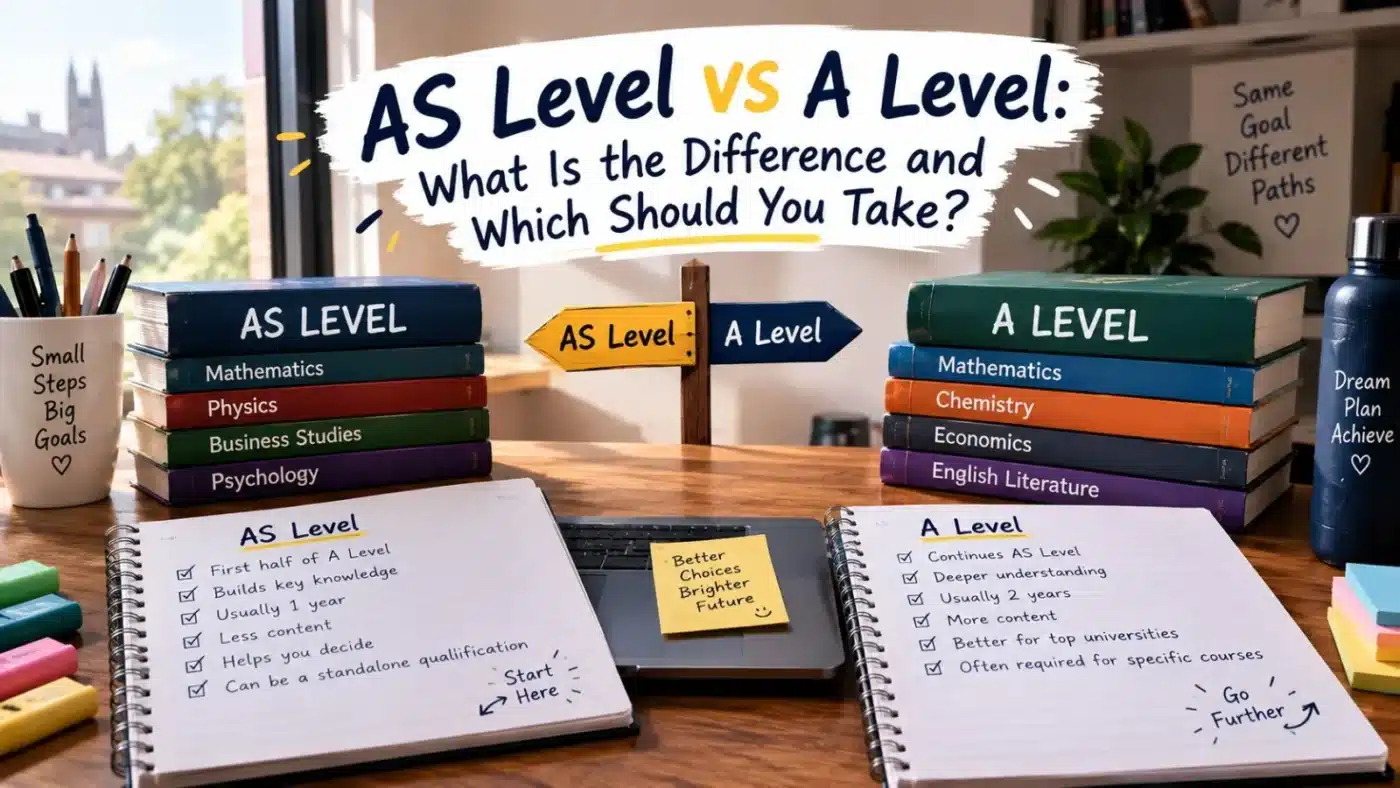
Quick Answer: AS Level is a standalone one-year qualification worth half an A Level, while A Level is a two-year qualification assessed entirely at the end of Year 13. Most students in 2026 take full A Levels rather than AS Levels, as AS results no longer count toward final A Level grades and carry limited weight in UCAS applications.
If you have heard both terms thrown around in school and nobody has properly explained the difference, you are not alone.
AS Level and A Level sound like they should be part of the same thing, and historically they were. But a series of qualification reforms changed the relationship between them significantly, and the advice students receive about whether to take AS Levels varies so much between schools that many families genuinely do not know what applies to their situation.
This guide explains clearly what each qualification is, how they differ, whether AS Levels still matter for university applications, and how to decide which path makes sense for your child.
What Is an AS Level? AS Level Explained
An AS Level (Advanced Subsidiary Level) is a standalone qualification that covers the first year of A Level content. It is assessed at the end of Year 12 through examinations, and results are awarded on the same A to E grading scale used for A Levels.
Before 2015, AS Levels were the first half of a full A Level, students took AS exams at the end of Year 12, and those results contributed 50% of the final A Level grade. Since qualification reforms took effect from 2017 onward, this is no longer the case. AS Levels are now entirely separate from A Levels, and AS results do not count toward A Level grades in any way.
An AS Level is roughly equivalent to half an A Level in terms of content and assessment, but it is a complete qualification in its own right, not a stepping stone to a full A Level.
AS Level Meaning: What the Qualification Actually Represents
In 2026, an AS Level represents:
- One year of study in a subject at advanced level
- External examination at the end of Year 12
- A standalone qualification graded A to E
- Approximately 40% of the content of a full A Level (the content covered in Year 12 of the full A Level course)
It does not represent the first half of an A Level grade, and it does not automatically progress into a full A Level, though students can continue to A Level in the same subject if their school offers it.
What Is the Difference Between AS Level and A Level?
AS Level vs A Level: Side by Side Comparison
Feature | AS Level | A Level |
Duration | 1 year (Year 12) | 2 years (Years 12 and 13) |
Assessment | Exams at end of Year 12 | All exams at end of Year 13 |
Grading scale | A to E | A* to E |
Contributes to A Level grade | No, separate qualification | Yes, this is the A Level |
UCAS points | Yes, lower than A Level | Yes, full tariff points |
University entry requirement | Rarely accepted as substitute | Standard requirement |
Availability | Offered by some schools | Universal |
The most important practical difference is that A Level exams are sat entirely at the end of Year 13, covering two full years of content. AS Level exams are sat at the end of Year 12, covering only Year 12 content. A student who takes an AS Level and then continues to A Level in the same subject will sit two separate sets of exams, the AS at the end of Year 12, and the full A Level at the end of Year 13, but neither result affects the other.
A Level vs AS Level UK: How the Reform Changed Things
Before the Ofqual reforms introduced between 2015 and 2017, the AS Level was formally the first half of an A Level. Students typically took four subjects to AS Level in Year 12, dropped one, and continued three subjects to full A Level in Year 13. The AS result contributed 40 to 50% of the final A Level grade depending on the subject.
Since the reform, A Levels are linear, assessed entirely at the end of the two-year course with no contribution from Year 12 performance. The AS Level became a separate qualification that happens to cover similar Year 12 content but carries no weight in the A Level grade.
This change fundamentally altered how schools approach Year 12. Most schools in 2026 no longer enter students for AS Level examinations as a matter of course, the additional exam burden in Year 12 without any grade benefit to the A Level has made AS Levels largely redundant in many school settings.
Do AS Levels Count for UCAS Points?
Yes, AS Levels do generate UCAS tariff points, but significantly fewer than full A Levels.
AS Level UCAS Points: What They Are Worth
AS Level Grade | UCAS Points |
A | 20 |
B | 16 |
C | 12 |
D | 8 |
E | 4 |
For comparison, a full A Level grade A* generates 56 UCAS points, and a grade A generates 48. An AS Level grade A generates 20, less than half the points of a full A Level grade A.
Do AS Levels Count Toward University Applications?
This depends entirely on the university and the course. The honest answer in 2026 is: for most competitive university applications, AS Level results carry limited weight and are rarely a decisive factor.
Most universities set their entry requirements in terms of full A Level grades. An AS Level result may provide some contextual information, it can show how a student performed in a subject early in their sixth form career, but it does not substitute for a full A Level in the same subject and is not a requirement for most degree programmes.
The exception is a small number of universities and programmes that still list AS Levels in their admissions criteria or that use AS results as part of contextual consideration for students whose predicted grades are close to the offer threshold. Students targeting specific universities should check those universities’ admissions pages directly rather than assuming a general rule applies.
AS Level Qualifications: Who Still Takes Them and Why
Which Students Take AS Levels in 2026?
Despite the qualification reform reducing their significance, AS Levels are still taken in several specific situations:
Students whose schools still enter for AS Levels a minority of schools continue to enter students for AS Level exams at the end of Year 12, either as a matter of policy or because specific departments find them useful for tracking student progress. Students in these schools take AS Levels as part of their normal sixth form programme.
Students taking four subjects who drop to three after Year 12 a student who starts four A Level courses in Year 12 and decides to drop one after Year 12 may take the AS Level in the dropped subject to have a qualification to show for that year of study, rather than leaving it entirely off their record.
Students who want a standalone qualification in a subject in some circumstances, a student might take an AS Level in a subject they are interested in but cannot commit to for two full years, a language, an art subject, or an additional science alongside their main A Level combination.
Independent school students following specific programmes some independent schools continue to use AS Levels as part of their educational philosophy, valuing the external benchmark they provide at the end of Year 12.
Should Students Take AS Levels Alongside Their A Levels?
For most students in 2026, the answer is: only if your school requires it or if there is a specific strategic reason.
The additional exam burden in Year 12, sitting AS Level examinations while also progressing through A Level content, carries a genuine workload cost. If those exams do not contribute to the A Level grade, the question is whether the benefit of having an AS qualification justifies that cost.
For students taking a fourth subject they plan to drop after Year 12, taking the AS Level in that subject makes sense, it converts a year of study into a recognised qualification rather than leaving it unrewarded. For students taking three A Levels with no intention of dropping one, the case for also sitting AS Level exams is much weaker.
AS Level Grades: How They Are Awarded
What Grades Do AS Levels Use?
AS Levels are graded on an A to E scale, without the A* grade that is available at full A Level. The absence of A* is one of the visible distinctions between AS and A Level results.
Grade boundaries for AS Levels are set by exam boards after each sitting, using the same comparable outcomes process that applies to A Levels, adjusting for paper difficulty so that grades represent consistent levels of performance rather than reflecting how hard a particular year’s paper happened to be.
Are AS Level Grades Harder or Easier to Achieve Than A Level Grades?
AS Level content covers Year 12 material only, which is less advanced than the full A Level content assessed at the end of Year 13. However, this does not straightforwardly make AS Levels easier, the student cohort sitting AS Levels has studied for one year rather than two, and the comparison between year-12-only performance and two-year-integrated performance is not simple.
What is clear is that an AS Level grade and an A Level grade in the same subject are different qualifications at different stages of study. Universities and employers understand this distinction and do not treat them as equivalent.
A Level vs AS Level: Which Should You Take?
How to Decide Between AS Level and A Level
The decision between AS Level and A Level is in most cases not a free choice, it is determined primarily by:
What your school offers. Most schools in 2026 offer full A Levels as the standard post-16 qualification and do not routinely enter students for AS Level exams. If your school does not enter students for AS Levels, the choice has already been made for you.
What your university direction requires. Full A Levels are the standard requirement for university entry. If your university direction requires three or four A Level grades, you need full A Levels, AS Levels do not substitute.
Whether you are taking a fourth subject. If you are starting four A Level courses and plan to continue only three to full A Level, taking the AS Level in the dropped subject is a sensible way to have something to show for that year of work.
Whether a specific programme values AS Levels. A small number of competitive programmes or scholarship processes still reference AS Level performance. If you are targeting one of these specifically, check their requirements directly.
For the vast majority of Year 11 students making sixth form choices in 2026, the practical answer is: take full A Levels in three subjects, work hard across both years, and aim for the strongest possible A Level grades. That combination is what almost every university and employer is looking for.
Common Mistakes Students Make About AS Levels
Understanding what goes wrong in decision-making about AS Levels helps students and parents avoid unnecessary confusion:
- Assuming AS Levels still contribute to A Level grades: they have not since the 2017 reform. Many parents who went through the previous system are unaware of this change.
- Thinking AS Levels are a backup if A Levels go wrong: AS Level and A Level exams are separate; sitting AS Levels does not provide a safety net for A Level results.
- Choosing AS Level as a less demanding alternative to A Level: universities do not accept AS Levels in place of A Levels for entry requirements, so this strategy rarely achieves what students hope.
- Not checking whether their school enters for AS Levels: the significant variation between schools means students should ask directly rather than assuming either way.
- Overestimating how much AS results affect university offers: for most applications to most universities, AS results play a minimal role in admissions decisions.
Key Takeaways: AS Level vs A Level
- AS Level is a one-year standalone qualification; A Level is a two-year qualification assessed entirely at the end of Year 13
- AS Level results have not contributed to A Level grades since the 2017 qualification reform
- AS Levels generate UCAS points but significantly fewer than full A Levels, an AS grade A earns 20 points versus 48 for a full A Level grade A
- Most competitive universities set entry requirements in full A Level grades, AS Levels rarely substitute
- Most schools in 2026 do not routinely enter students for AS Level exams
- Taking an AS Level in a dropped fourth subject is the most common strategic reason for sitting AS Level exams
- For most Year 11 students, the decision is effectively made by the school, three full A Levels remain the standard post-16 pathway
How Tutor Globe Supports Year 12 and Year 13 Students
Whether a student is taking AS Levels, full A Levels, or navigating the decision between the two, the quality of subject support in Year 12 makes a significant difference to Year 13 outcomes.
Tutor Globe has A Level specialists across all major subjects, Mathematics, Sciences, Humanities, Economics, Psychology, and more, who know the specific boards and specifications being sat and provide targeted, board-specific support rather than generic subject tutoring.
For students who are finding A Level content more demanding than expected in Year 12, which is common given the significant jump from GCSE, getting specialist support early prevents the gaps from compounding into Year 13 content. For students targeting specific grades for competitive university applications, the right specialist focused on the right topics makes that preparation significantly more efficient.
A trial session with Tutor Globe is a practical, low-commitment starting point, it gives a clear picture of where a student stands and what targeted preparation toward their grade goal actually looks like.
Frequently Asked Questions: AS Level vs A Level
What is the difference between AS Level and A Level?
AS Level covers one year of study assessed at the end of Year 12. A Level covers two years assessed entirely at the end of Year 13. Since 2017, AS results do not contribute to A Level grades, they are entirely separate qualifications graded on different scales.
Do AS Levels still count for UCAS?
Yes, AS Levels generate UCAS tariff points, a grade A earns 20 points. However, most universities set entry requirements in full A Level grades, and AS results play a minimal role in most competitive admissions decisions in 2026.
Can you go to university with just AS Levels?
In most cases, no. University entry requirements are set in full A Level grades, and AS Levels do not substitute. A small number of programmes accept a mix of qualifications, but this is the exception rather than the rule. Students planning university entry should aim for full A Levels.
Is AS Level harder than A Level?
AS Level covers less content, Year 12 material only, compared to the full two-year A Level course. However, they are different qualifications at different stages of study rather than directly comparable in difficulty. A Level questions draw on deeper understanding developed across two years that AS Level questions do not require.
Should I take four subjects to AS Level and drop one?
This depends on your school’s approach and your specific situation. If your school enters students for AS Levels and you plan to take four subjects before dropping one after Year 12, taking the AS in the dropped subject gives you a qualification to show for that year. If your school does not enter for AS Levels, this consideration does not apply.
What is the A Level vs AS Level grading difference?
A Levels are graded A* to E. AS Levels are graded A to E the A* grade is not available at AS Level. Both use the same comparable outcomes process to set grade boundaries after each sitting.
Are AS Levels worth doing in 2026?
For most students, full A Levels are the more valuable qualification and the standard expectation for university entry. AS Levels have specific value in particular circumstances, as a standalone qualification in a dropped subject, or in schools that still use them systematically. Outside those circumstances, the additional exam burden of AS Levels rarely justifies the limited additional benefit in 2026.
Final Thoughts
The AS Level vs A Level question is genuinely simpler than the confusion around it suggests. For most students in 2026, the answer is: full A Levels in three subjects, studied well across both years, with the strongest possible grades at the end of Year 13.
AS Levels have specific value in specific situations, and if your situation is one of them, taking them makes sense. But for the majority of Year 11 students starting sixth form, three full A Levels remain the straightforward, universally understood pathway to university and beyond.
If your child is starting Year 12 and wants specialist support in their A Level subjects, whether to build strong Year 12 foundations or to maintain momentum through to Year 13 exams, Tutor Globe has subject specialists matched to the exact boards and specifications being studied. A trial session is the most practical starting point.
