
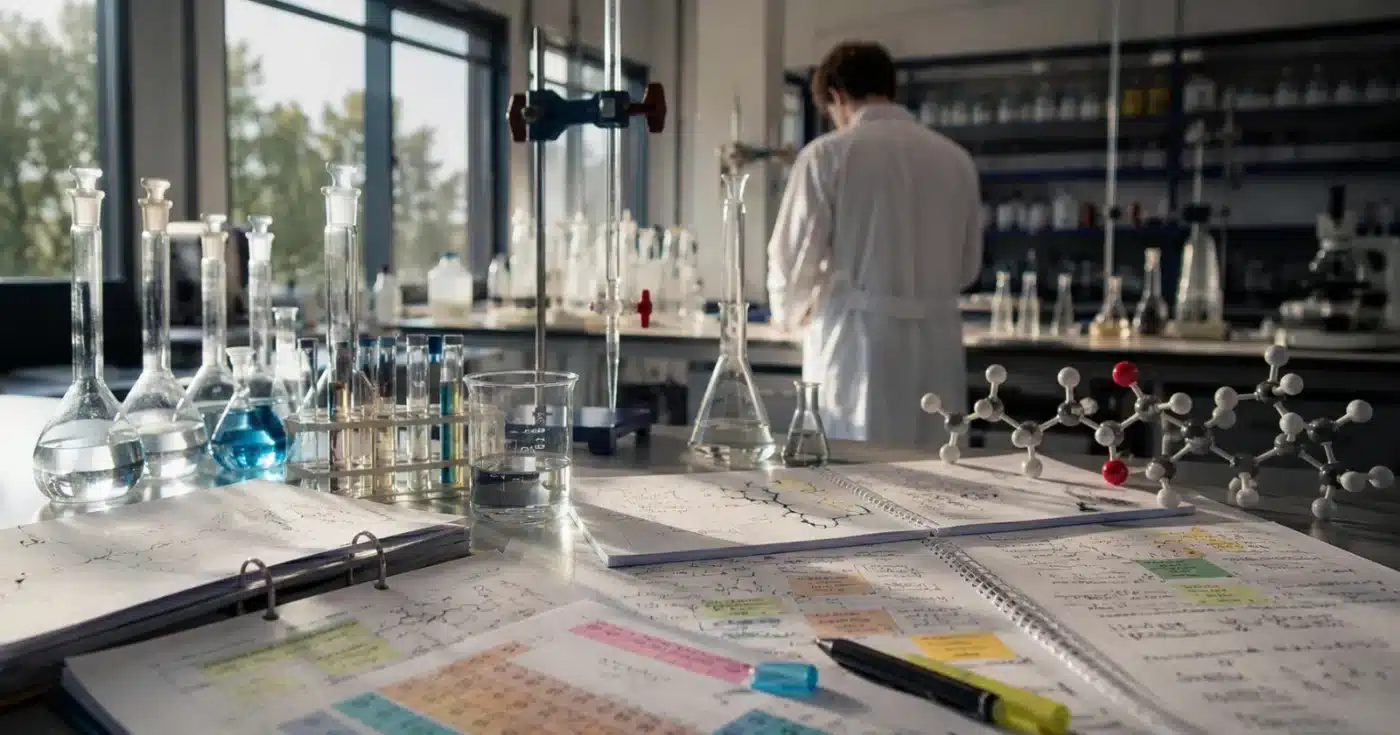
Chemistry has a way of humbling students who thought they were good at science. You can leave your GCSE with an A* in Chemistry, walk into Year 12 feeling confident, and then spend the first half term quietly wondering whether you accidentally enrolled in a different subject. The content is denser. The questions go deeper. The mark scheme expects a level of precision that most students have never had to produce before.
That experience is normal. It is also fixable. If you find the jump in difficulty overwhelming, working alongside a specialist A Level Chemistry tutor helps bridge the gap between GCSE foundations and A Level rigor.
The students who do best in A Level Chemistry are not the ones who find it naturally easy. They are the ones who figured out early that this subject rewards a very specific kind of preparation, and who built that preparation into their revision before the exam season rather than discovering what they needed to do when it was too late.
What A Level Chemistry Revision Actually Requires
Before getting into topics and techniques, it helps to understand why A Level Chemistry revision fails for so many students who are working genuinely hard.
The most common pattern: a student reads through notes, watches explanations, highlights content, feels reasonably prepared, and then opens a past paper and finds the questions are harder and more specific than anything their revision prepared them for.
This happens because A Level Chemistry tests three distinct types of thinking simultaneously, and most revision approaches only address one or two of them.
Factual recall: definitions, reagents, conditions, equations, mechanisms. The content that needs to be memorised precisely and retrieved accurately under exam pressure.
Conceptual understanding: why reactions happen, what drives equilibria, how bonding affects properties, what trends in the periodic table mean at an atomic level. The understanding that allows knowledge to be applied to unfamiliar contexts.
Exam technique: knowing what each question type is asking, what the mark scheme requires in written answers, how to structure explanations, when to use specific terminology. The skill of showing what you know in a form that earns marks.
Students who revise only for recall can answer straightforward recall questions but struggle with application. Students who understand the concepts deeply but have not practised exam technique lose marks on questions they actually understand. Effective A Level Chemistry revision builds all three simultaneously, and the structure of revision time needs to reflect that.
AQA A Level Chemistry vs Edexcel A Level Chemistry: Know Your Board First
The practical starting point for any A Level Chemistry revision plan is knowing which board is being sat, and building every element of revision around that board’s specification, past papers, and mark scheme language.
AQA A Level Chemistry and Edexcel A Level Chemistry cover the same core content, organic chemistry, physical chemistry, inorganic chemistry. Still, they structure it differently, assess it with different question formats, and reward slightly different things in written answers. AQA past papers and Edexcel past papers are not interchangeable for timed practice, and using the wrong board’s materials builds habits that do not match the actual exam.
Download the current specification document for the correct board. Every topic in that document is fair game. Every topic outside it is not worth revision time regardless of how interesting it is or how thoroughly it was covered in class.
A Level Chemistry Topics: Complete Breakdown by Area
The A Level Chemistry specification covers three broad areas: Physical Chemistry, Inorganic Chemistry, and Organic Chemistry. Understanding what each area demands, and where the most marks are concentrated, shapes how revision time should be allocated.
Physical Chemistry Topics: A Level Chemistry Foundation
Physical chemistry is the most mathematically demanding area of A Level Chemistry and the one where students who are comfortable with numbers have a genuine advantage. The major topics are:
Atomic Structure and Bonding builds on GCSE foundations but goes significantly deeper, electron configuration in subshells, ionisation energies and trends, the shapes of molecules using VSEPR theory, and the detailed relationship between bonding type and physical properties. This content underpins almost everything else in the specification and needs to be genuinely understood rather than superficially memorised.
Energetics covers enthalpy changes, Hess’s Law, bond enthalpies, and in A2 moves into lattice enthalpy, entropy, and Gibbs free energy. Calculation questions in energetics are common and reliable marks for students who have practised the methods carefully. Conceptual questions about why certain reactions are or are not feasible require understanding of entropy and Gibbs free energy that goes beyond GCSE.
Kinetics covers rate of reaction at a deeper level than GCSE, rate equations, orders of reaction, rate constants, and the Arrhenius equation. Rate equation questions appear frequently and reward students who have practised interpreting experimental data to determine orders of reaction, a skill that requires deliberate practice rather than just content knowledge.
Equilibria covers dynamic equilibrium, Le Chatelier’s principle (extended from GCSE), and the equilibrium constant Kc and Kp. Equilibrium questions are among the most consistently tested in A Level Chemistry and among the most consistently mishandled, students who understand Le Chatelier’s principle qualitatively often struggle with quantitative equilibrium calculations, which require a different level of preparation.
Acids and Bases at A Level introduces pH calculations, weak acids and bases, buffer solutions, and titration curves. This is a topic where precise calculation methodology matters enormously, a small error in the setup of a pH calculation costs the method marks that would otherwise be available even with arithmetic errors. Practising the calculation setups rather than just understanding the concepts is essential.
Electrochemistry covers electrode potentials, the electrochemical series, and predicting the feasibility of reactions using standard electrode potentials. This is a topic that many students find confusing initially, the sign conventions are precise and the reasoning involved is more abstract than most physical chemistry topics, but it becomes much more manageable with structured practice.
Inorganic Chemistry Topics, A Level Chemistry
Inorganic chemistry covers the chemistry of elements across the periodic table and their compounds, with particular focus on:
Period 3 Elements and Their Oxides properties, reactions with water and oxygen, and trends across the period. This is content-heavy and rewards systematic revision of the patterns rather than memorising individual facts in isolation.
Transition Metals is one of the most consistently examined inorganic topics and one where the mark scheme is particularly precise about terminology. Oxidation states, complex ion formation, colour, catalytic behaviour, and the variable oxidation states of transition metals all feature regularly. Students who understand the electronic basis for transition metal behaviour answer questions more reliably than those who have memorised facts without the underlying framework.
Group Chemistry particularly Group 2 and Group 7 (halogens), covers trends in reactivity, reactions, and compounds. Halogen chemistry at A Level is significantly more detailed than at GCSE and includes disproportionation, tests for halide ions, and the industrial and environmental significance of halogen compounds.
Organic Chemistry Topics: A Level Chemistry
Organic chemistry is where A Level Chemistry feels most different from GCSE and where many students lose the most marks unnecessarily.
Functional Groups and Reactions: A Level Organic Chemistry is built around functional groups and the reactions associated with each one. Alkanes, alkenes, halogenoalkanes, alcohols, aldehydes, ketones, carboxylic acids, esters, amines, and amides all feature, each with specific reagents, conditions, and products that need to be known precisely.
Reaction Mechanisms: curly arrow mechanisms are the language of organic chemistry at A Level, and drawing them correctly, showing electron pair movement, intermediates, and products accurately: is tested directly in exam questions. Students who can draw mechanisms correctly earn reliable marks. Students who cannot lose them consistently.
Organic Synthesis: questions that require students to design a multi-step synthetic route from one compound to another draw on knowledge across the entire organic chemistry specification. These questions cannot be answered by knowing individual reactions in isolation, they require a connected understanding of which functional group transformations are possible and in what order they can be achieved.
Spectroscopy and Analysis: mass spectrometry, infrared spectroscopy, and NMR spectroscopy are used to identify organic compounds and appear in questions that require students to interpret spectra and deduce structures. These questions reward systematic practice more than general revision.
A Level Chemistry Topics: What to Prioritise
Not all topics carry equal weight in the exam, and understanding where marks are concentrated helps allocate revision time more effectively. Based on analysis of AQA and Edexcel A Level Chemistry past papers, here is a prioritised view:
Topic Area | Exam Frequency | Mark Value | Revision Priority |
Organic Mechanisms | Very high, appears in every paper | High | Essential, practise drawing mechanisms regularly |
Equilibria and Kc/Kp calculations | High, appears consistently | High | Essential, practise calculation setups specifically |
Acids, Bases and pH | High | High | Essential, calculation methods need repeated practice |
Transition Metals | High | Medium-High | High, content-heavy but predictable question types |
Energetics and Thermodynamics | Medium-High | High | High, Hess’s Law and Gibbs free energy calculations |
Kinetics and Rate Equations | Medium-High | Medium | High, data interpretation skills needed |
Organic Synthesis | Medium | High | High, requires connected knowledge across all organic |
Spectroscopy | Medium | Medium | Medium-High, systematic practice produces reliable marks |
Period 3 and Group Chemistry | Medium | Medium | Medium, content can be revised systematically |
Electrochemistry | Lower | Medium | Medium, often underrevised but produces reliable marks |
The pattern is clear: organic chemistry and physical chemistry calculation topics are where the most exam marks are concentrated, and where revision effort has the highest return. Inorganic chemistry matters but is more predictable and more manageable through systematic content revision.
How to Revise A Level Chemistry: The Methods That Actually Work
Building Organic Chemistry Knowledge Through Active Recall
Organic chemistry is the area where passive revision is most consistently ineffective. Reading through reaction summaries produces familiarity with the content without building the retrieval speed that exam questions require.
The most effective organic chemistry revision habits:
- Reagent and condition flashcards: one side shows the starting material and product, the other shows the reagents and conditions required. Tested in both directions, given the starting material and product, identify the reagents; given the reagents, predict the product
- Mechanism drawing from memory: not copying mechanisms from notes, but covering the notes and drawing the mechanism from recall, then checking for accuracy of electron pair movements, intermediate structures, and products
- Synthesis route practice: working through past paper organic synthesis questions and checking whether the proposed route would actually produce the target compound via the correct functional group transformations
Physical Chemistry Calculation Practice: What Works and What Does Not
The most common physical chemistry revision mistake is reading through worked examples and feeling that the method is understood, without actually attempting the calculations independently.
Reading a worked example of a pH calculation and following the logic is not the same skill as sitting in front of an exam question with no model answer and producing the correct setup from scratch. These are different things, and only one of them is what the exam tests.
Effective physical chemistry revision means:
- Attempting calculation questions independently before checking the method
- Identifying specifically where errors occur, is it the initial setup, the algebra, the logarithm calculation, or the unit conversion?
- Practising the same type of calculation multiple times until the setup is automatic, not just familiar
Using A Level Chemistry Past Papers the Right Way
A Level Chemistry past papers are the single most important revision resource, but the way they are used determines whether they produce improvement or just measure current performance.
Here is the approach that produces genuine grade improvement:
- Attempt under strict exam conditions: full paper, time limit, no notes, mark scheme only visible after completion
- Mark using the official AQA or Edexcel mark scheme: paying specific attention to the required terminology in written answers, not just whether the answer conveys approximately the right idea
- Read examiner reports after marking, these describe exactly what cost marks most frequently in that sitting and are more specific than any revision guide
- Track errors by topic: a pattern of losing marks in kinetics, mechanisms, and pH calculations is more useful information than a total paper score, because it tells the next revision session where to focus
- Attempt the same question type again before the next full paper, fixing the specific error before moving on rather than repeating the same pattern across multiple papers
A Level Chemistry Grade Boundaries: What Students Need to Understand
A Level Chemistry grade boundaries shift every year based on paper difficulty and cohort performance. The mark required for an A varies between sittings in ways that make targeting a specific percentage less reliable than building genuine understanding and exam fluency.
What grade boundaries mean practically:
- A student who is consistently performing in the 70-75% range on past papers is close to A grade territory but will benefit from specifically targeting the question types where marks are still being dropped
- Grade boundaries for A Level Chemistry are typically published by AQA and Edexcel on their official websites after each sitting, and students can use historical boundary data to get a rough sense of where their past paper performance sits relative to grade thresholds
- The most reliable path to consistent A grade performance is not chasing a specific percentage, it is building the precision of recall, calculation setup, and written explanation that produces consistent marks across all question types
A Level Chemistry Study Guide: Building a Realistic Revision Timetable
Revising A Level Chemistry effectively across a two-year course requires more structure than most students naturally build. Here are the habits that make the biggest difference when built consistently:
- Revise each topic as it is taught rather than leaving everything for Year 13, A Level Chemistry has too much content for last-minute revision to cover adequately
- Build an organic reactions summary as topics are taught, a single document listing every reaction covered, with reagents, conditions, and products, updated as new reactions are introduced, becomes the most useful revision resource available by the time exams arrive
- Practise mechanisms weekly even outside formal revision periods, the speed and accuracy of mechanism drawing improves with frequency rather than with occasional intensive sessions
- Do past paper questions by topic throughout Year 12 and Year 13, not just full papers in the final term, topic-level practice builds focused understanding and makes the full paper stage more productive
- Use the examiner reports from recent sittings at the start of revision to understand where marks are typically lost before revising content, this shapes revision priorities rather than discovering gaps when it is too late
How Tutor Globe Supports A Level Chemistry Students
A Level Chemistry is the subject where the gap between understanding content in class and being able to demonstrate that understanding in an exam paper is most consistently wide, and where the right specialist support closes that gap most efficiently.
The specific things a specialist A Level Chemistry tutor provides that self-directed revision cannot:
- Identifying which mechanisms a student is drawing incorrectly before an exam reveals the error in a marked paper
- Explaining the conceptual basis for equilibria, acids and bases, or thermodynamics in a way that makes the calculation methods feel logical rather than arbitrary
- Looking at a student’s written answers to explain questions and identifying precisely where the language falls short of what the mark scheme requires
- Building a focused revision plan that reflects which topic areas are costing most marks rather than covering everything equally
Tutor Globe has A Level Chemistry specialists who work across AQA and Edexcel specifications and know the papers, the mark schemes, and the specific habits that produce consistent A grade performance. Whether a student needs help securing physical chemistry calculation methods, wants detailed feedback on organic mechanism accuracy, or is pushing from a B toward an A in the final months before the exam, the right specialist makes that process significantly more efficient.
The board-specific filtering on Tutor Globe means finding a tutor who knows AQA A Level Chemistry or Edexcel A Level Chemistry specifically, not a general Chemistry tutor, but someone who knows the exact papers being sat and what the mark scheme rewards in those papers specifically.
A trial session is the most practical starting point. Bring a marked past paper and the specific topics that keep producing errors. The conversation that follows is usually more clarifying than weeks of general revision.
Frequently Asked Questions About A Level Chemistry Revision
Is A Level Chemistry hard?
It is one of the more demanding A Levels, the content is dense, the questions require multi-layered thinking, and the mark scheme is precise about terminology in a way that catches students who understand the subject broadly but imprecisely. It also responds very well to structured, targeted preparation. Students who build revision habits early and address gaps systematically consistently achieve strong results.
How should I start A Level Chemistry revision?
Start by downloading the specification for your specific board and reading through it as a checklist. Identify topics you are confident in and topics where understanding is shaky. Build a revision plan that addresses weak areas first rather than starting from the beginning of the specification sequentially. Organic reactions summary and mechanism practice are worth starting early because they accumulate value over time.
How many past papers should I do for A Level Chemistry?
As many as possible under proper exam conditions, with careful mark scheme review after each one. For most students, working through the five most recent sittings fully and carefully is more valuable than doing ten past papers without systematic review. Quality of review matters more than quantity of papers attempted.
What is the difference between AQA and Edexcel A Level Chemistry?
Both boards cover the same core content as required by the A Level specification. The differences are in paper structure, question style, and mark scheme language. AQA questions tend to be slightly more open-ended in extended writing sections. Edexcel papers are often more structured in multi-step questions. Both are assessed at the same level of difficulty, the right board is whichever one your school offers.
Which A Level Chemistry topics are most important to revise?
Organic mechanisms, equilibrium calculations, acids and bases pH calculations, and transition metal chemistry appear most consistently across past papers and carry significant marks. Organic synthesis questions draw on knowledge across the whole organic specification. These areas deserve the most revision time, though no topic should be completely neglected given the breadth of the specification.
What do A Level Chemistry examiners look for in written answers?
Precise scientific terminology, specific reagents and conditions in organic questions, clearly structured explanations that address the specific question asked rather than the topic generally, and mechanism drawings that accurately represent electron pair movement. Examiner reports consistently identify imprecise language, missing reagents or conditions, and incomplete mechanisms as the most common sources of mark loss in extended answer questions.
Final Thoughts
A Level Chemistry rewards students who prepare precisely rather than broadly. More hours revising content that is already understood does not move grades. Targeted work on the specific topic areas and question types that are costing marks, combined with deliberate practice of the calculation methods and mechanism drawing that appear in every paper, is what produces the improvement that effort alone does not.
The students who consistently achieve A and A* in A Level Chemistry are not the most naturally gifted chemists in the room. They are the ones who know the specification thoroughly, draw mechanisms accurately and automatically, set up calculations correctly from the first step, write answers in the precise language that mark schemes reward, and addressed their weak areas before the exam rather than hoping those topics would not come up.
That level of preparation is achievable. It requires the right approach, honest self-assessment, and, for most students, the kind of specific, board-level feedback that helps them see exactly what their current preparation is and is not producing.
If your child is working toward A Level Chemistry and wants support matched to their specific board and the topics where marks are being lost, Tutor Globe is worth exploring. A trial session with a specialist who knows the AQA or Edexcel papers in depth is the most productive starting point.
Moreover, if you’re looking for dedicated one-to-one support, you can find an experienced A Level Chemistry tutor to guide your preparation.
