
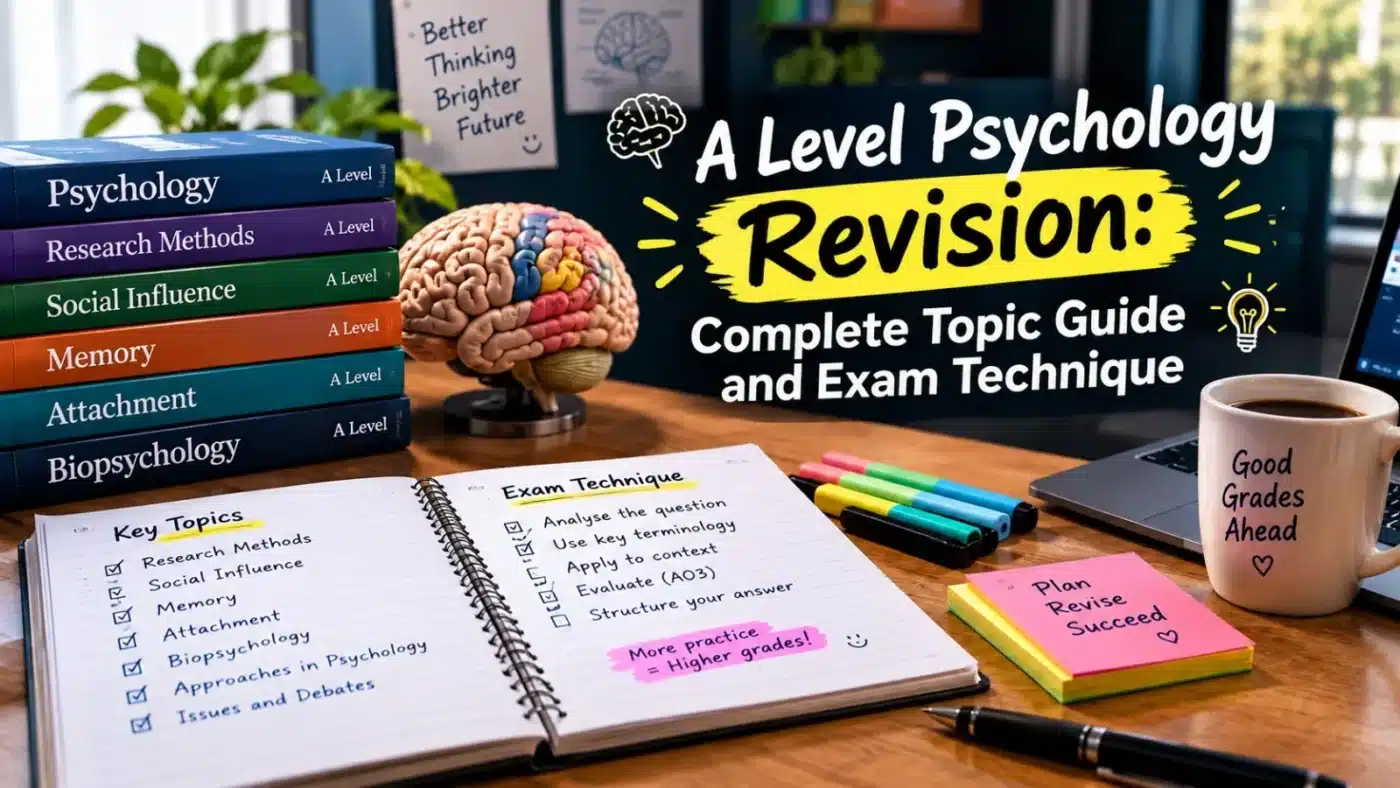
A Level Psychology revision works best when it combines active recall of the extensive factual content with deliberate practice of the specific essay and evaluation skills the AQA and Edexcel mark schemes reward. Students who revise content and exam technique together consistently outperform those who treat them as separate tasks.
Most students who choose A Level Psychology do so because the subject genuinely interests them. Human behaviour, mental health, research methods, the biology of the brain. these are topics that feel relevant in a way that abstract academic subjects sometimes do not.
What surprises many of them is how demanding it turns out to be.
A Level Psychology is not the soft option it is sometimes assumed to be. The content volume is large, the research methodology component is genuinely mathematical, and the mark scheme rewards a very specific type of evaluative writing that takes most students a significant amount of time and practice to develop. Students who arrive expecting an engaging discussion-based subject and find a specification full of precise terminology, statistical tests, and 16-mark essay requirements sometimes feel blindsided.
This guide is the honest preparation for what the subject actually demands, and what revision needs to look like to produce the grades the content knowledge deserves.
What Is A Level Psychology and What Does It Actually Test?
A Level Psychology is a two-year qualification that covers the scientific study of human behaviour and mental processes. It combines biological, cognitive, social, and developmental approaches to psychology with a substantial research methods component that requires students to understand how psychological research is designed, conducted, and evaluated.
The subject is assessed through written examinations at the end of Year 13, with no coursework component. The mark scheme rewards three things simultaneously:
- Knowledge and Understanding: accurate recall and explanation of psychological theories, studies, and concepts
- Application: the ability to apply psychological knowledge to novel scenarios or case studies presented in exam questions
- Evaluation: the ability to critically assess theories and research, considering their strengths, limitations, and the evidence for and against them
Students who revise only for knowledge: which is the most natural revision instinct, consistently find that the evaluation marks elude them. Those marks require a different kind of preparation.
How to Revise A Level Psychology: The Methods That Work
Is Active Recall Better Than Re-Reading for Psychology?
Yes, significantly. Active recall is the most evidence-supported revision method for content-heavy subjects, and A Level Psychology is one of the most content-heavy A Levels available.
Re-reading notes produces recognition, the ability to identify information when you see it. Exams require retrieval, the ability to produce information from memory with nothing in front of you. These are different cognitive tasks, and only one of them is what the exam tests.
Active recall for Psychology looks like:
- Cover and reproduce: covering notes on a study or theory and writing everything recalled from memory, then checking gaps
- Flashcard testing: one side shows the psychologist’s name or theory, the other shows the key details, methodology, findings, and evaluation points, tested in both directions
- Self-explanation: explaining a theory or study out loud in precise psychological terminology, as if teaching it to someone who knows nothing about it
- Past paper questions from memory: attempting short-answer and essay questions without notes before checking the mark scheme
What Is the Best Way to Revise Psychology Studies?
For each psychological study, students need to know and be able to reproduce:
- Aim: what the researcher was trying to investigate
- Methodology: design, sample, procedure, and key methodological decisions
- Findings: specific results, including quantitative data where relevant
- Conclusions: what the findings suggest about human behaviour or mental processes
- Evaluation: at least three specific strengths and three specific limitations, including methodological criticisms, ethical issues, and real-world applications
The specific detail matters. “Milgram found that most people obeyed” is not the same as “Milgram found that 65% of participants delivered the maximum 450-volt shock when instructed to do so by an authority figure.” The second is what mark schemes reward.
A Level Psychology Topics: Complete Specification Breakdown
What Topics Are Covered in AQA A Level Psychology?
AQA A Level Psychology, the most widely sat specification, covers the following major topic areas across Years 12 and 13:
Social Influence covers conformity, obedience, minority influence, and social change. Key studies include Asch’s conformity experiments, Milgram’s obedience research, and Moscovici’s work on minority influence. This topic appears in almost every paper and is one of the most predictable in terms of question format.
Memory covers the multi-store model, the working memory model, eyewitness testimony, and cognitive interview. The evaluation of competing models of memory, their strengths, limitations, and supporting research is regularly examined alongside the applied content on eyewitness testimony.
Attachment covers theories of attachment, types of attachment, the Strange Situation procedure, and the role of early attachment in later development. Bowlby’s theory, Ainsworth’s research, and the cross-cultural studies of attachment are all regularly examined.
Psychopathology covers definitions of abnormality, characteristics of mental disorders including phobias, depression, and OCD, and psychological and biological treatments. This is a topic where both the characteristics of each disorder and the evaluation of each treatment approach need to be known in specific detail.
Approaches in Psychology is a Year 12 topic that covers the biological, behaviourist, cognitive, humanistic, and psychodynamic approaches. This topic is heavily examined in essay questions that ask students to compare approaches or discuss the assumptions of a named approach.
Biopsychology covers the nervous system, the brain, localisation of brain function, neuroplasticity, and ways of studying the brain including fMRI, EEG, and post-mortem studies. This is one of the most factually demanding topics in the specification and one where the biological detail needs to be known precisely.
Research Methods is the topic that most distinguishes A Level Psychology from what many students expect. It covers experimental design, sampling methods, ethical guidelines, statistical tests, and the interpretation of psychological data. Research methods questions appear on every paper and in every question type, including embedded within questions about specific topics.
Year 13 Topics students study three optional topics from a list that includes Relationships, Gender, Cognition and Development, Schizophrenia, Eating Behaviour, Stress, Aggression, Forensic Psychology, and Addiction. The specific optional topics studied depend on the school and teacher.
What Are the Hardest A Level Psychology Topics?
Based on examiner reports and student experience across multiple years, the topics that produce most difficulty are:
- Research Methods: the statistical content and the application of methodological knowledge to novel scenarios catches many students off guard
- Biopsychology: the biological detail required is more demanding than students typically expect from a psychology course
- The optional topics in Year 13: particularly Schizophrenia and Addiction, which have large content volumes and complex evaluation demands
A Level Psychology Essays: What the Mark Scheme Rewards
How Are A Level Psychology 16-Mark Essays Marked?
16-mark essays in A Level Psychology are assessed using a levels-based mark scheme that rewards increasing sophistication of psychological reasoning. Understanding what distinguishes each level is more useful than any generic advice about writing more.
Level 1 (1–4 marks): basic knowledge with limited accuracy and minimal evaluation. Responses at this level describe rather than explain, and evaluation is absent or superficial.
Level 2 (5–8 marks): reasonable knowledge with some accuracy and basic evaluation. Analysis is present but underdeveloped. Evaluation points are identified but not elaborated.
Level 3 (9–12 marks): accurate knowledge with effective evaluation that considers both strengths and limitations. Analysis is developed and connects evidence to the question. Writing is generally clear and organised.
Level 4 (13–16 marks): thorough, accurate knowledge with sophisticated evaluation. Evaluation is elaborated and uses psychological evidence specifically. The response demonstrates genuine critical thinking, not just identifying limitations but explaining their implications for the theory or study being evaluated.
What Is the Best Structure for a Psychology 16-Mark Essay?
A reliable structure for 16-mark A Level Psychology essays:
Opening paragraph: identify the key theory, concept, or debate the question addresses. Make a clear initial point rather than restating the question.
Knowledge paragraphs: explain the theory, model, or research clearly and accurately, with specific detail. Use psychological terminology precisely. Include relevant studies with methodology and findings.
Evaluation paragraphs: each evaluation point should follow the PEEL structure: Point (the evaluation claim), Explanation (why this is a strength or limitation), Evidence (the research or reasoning that supports the evaluation), and Link (why this matters for the theory or question overall).
Conclusion: make a clear judgement about the question. Which explanation is most supported? What are the most significant limitations? What does the evidence as a whole suggest?
The most common reason A Level Psychology essays do not reach Level 4 is that evaluation points are stated rather than elaborated. “One limitation is that the research lacks ecological validity” earns fewer marks than “One limitation is that Milgram’s study lacks ecological validity because the laboratory setting, with unfamiliar equipment and a researcher present, is unlike real-world obedience situations, meaning the findings may not generalise to genuine authority contexts. This is supported by Hofling et al.’s hospital study, which found lower obedience rates in a more naturalistic setting.”
Research Methods in A Level Psychology: Why It Matters More Than Students Expect
Research methods is the topic that most consistently limits Psychology grades, not because it is the hardest content, but because it appears everywhere in the paper in ways students do not anticipate.
What Research Methods Knowledge Do A Level Psychology Students Need?
Students need to know and apply:
- Experimental designs: independent groups, repeated measures, matched pairs, including the advantages and disadvantages of each
- Sampling methods: random, opportunity, volunteer, stratified, systematic, with evaluation of each
- Statistical tests: when to use each test, how to interpret the result, and what significance means in psychological research
- Ethical guidelines: the BPS code of ethics, including informed consent, deception, debriefing, and the right to withdraw
- Data types and analysis: the difference between qualitative and quantitative data, levels of measurement, measures of central tendency and dispersion
- Research designs: laboratory, field, and natural experiments; case studies; observations; interviews; questionnaires, with evaluation of each
The application element is what catches most students. A question that presents a novel study and asks students to identify the sampling method used, suggest a suitable statistical test, or evaluate a methodological decision requires the ability to apply research methods knowledge to an unfamiliar context, not just recall it.
AQA A Level Psychology Past Papers: How to Use Them Effectively
What Is the Most Effective Way to Use Psychology Past Papers?
Past papers are the single most important revision tool for A Level Psychology, but only when used in a way that produces learning rather than just measuring current performance.
The approach that produces consistent improvement:
- Attempt questions under timed conditions: the exact time the exam allocates, no notes, mark scheme only after completion
- Mark using the official AQA mark scheme: paying specific attention to the elaboration required for evaluation marks, not just whether the point was identified
- Read examiner reports: AQA publishes examiner reports after every sitting. For Psychology specifically, these consistently identify the same issues: insufficient elaboration of evaluation points, imprecise use of psychological terminology, and failure to apply knowledge to the specific scenario in application questions
- Track errors by question type: is the issue knowledge accuracy, evaluation elaboration, application to scenarios, or research methods? Each requires a different revision response
- Rewrite answers that missed marks: specifically addressing what the mark scheme showed was missing
A Level Psychology Grade Boundaries: What Students Need to Know
A Level Psychology grade boundaries shift each year based on paper difficulty and cohort performance. AQA publishes grade boundary data after each sitting.
What stays consistent is the quality of response each grade represents. Students targeting A and A* need to be consistently producing Level 3 and Level 4 essay responses, with elaborated evaluation, precise terminology, and clear application. Building that consistency through regular timed practice is what produces the grades, not targeting a specific percentage.
A Level Psychology Study Guide: Building a Realistic Revision Plan
How Should A Level Psychology Revision Be Structured?
Effective A Level Psychology revision needs to address content knowledge, evaluation skills, and research methods application simultaneously, not sequentially.
A realistic revision structure:
Early revision, content consolidation with evaluation practice. For each topic, consolidate factual knowledge using active recall, then immediately practise writing one evaluation paragraph on a past paper question. This builds evaluation habit at the same time as content knowledge.
Middle revision, topic-level past paper questions. Work through short-answer and application questions on individual topics before full papers. This builds familiarity with how each topic is examined without full paper time pressure.
Later revision, full timed papers. Full papers under exam conditions, marked against official mark schemes, with examiner report review after each. Errors tracked by topic and question type.
Final weeks, precision and elaboration. Specifically practise the evaluation elaboration that distinguishes Level 3 from Level 4. Practise research methods application questions, the question type most students underperform on relative to their content knowledge.
Key Takeaways: A Level Psychology Revision
- A Level Psychology tests knowledge, application, and evaluation simultaneously, revision must address all three
- Active recall produces significantly better retention than re-reading for the extensive factual content the specification requires
- 16-mark essays reach Level 4 through elaborated evaluation, stating a limitation is not the same as explaining its implications
- Research methods appears throughout every paper and requires application to novel scenarios, not just recall
- AQA examiner reports are the most specific and actionable revision feedback available, reading them after every marked past paper is essential
- Grade boundaries shift each year, target consistent Level 3 and Level 4 performance rather than a fixed percentage
- Optional topics in Year 13 deserve as much revision time as compulsory topics, they carry equal marks
How Tutor Globe Supports A Level Psychology Students
Psychology is the A Level where the gap between content knowledge and exam performance is most consistently wide, and where targeted specialist feedback closes that gap most efficiently.
A student who knows Milgram’s study in detail can still write a Level 2 essay about it if they have not been taught what elaborated evaluation looks like in practice. Seeing the difference between a Level 2 and a Level 4 response to the same question, explained specifically by someone who knows the mark scheme — is what develops the essay skill that content revision alone cannot build.
Tutor Globe has A Level Psychology specialists who work with AQA and Edexcel students specifically, knowing the papers, mark schemes, and the particular habits in written answers that produce consistent top-band performance. Whether a student needs help with research methods application, wants essay feedback that identifies specifically what the mark scheme was looking for, or is targeting A and A* in the final months before exams, the right specialist makes that process significantly more efficient.
The subject-specific filtering on Tutor Globe means finding a tutor who knows A Level Psychology specifically, not a general science tutor, but someone who works with this specification regularly and knows where the marks are and where they are typically lost.
A trial session with a past paper essay in hand is the most productive starting point. The mark scheme analysis of what that essay achieved and what it missed is almost always the most useful feedback a Psychology student receives across their entire revision period.
Frequently Asked Questions About A Level Psychology Revision
Is A Level Psychology hard?
A Level Psychology is more demanding than many students expect. The content volume is large, the research methods component requires genuine mathematical and analytical ability, and the essay mark schemes reward elaborated evaluation that takes deliberate practice to develop. Students who revise systematically and practise essay writing regularly achieve strong results.
What topics are in A Level Psychology?
AQA A Level Psychology covers Social Influence, Memory, Attachment, Psychopathology, Approaches in Psychology, Biopsychology, and Research Methods as compulsory content. Students also study three optional topics from a list including Relationships, Gender, Schizophrenia, Eating Behaviour, Stress, Aggression, Forensic Psychology, and Addiction.
How do you get an A in A Level Psychology?
Consistently producing Level 3 and Level 4 essay responses, with elaborated evaluation, precise psychological terminology, and accurate application to novel scenarios, is what A grade performance requires. This is developed through regular timed essay practice with honest mark scheme review and targeted attention to research methods application questions.
How long are A Level Psychology essays?
16-mark essays typically require around 500 to 700 words under timed conditions, though length alone does not determine marks. A concise, well-elaborated response that reaches Level 4 will consistently outscore a longer response that stays at Level 2 or 3 through repetition and vagueness.
What is the hardest part of A Level Psychology?
Research methods is consistently identified by both students and examiners as the most challenging component, not because the concepts are inherently difficult, but because questions require applying methodological knowledge to novel scenarios rather than recalling it from a familiar context. Biopsychology is the most factually demanding individual topic.
How are A Level Psychology essays marked?
AQA and Edexcel mark extended Psychology essays using levels-based mark schemes with four levels. Higher levels reward increasingly elaborated evaluation, precise use of psychological evidence, and clear application to the question. The most common reason essays do not reach Level 4 is that evaluation points are stated without explanation of their implications.
Are A Level Psychology past papers useful for revision?
Extremely, when used correctly. Attempting papers under timed conditions, marking against official mark schemes, and reading examiner reports immediately after marking produces consistent grade improvement. The examiner reports in particular contain specific, actionable feedback that is more useful than any general revision guide.
What is the difference between AQA and Edexcel A Level Psychology?
Both boards cover core psychological topics and research methods, but the specific content, optional topics, paper structures, and mark scheme language differ. Students should revise exclusively using their own board’s materials. past papers, mark schemes, and examiner reports, to ensure preparation matches the actual exam.
Final Thoughts
A Level Psychology rewards students who understand what the mark scheme rewards and have practised producing it, not students who know the most studies or have read the most notes.
The students who consistently achieve A and A* are the ones who built active recall habits early, practised writing elaborated evaluation rather than just identifying points, took research methods seriously throughout the course rather than treating it as a separate section to be revised last, and used past papers honestly as diagnostic tools rather than confidence measures.
That preparation is achievable for any student willing to revise differently, not harder necessarily, but more precisely.
If your child is working toward A Level Psychology and wants specialist support matched to their specific board, their current essay level, and the specific question types where performance is inconsistent, Tutor Globe is the practical next step. A trial session with a past paper essay is the most productive starting point.
