
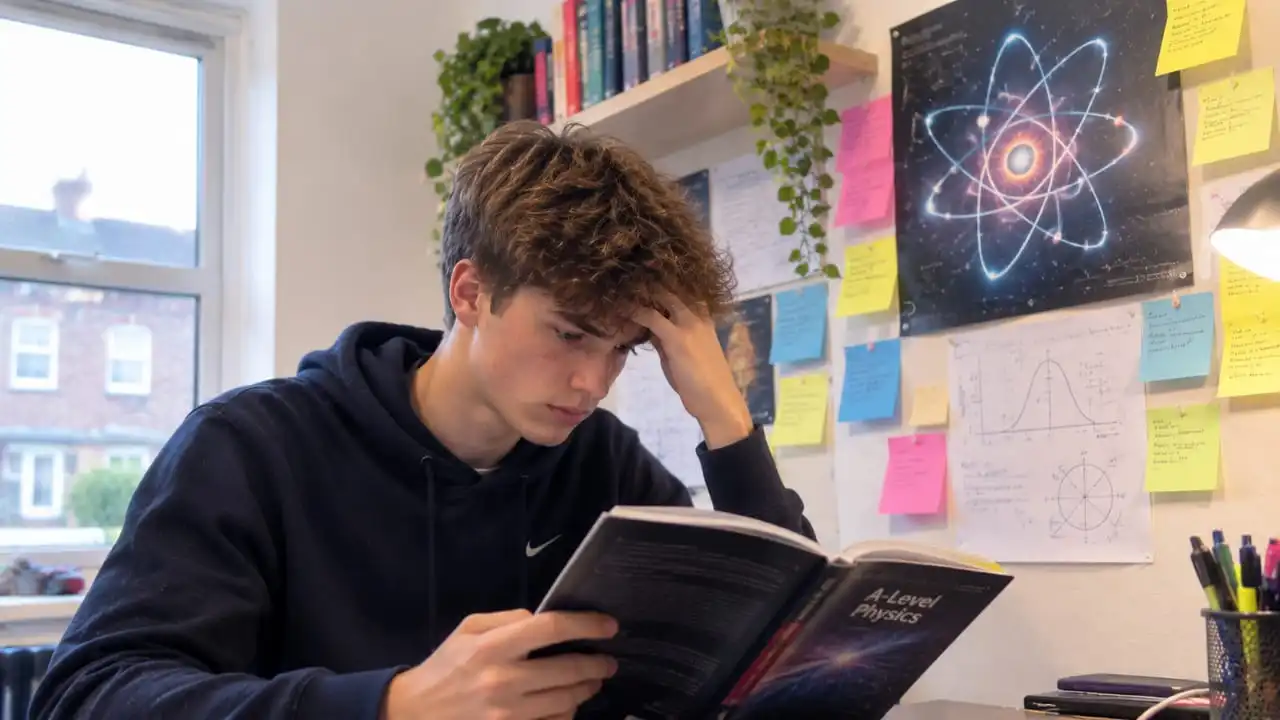
Quick Answer: Yes, A Level Physics is hard for most students, mainly because of the jump in maths and the abstract ideas. But it is very learnable. Students who practise problems daily, understand concepts instead of memorising, and use past papers tend to do well. It is harder than GCSE, yet it rewards steady effort more than natural talent.
When I ask students “is A Level Physics hard?”, I usually get one of two answers. Some say it is the hardest subject they have ever taken. Others say it clicked once they found the right way to study.
Both are true. A-Level Physics is a demanding subject, but the difficulty comes from a few specific places, and each one can be fixed. This guide tells you honestly what makes it hard, which topics catch people out, and how to make it easier.
Is A-level physics hard?
For most students, yes. The step up from GCSE is big, and it surprises people who found GCSE Physics easy.
Here is why it feels harder:
- More maths. You use algebra, trigonometry, logarithms and sometimes calculus ideas.
- Abstract ideas. Fields, waves and quantum physics are hard to picture.
- Multi-step problems. Questions rarely give you one neat equation to use.
- Faster pace. Teachers cover a lot of content quickly.
- Less hand-holding. You must practise alone, not only in lessons.
That said, “hard” does not mean “impossible”. Thousands of students get A and A* every year, and most of them are not geniuses.
How Hard Is A Level Physics Compared to Other Subjects?
Physics is usually ranked among the harder A Levels, along with Maths, Further Maths and Chemistry. Here is a simple comparison of what each one demands:
Subject | Main challenge | Maths level |
Physics | Abstract ideas plus problem solving | High |
Maths | Pure reasoning and speed | Very high |
Chemistry | Large content plus calculations | Medium to high |
Biology | Large amount of content to remember | Low to medium |
Grade statistics are published every year by exam boards and Ofqual, so check the latest figures for the real percentages. What they usually show is that Physics sits in the middle of the pack for top grades. It is hard, but fair.
If you are weighing up your options, our guide to Hardest A Level Subjects Ranked looks at the whole picture.
Why Is A-Level Physics Hard? The Real Reasons
The jump from GCSE is bigger than it looks
GCSE Physics gives you most equations on a sheet and keeps the maths simple. At A-Level, you need to choose the right equation, rearrange it, and often combine two or three. Many students lose marks on method, not on understanding.
Maths and physics must work together
If your maths is shaky, physics feels harder than it really is. Students taking A-Level Maths alongside Physics often find the two help each other. If you are not taking Maths, spend extra time practising algebra and rearranging equations.
Concepts you cannot see
You cannot see an electric field or a wave function. Understanding them means building a mental picture from diagrams and examples. This takes time, and it is normal to feel stuck at first.
Exams test application, not recall
You will get questions you have never seen before. The exam checks whether you can apply a principle to a new situation. That is why memorising notes is not enough.
What Are the Hardest Topics in A-Level Physics?
Students often name these topics as the toughest, but we have a solution for you to study A level physics with these best tutors in the world.:
- Fields. Gravitational, electric and magnetic fields use similar ideas, which confuses many people.
- Simple harmonic motion. It mixes graphs, equations and energy.
- Circular motion. You must work out which force provides the centripetal force.
- Quantum and particle physics. The ideas feel strange and unfamiliar.
- Capacitors and exponential decay. They need logarithms and careful graph work.
- Practical skills and data analysis. These are marked in written exam questions too.
The good news is that topics usually feel easier after you have done about 15 to 20 questions on them. Struggle at the start is normal.
How to Make A-Level Physics Easier
Practise problems, do not just read notes
Physics is a doing subject. After each lesson, try three or four questions without looking at your notes. When you get stuck, that is where learning happens. Our guide on how to revise effectively explains why testing yourself beats rereading.
Learn the idea behind every equation
Ask “what is this equation telling me?” instead of only memorising it. If you know that force equals the rate of change of momentum, you can handle many different questions.
Draw diagrams for every problem
A quick sketch of forces, circuits or waves often makes the solution clear. Examiners also give marks for correct diagrams.
Fix your maths early
Practise rearranging equations, working with powers of ten, and using your calculator properly. A few weeks of focused practice makes a huge difference.
Use past papers properly
Do them under timed conditions, mark them with the official mark scheme, and note down every mistake. Our guide to A Level Past Papers: The Ultimate Revision Strategy shows a step by step method.
Ask for help early
If a topic does not make sense after a week, ask your teacher or find a tutor. Small gaps in Year 12 become big problems in Year 13.
Is A-Level Physics Hard Without A-Level Maths?
It is harder, but not impossible. Physics needs a good level of maths, and many sixth forms ask for at least a grade 6 or 7 at GCSE Maths before you can take it. If you skip A-Level Maths, practise the maths skills inside physics regularly and ask your teacher which topics use the most algebra.
Is A-Level Physics Worth It?
If you enjoy problem solving, it is very worth it. A-Level Physics opens the door to engineering, physics, computer science, architecture and many other degrees. Universities respect it because it shows strong thinking skills. If you do not need it for your future plans and you dislike maths, you may be happier with a different subject. Choose based on your goals and interests, not only on difficulty.
Is A-Level Physics Hard Compared to GCSE?
Yes, noticeably. Think of GCSE as learning the rules and A-Level as using them in new situations. Here are the main differences:
Area | GCSE Physics | A-Level Physics |
Maths | Basic algebra | Algebra, trigonometry, logarithms |
Equations | Many given | You must choose and combine |
Questions | Often direct | Often multi-step and unfamiliar |
Content | Smaller | Much larger and deeper |
If you are still deciding whether to take it, How to Choose A Level Subjects can help you build the right combination.
Key Takeaways
- A-Level Physics is hard for most students, mainly due to maths and abstract ideas
- It is learnable and rewards steady practice
- Fields, SHM and circular motion are common trouble spots
- Practise problems, understand equations and use past papers
- Strengthen your maths early
- Ask for help quickly if you feel stuck
- It is a great choice for science and engineering paths
Frequently Asked Questions
Is A-Level Physics hard?
Yes, for most students. It has more maths and more abstract ideas than GCSE. With regular practice, it becomes manageable.
How hard is A-Level Physics compared to Chemistry?
Both are tough. Physics leans on maths and problem solving, while Chemistry has more content to learn plus calculations. Which is harder depends on your strengths.
Is A-Level Physics harder than Maths?
Most students find Maths harder in terms of pure reasoning, while Physics adds hard concepts on top of maths. They support each other well.
Can I get an A in A-Level Physics?
Yes. Students who practise daily, use past papers and fix weak topics regularly achieve top grades.
What GCSE grade do I need for A-Level Physics?
Many schools ask for grade 6 or 7 in Physics or Combined Science and in Maths. Check your own school’s requirements.
What is the hardest part of A-Level Physics?
Many students say fields, simple harmonic motion and the maths used in multi-step problems.
How many hours a week should I study Physics?
Around four to five hours outside lessons works well for most students, split into short, regular sessions.
Is A-Level Physics worth taking?
Yes, if you want engineering, science or technical careers, or you enjoy problem solving.
Final Thoughts: Is A-Level Physics Hard? Yes, But You Can Do It
So, is A-Level Physics hard? Yes, and pretending otherwise would not help you. But the difficulty is specific and fixable. Build your maths, practise problems often, understand the ideas and get help early.
Start this week. Pick one topic you find confusing, try five questions on it, and note where you get stuck. That is the first step toward making Physics feel easier. If you want personal support, The Tutor Globe can match you with a tutor who knows your exact exam board.