
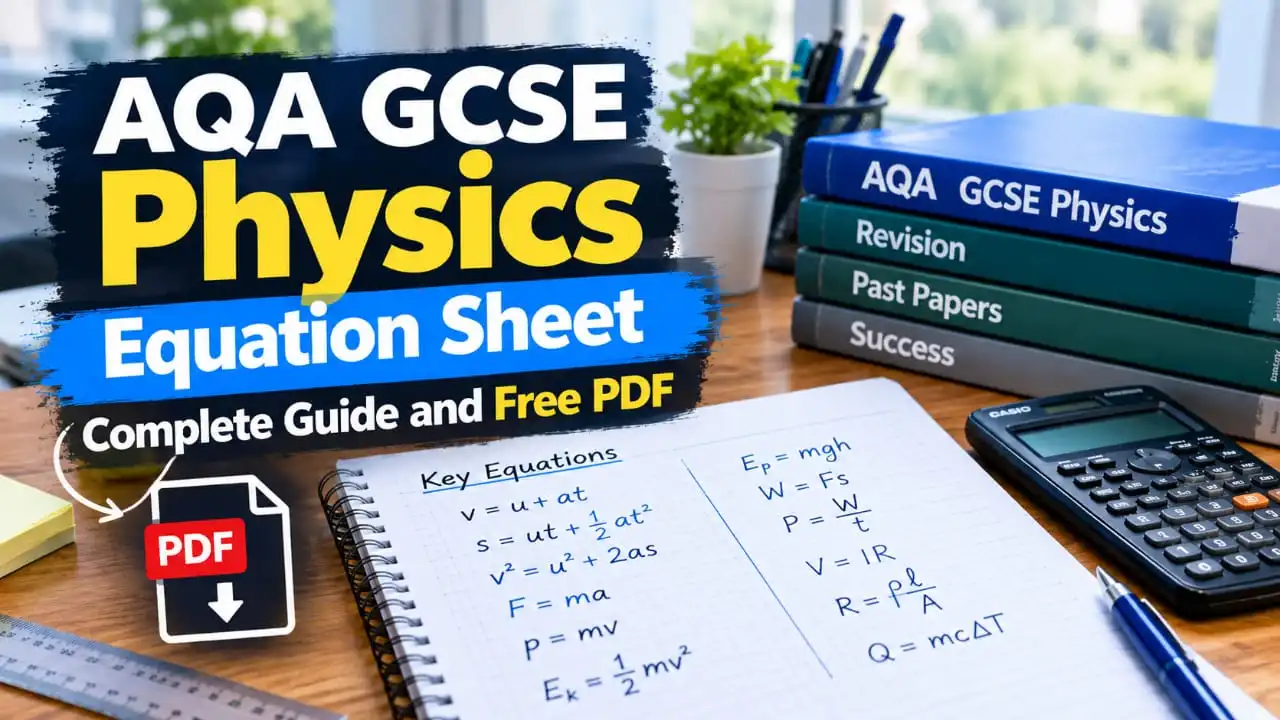
Quick Answer: The AQA GCSE physics equation sheet provides a list of equations students are given in the exam. However, not all physics equations are on the sheet, students must also memorise a separate set of equations from their own recall. Knowing which equations are provided and which must be memorised is one of the most important exam preparation steps for AQA GCSE Physics students. Every AQA GCSE Physics student gets handed a list of equations at some point in Year 10 or Year 11. Some file it away. Some highlight it. Very few actually use it in the way that genuinely helps exam performance. The problem is not that students do not have the AQA physics equation sheet, it is that most students do not know how to use it strategically. They are not sure which equations will be given in the exam, which ones they need to have memorised independently, how to rearrange equations under time pressure, or which equations appear most frequently in the hardest questions on the paper. This guide fixes all of that. By the end, you will know exactly what the AQA GCSE physics equation sheet contains, which additional physics equations GCSE students must memorise themselves, and how to use equation knowledge to pick up marks consistently across every paper. What Is the AQA Physics Equation Sheet? The AQA GCSE physics equation sheet is a list of equations provided to students during their GCSE Physics examinations. It covers the equations that AQA has decided students do not need to memorise, instead, they are printed and given out at the start of the exam so students can focus on applying the equations rather than simply recalling them. The equation sheet is provided for both AQA GCSE Physics (separate science) and AQA GCSE Combined Science: Trilogy for the physics component. The content of the sheet is the same for both, though the number of equations tested differs slightly between the two specifications. What Does the AQA Physics Formula Sheet Include? The AQA GCSE physics formula sheet is divided into two sections: Equations given in the exam: these appear on the formula sheet provided during the exam. Students do not need to memorise these but do need to know how to identify the right equation for a given question, substitute values correctly, rearrange when necessary, and apply appropriate units. Equations students must memorise: these do not appear on the formula sheet. AQA expects students to have committed these to memory and be able to recall and apply them without any reference material. Understanding this two-category structure is the foundation of effective physics equation revision. Many students make the mistake of treating all physics equations GCSE papers test as equally important to memorise, without realising that roughly half of them will be provided in the exam. AQA GCSE Physics Equation Sheet: Equations Provided in the Exam The following equations appear on the AQA physics equation sheet and are given to students during their GCSE Physics examinations. Students do not need to memorise these, but they do need to understand what each one means and how to use it. Forces and Motion Equations, Given on Sheet Resultant force: F = ma (force = mass × acceleration) Work done: W = Fs (work done = force × distance) Kinetic energy: Ek = ½mv² (kinetic energy = 0.5 × mass × velocity²) Gravitational potential energy: Ep = mgh (GPE = mass × gravitational field strength × height) Momentum: p = mv (momentum = mass × velocity) Force and momentum: F = mΔv / Δt (force = change in momentum / time) Wave speed: v = fλ (wave speed = frequency × wavelength) Electricity Equations, Given on Sheet Charge: Q = It (charge = current × time) Power: P = IV (power = current × voltage) Power (alternative): P = I²R (power = current² × resistance) Energy transferred: E = QV (energy = charge × voltage) Energy transferred (alternative): E = Pt (energy = power × time) Efficiency: Efficiency = useful output energy / total input energy Thermal and Nuclear Equations, Given on Sheet Change in thermal energy: ΔE = mcΔθ (energy = mass × specific heat capacity × temperature change) Thermal energy for change of state: E = mL (energy = mass × specific latent heat) Pressure and volume: pV = constant (for a fixed mass of gas at constant temperature) Physics Equations GCSE Students Must Memorise: Not on the Formula Sheet This section is where most students lose marks. The following equations do not appear on the AQA GCSE physics equation sheet, students must recall them entirely from memory during the exam. Forces and Motion, Must Memorise Weight: W = mg (weight = mass × gravitational field strength) Speed: v = d/t (speed = distance / time) Acceleration: a = Δv/t (acceleration = change in velocity / time) Electricity, Must Memorise Ohm’s Law / Resistance: V = IR (voltage = current × resistance) Total resistance in series: R_total = R₁ + R₂ Total resistance in parallel: 1/R_total = 1/R₁ + 1/R₂ Waves, Must Memorise Period and frequency: T = 1/f (period = 1 / frequency) Magnetism and Electromagnetism, Must Memorise Transformer equation: Vs/Vp = Ns/Np Transformer power: VpIp = VsIs Space, Must Memorise Orbital speed: v = 2πr/T Edexcel Physics Formula Sheet: How It Compares to AQA Many students and parents search for information about the Edexcel physics formula sheet when they are actually sitting AQA, or vice versa. Understanding the difference matters for revision. The Edexcel GCSE Physics formula sheet follows a similar structure to AQA, some equations are provided in the exam, others must be memorised. However, the specific equations in each category differ between the two boards. The wording of equations, the symbols used, and occasionally the form in which an equation is presented can differ between AQA and Edexcel papers. Students sitting AQA GCSE Physics should revise exclusively using the AQA physics equation sheet and AQA specification. Using Edexcel resources or a mixed set of […]
Category Archives: Uncategorized

Oct
Quick Answer: The most common signs your child needs a tutor include consistently dropping grades, avoidance of homework, loss of confidence in a specific subject, falling behind after illness or a school transition, and struggling with exam preparation despite apparent effort. Acting early , before small gaps become significant ones , consistently produces better outcomes than waiting until results confirm the problem. Every parent notices the signs eventually. The homework that takes three times longer than it should. The test result that comes home with a comment scrawled in red. The child who used to enjoy a subject and now says they hate it without being able to explain why. Most parents sit with these signs for longer than they should , partly because they are not sure if the problem is serious enough, partly because they are not sure what the right response is, and partly because bringing in a tutor can feel like an admission of something, though it is never quite clear what. This guide makes the decision clearer. Here are ten signs your child needs a tutor , explained honestly, with guidance on what each sign typically means and what to do about it. Why Recognising the Signs Your Child Needs a Tutor Matters Early The most expensive tutoring mistake parents make is not choosing the wrong tutor. It is waiting too long before getting any tutor at all. Small academic gaps do not typically resolve themselves. A student who does not fully understand fractions in Year 5 will struggle with algebra in Year 7, which creates difficulties with equations in Year 9, which limits GCSE Maths performance in Year 11. By the time the GCSE grade arrives, the problem looks like a Maths problem. It is actually a Year 5 fractions problem that was never addressed. Recognising the signs your child needs a tutor early , and acting on them while there is still time to address the root cause rather than patch the symptoms , is consistently more effective than late intervention under exam pressure. Sign 1: Grades Are Dropping Consistently When Dropping Grades Signal a Need for Tutoring Support One poor test result is not a sign your child needs a tutor. Every student has off days. But a consistent downward trend across multiple assessments in the same subject , or a sudden significant drop after a period of stable performance , is a clear signal that something specific is going wrong. The question is whether the drop reflects a motivational issue, a teaching issue, a specific knowledge gap, or something happening at home or socially. A tutor who assesses the student properly in the first session can usually identify which of these is actually the problem within thirty to forty-five minutes , which is information that is much more useful than the grade itself. If your child’s grades are dropping in a subject they previously managed well, that is one of the clearest signs your child needs a tutor , specifically because it suggests a gap has opened up at a particular point in the curriculum that, if identified and addressed, is usually very fixable. Sign 2: Your Child Avoids Homework in a Specific Subject Homework Avoidance as a Signal of Hidden Difficulty Children and teenagers rarely say “I avoid this homework because I do not understand it.” They say they are tired, that the teacher is boring, that the homework is pointless, or that they will do it later. Later never comes, or it arrives after two hours of painful non-engagement that leaves everyone frustrated. Homework avoidance in a specific subject , not all subjects, not all the time, but consistently in one area , is almost always a signal that the work feels impossible rather than boring. Students avoid things they cannot do more readily than things they dislike. When avoidance is targeted at one subject, that subject is almost always one where the student does not know how to start because they are missing something foundational. This is one of the signs your child needs a tutor that parents most commonly misread as a behaviour problem when it is actually a knowledge problem. A tutor who can make the work feel manageable removes the avoidance behaviour at its root rather than at its surface. Sign 3: Your Child Says They Are Fine But Results Say Otherwise The Gap Between Reported Confidence and Actual Performance “I understand it” is one of the most misleading things a student can say , and they almost never say it deliberately to deceive. Students genuinely believe they understand material that they have heard explained, nodded along with, and perhaps even taken notes on. What they lack is the experience of retrieving that material independently under pressure, which is what the exam tests. The gap between a student’s reported confidence and their actual test performance is one of the most consistent signs your child needs a tutor , because it suggests that understanding has been confused with familiarity. A tutor who uses active recall in sessions, asking the student to explain concepts back without reference to notes, quickly reveals exactly where genuine understanding ends and surface familiarity begins. If your child consistently reports feeling prepared and consistently underperforms relative to that reported confidence, a tutor who diagnoses the gap is significantly more useful than simply telling the student to revise more. Sign 4: Your Child Has Fallen Behind After Illness or School Transition Catching Up After Disruption: When a Tutor Fills the Gap Missing several weeks of school through illness, or transitioning from one school to another mid-year, creates gaps that classroom teaching rarely has time to fill. Teachers cover new content while your child is absent. The class moves on. Your child returns and has to follow new content built on foundations they missed. This is one of the signs your child needs a tutor that is most straightforward to act on , because the cause is clear, the gap is identifiable, and […]

Oct
Quick Answer: The AQA GCSE Chemistry specification covers eight major topic areas across two exam papers, from atomic structure and bonding through to organic chemistry and chemical analysis. Students must also complete required practice assessed through written exam questions. Understanding exactly what the AQA chemistry specification requires, topic by topic, is the foundation of effective GCSE chemistry revision. Most GCSE chemistry students revise from textbooks, revision guides, or class notes, without ever properly reading the AQA GCSE chemistry specification itself. That is a significant missed opportunity. The specification document is the single most authoritative guide to what will and will not appear in the exam. Every learning objective listed in the AQA chemistry specification is a potential exam question. Every topic not listed is not worth revision time, regardless of how thoroughly it was covered in class. Students who revise to the specification rather than to the textbook consistently use their revision time more efficiently than those who do not. This guide takes the AQA GCSE chemistry specification and makes it genuinely useful, breaking down every topic area, explaining what each requires, identifying where the most exam marks sit, and showing how each topic connects to the others. Whether your child is in Year 10 building foundations or in Year 11 preparing for final exams, this guide gives a clear picture of what the AQA chemistry specification actually demands. What Is the AQA GCSE Chemistry Specification? The AQA GCSE chemistry specification is the official document produced by AQA that defines exactly what content is assessed in GCSE chemistry examinations. It lists every topic, subtopic, and learning objective that students are expected to know and apply. The specification applies to both AQA GCSE Chemistry as a separate science qualification and to the chemistry component of AQA GCSE Combined Science: Trilogy. The content is broadly similar between the two, though separate science Chemistry covers additional Higher Tier content that does not appear in Combined Science. How Is AQA GCSE Chemistry Assessed? The AQA GCSE chemistry specification is assessed through two written exam papers: Paper 1 covers topics 1 to 5, atomic structure and the periodic table, bonding and structure, quantitative chemistry, chemical changes, and energy changes. Paper 2 covers topics 6 to 8, the rate and extent of chemical change, organic chemistry, chemical analysis, and the chemistry of the atmosphere and using resources. Both papers are one hour and forty-five minutes long and carry equal weighting, each worth 50% of the final GCSE Chemistry grade. Both papers include multiple choice questions, structured questions, closed short answer questions, and open response questions. Required Practicals, a set of specific experiments students must carry out during the course, are assessed through questions on both papers rather than through separate practical examinations. Chemistry Specification: Foundation vs Higher Tier The AQA GCSE chemistry specification differentiates between Foundation Tier and Higher Tier content. Foundation Tier covers grades 1 to 5. Higher Tier covers grades 4 to 9. Higher Tier content, sometimes marked in the specification as Higher Tier only, includes more complex calculations, more detailed mechanistic understanding, and additional topic content that does not appear in Foundation papers. Students targeting grade 6 and above should ensure they are revising Higher Tier content and are entered for Higher Tier exams. AQA GCSE Chemistry Specification: Topic 1: Atomic Structure and the Periodic Table What Topic 1 Covers Topic 1 is foundational content that underpins almost everything that follows in the AQA chemistry specification. It covers: The structure of atoms, protons, neutrons, and electrons, their relative masses and charges, and where they are located within the atom Atomic number and mass number, what each means and how to use them to determine the composition of an atom Isotopes, atoms of the same element with different numbers of neutrons, why they have the same chemical properties but different physical properties The development of the atomic model, from the plum pudding model to the nuclear model, and how experimental evidence led to each revision Electronic configuration, how electrons are arranged in shells and how to write and draw electronic configurations for the first twenty elements The periodic table, how elements are arranged, what periods and groups represent, and how the periodic table is organised by atomic number Properties of metals and non-metals, how they differ in physical and chemical properties Group 0, Group 1, and Group 7, the noble gases, alkali metals, and halogens, their properties and trends down each group Transition metals, their properties and how they differ from Group 1 metals What Topic 1 Requires in the Exam Topic 1 questions range from straightforward recall “state the charge of a proton” through to application questions that require students to use electronic configuration to explain reactivity trends or to deduce the composition of an atom from its atomic and mass number. The most consistently examined elements of Topic 1 are electronic configuration, periodic table trends, and the properties of Group 1 and Group 7 elements. Students who understand the link between electronic structure and chemical behaviour, rather than memorising facts in isolation, handle the harder Topic 1 questions significantly better. AQA GCSE Chemistry Specification: Topic 2: Bonding, Structure and the Properties of Matter What Topic 2 Covers Topic 2 is the topic that most consistently trips up GCSE Chemistry students , not because the content is inherently the most difficult, but because it requires three different types of understanding simultaneously: what type of bonding exists in a substance, what structure that bonding produces, and how that structure determines the physical properties. The AQA chemistry specification requires students to know and apply: Ionic bonding: electron transfer between metals and non-metals, the formation of ions, the structure of ionic compounds and their properties including high melting points and conduction when dissolved or molten Covalent bonding: electron sharing between non-metals, single and multiple covalent bonds, the difference between simple molecular and giant covalent structures Simple molecular structures: low melting points, no electrical conduction, and why these properties arise from weak intermolecular forces rather than […]

Oct
Quick Answer: How much does a tutor cost in 2026? Private tutor costs range from £25 to £120 per hour depending on subject, level, experience, and whether sessions are online or in-person. GCSE tutoring averages £35 to £65 per hour, A Level tutoring £50 to £90 per hour, and specialist tutoring can exceed £100 per hour. Online tutoring typically costs 15 to 25% less than equivalent in-person sessions. How much does a tutor cost? It is one of the first questions every parent asks, and one of the most poorly answered anywhere online. Most tutoring platforms list price ranges so wide they are almost useless. “£20 to £150 per hour” tells a parent almost nothing about what they will actually pay for a qualified specialist who knows their child’s specific exam board and subject. And the gap between the cheapest available tutor and the most appropriate one for a specific situation can be enormous in both directions. Parents who choose purely on price sometimes pay for sessions that produce very little improvement. Parents who assume the most expensive tutor is automatically the best are not always right either. Understanding how much does a tutor cost, and what drives those differences, is what allows families to make genuinely informed decisions. This guide gives parents a specific, honest picture of what private tutoring actually costs in 2026, broken down by level, subject, format, and location, so the decision is based on real information rather than vague estimates. How Much Does a Tutor Cost, What Drives the Price? Before looking at specific figures, understanding what drives tutoring prices helps make sense of the variation. How much does a tutor cost depends on several factors working together. Tutor Experience and Qualifications The most significant driver of price variation within any subject is tutor experience and formal qualifications. A tutor with a relevant degree, a teaching qualification such as QTS or PGCE, and several years of documented tutoring experience in a specific subject charges significantly more than a recent graduate offering tutoring for the first time. That price difference is often justified, but not always. An experienced AQA Chemistry tutor who has worked with thirty students and knows exactly which mark scheme habits cost marks delivers something materially different from someone who recently passed the same exam. But some newer tutors with strong subject knowledge and natural teaching ability outperform more experienced ones. Reviews and trial sessions reveal more than credentials alone. Subject, Level and Exam Board Subject and level are the two most consistent price determinants. Higher-level subjects cost more, A Level tutoring costs more than GCSE, which costs more than primary support. Technically demanding subjects like Mathematics, Physics, and Chemistry command higher rates than most humanities at the same level. Exam board knowledge also affects how much a tutor cost should be assessed. A tutor with specific AQA experience is more valuable for an AQA student than a tutor with general Chemistry knowledge. This specialist matching is worth paying for, and is one reason platforms like Tutor Globe that filter by board and qualification deliver better value than general searches. Online vs In-Person Format Online tutoring consistently costs less than equivalent in-person tutoring. Tutors working online do not factor travel time into rates, and the larger online pool creates more competitive pricing. The typical difference is 15 to 25%, meaningful over a full academic year but not so large it should override format decisions made on educational grounds. Location In-person tutoring prices vary significantly by location. London and major cities command considerably higher rates than smaller towns, reflecting both higher living costs and stronger local demand. Online tutoring largely removes this geographic variation, which is one reason parents outside major cities often find online tutoring both better value and better matched to specialist needs. How Much Does a Tutor Cost, Complete Breakdown by Level How Much Does a Primary School Tutor Cost? How much does a tutor cost at primary level depends primarily on whether the need is general support or specific entrance exam preparation. Primary School Tutoring Type In-Person Rate Online Rate General literacy and numeracy support £25–£45 £20–£38 11+ preparation (grammar school entrance) £35–£65 £28–£55 Specialist SEN support £40–£70 £32–£58 Gifted and talented enrichment £35–£60 £28–£50 11+ preparation commands a premium because the pool of tutors familiar with specific regional formats, GL Assessment, CEM, and school-specific papers, is genuinely smaller than for general primary support. How Much Does a GCSE Tutor Cost? How much does a tutor cost at GCSE is the question most parents ask first, as GCSE is the most common tutoring level. Prices reflect both the range of subjects and the significant variation between general support tutors and board-specific specialists. GCSE Subject In-Person Rate Online Rate Mathematics £40–£65 £30–£55 English Language and Literature £35–£60 £28–£50 Biology, Chemistry, Physics £40–£65 £32–£55 Combined Science £38–£62 £30–£52 History and Geography £35–£55 £28–£48 Modern Languages £35–£60 £28–£52 Computer Science £40–£65 £32–£55 Economics and Business Studies £38–£60 £30–£52 GCSE tutoring at the higher end of these ranges typically reflects tutors with formal teaching qualifications and specific exam board expertise. Tutors at the lower end are more likely to be recent graduates with strong subject knowledge but less focused teaching experience. How Much Does an A Level Tutor Cost? How much does a tutor cost at A Level is where prices rise most noticeably. The specialist subject knowledge required, the higher stakes of the qualification, and the smaller pool of genuinely qualified tutors all push rates higher. A Level Subject In-Person Rate Online Rate Mathematics £55–£85 £45–£75 Further Mathematics £65–£100 £55–£88 Physics £55–£85 £45–£75 Chemistry £55–£85 £45–£75 Biology £50–£80 £40–£70 Economics £50–£80 £40–£70 Psychology £45–£75 £38–£65 History £45–£75 £38–£65 English Literature £45–£75 £38–£65 Modern Languages £50–£80 £40–£70 Further Mathematics consistently commands the highest rates among standard A Level subjects. The combination of highly technical content and small qualified tutor pool means how much does a tutor cost for Further Maths is a question that frequently surprises parents unfamiliar with the market. How Much […]

Sep
Quick Answer: To find the right online tutor, check their subject qualifications and exam board experience, read verified reviews, confirm they know your child’s specific curriculum, book a trial session before committing, and assess how your child responds in the first session. The tutor’s board-specific knowledge matters more than general subject expertise. Finding an online tutor sounds straightforward until you actually try to do it. There are thousands of tutors available across dozens of platforms, all with profiles that describe themselves in broadly similar terms, experienced, passionate, results-focused, patient. Some of those claims are accurate. Some are not. And for a parent who does not know the subject well enough to assess a tutor’s knowledge directly, telling the difference from a profile alone is genuinely difficult. The consequences of choosing the wrong tutor are not just financial. A poor tutor match wastes revision time that cannot be recovered, creates a negative association with the subject, and sometimes actively builds wrong habits that take longer to undo than they took to form. This guide gives parents a specific, practical framework for finding the right online tutor, not a vague checklist, but seven concrete things to check that consistently separate tutors who produce results from those who do not. Why Finding the Right Online Tutor Matters More Than Most Parents Realise The tutoring market has expanded significantly over the past few years. More tutors are available online than ever before, at a wider range of price points, in a wider range of subjects. That is genuinely good news for families, more choice and more competition means better access to specialist support. But more choice also means more variation in quality. A larger pool of available tutors includes more excellent tutors and more ineffective ones. Without the right framework for evaluation, the risk of an expensive and time-consuming mismatch is real. The stakes are also higher than they appear at the point of booking. A student preparing for GCSE or A Level exams is working within a fixed timeline. A tutor who spends several sessions establishing rapport without addressing the specific gaps limiting the grade costs something that cannot be replaced, time. Getting the match right from the start is not a luxury. It is what makes the tutoring genuinely useful. 1. Check Their Qualifications and Subject Expertise What Qualifications Should an Online Tutor Have? This is the most fundamental check and the one most parents either skip or approach too vaguely. A tutor’s qualifications matter in two distinct ways, their academic qualifications in the subject itself, and their teaching or tutoring experience. Both matter, and neither alone is sufficient. Academic qualifications tell you whether the tutor genuinely knows the subject at and above the level being taught. A tutor teaching A Level Chemistry should have at minimum a degree-level qualification in Chemistry or a closely related discipline. A tutor teaching GCSE Mathematics should have a strong quantitative background. These are reasonable minimum expectations. Online tutor qualifications relevant to teaching specifically include a formal teaching qualification (QTS or PGCE for UK-curriculum subjects), tutoring experience with documented outcomes, or demonstrable track record working with students on the specific qualification being sat. Teaching experience matters separately from subject knowledge, someone who knows Chemistry brilliantly is not automatically able to explain it effectively to a struggling Year 11 student. What to ask directly: “What is your academic background in this subject?” and “How many students have you tutored specifically at this level and exam board?” Vague answers to either question are informative. 2. Verify Exam Board and Curriculum Knowledge Why Exam Board Experience Matters More Than General Subject Knowledge This is the check that most parents do not think to make, and it is one of the most consequential. A Level Chemistry taught by AQA and A Level Chemistry taught by Edexcel assess the same underlying science, but through different paper formats, different mark scheme language, and different question styles. A tutor who knows AQA Chemistry deeply may not know that Edexcel marks organic mechanism questions differently, or that the Edexcel data booklet contains different information from AQA’s, or that recent Edexcel papers have weighted certain topics more heavily than AQA has. These differences are specific and they matter for exam performance. A student who sits Edexcel needs a tutor who knows Edexcel, not a tutor who knows Chemistry and will figure out the Edexcel specifics as they go. The same principle applies across GCSE, IGCSE, A Level, and IB. Before booking any tutor, confirm: Which exam board does the tutor have specific experience with? How many students have they worked with on that specific board? Are they familiar with the current version of the specification? Tutor Globe’s filtering system is built around exactly this principle, allowing families to search by specific board and qualification level rather than just by subject, which is the only way to ensure the tutor matched to a student knows the exact papers being sat. 3. Read Verified Reviews and Tutor Ratings How to Evaluate Online Tutor Reviews Effectively Reviews are a useful signal, but only when they are verified, specific, and relevant to the situation being evaluated. Verified reviews come from students or parents who have actually completed sessions through a platform that confirms the booking took place. Unverified reviews, testimonials on a tutor’s own website or social media page, cannot be confirmed as genuine and should be weighted accordingly. Specific reviews describe what the tutor did well or poorly in concrete terms. “She explained quadratic equations in a way my daughter finally understood, and she got a grade 7 in her mock after six sessions” is useful information. “Great tutor, highly recommend” is not. Relevant reviews come from students at a similar level and in a similar subject. A tutor with excellent reviews for primary Maths tutoring is not necessarily the right choice for A Level Maths, even if the general praise is positive. When reading tutor reviews, look specifically for: Mentions of grade improvement and the timeframe […]

Sep
Quick Answer: Neither online tutoring nor in-person tutoring is universally better, the right choice depends on your child’s age, learning style, subject, and practical circumstances. Online tutoring offers greater flexibility and access to specialist tutors worldwide. In-person tutoring suits younger children or those who struggle to focus on screen. Most families find one format works significantly better than the other once they try both. There was a time when this question barely existed. If your child needed a tutor, you found someone local, they came to the house or you drove to their centre, and that was tutoring. That world has changed substantially. Online tutoring has grown from a pandemic-era workaround into a genuinely preferred option for millions of families, not because in-person tutoring stopped working, but because the quality and convenience of virtual tutoring has improved to the point where the comparison is real and worth making honestly. This guide does that. Not a promotional case for one format over the other, but an honest breakdown of what each actually offers, where each falls short, and how to decide which works best for your specific child and situation. What Is the Difference Between Online Tutoring and In-Person Tutoring? Online tutoring takes place remotely, typically over a video call platform such as Zoom, Google Meet, or a platform-specific tool built into a tutoring service. The tutor and student connect through screens, sharing work via digital whiteboards, document sharing, or screen sharing. Sessions are scheduled flexibly and require only a device and internet connection. In-person tutoring happens face to face, either at the student’s home, the tutor’s home or office, or a tutoring centre. The tutor and student are physically present in the same space, working on paper or a shared physical surface. Both formats can be delivered by individual private tutors or through tutoring organisations. Both can be scheduled weekly, intensively, or on-demand. The format affects the logistics and the learning environment, it does not determine the quality of the teaching, which depends on the tutor regardless of where the session takes place. Benefits of Online Tutoring: What It Does Better Access to Specialist Tutors Without Geographic Limits The most significant practical advantage of online tutoring is that geography is irrelevant. A family in a rural area with no local tutors experienced in A Level Further Mathematics can access a specialist with ten years of experience teaching that exact subject. A student preparing for a highly specific exam, IB, IGCSE, Oxbridge entrance, can find a tutor who has worked with that specific qualification repeatedly, regardless of where either party lives. This matters most for niche subjects, specific exam boards, and students at the extremes of the ability range, either significantly behind and needing specialist SEN experience, or significantly ahead and needing a tutor who can stretch rather than just support. Flexibility and Scheduling Convenience Online tutoring sessions can be scheduled more flexibly than in-person sessions because there is no travel time involved for either party. A tutor who lives an hour away is not available for a 45-minute evening session in practice. The same tutor working online can schedule that session without any practical barrier. This flexibility makes consistent weekly sessions more achievable for busy families, which matters because consistency is what produces learning improvement over time. A tutoring arrangement that works logistically is more likely to continue and compound than one that requires significant effort from both sides. A Wider Range of Available Tutors at Different Price Points Because online tutoring opens the market nationally and internationally, there is more competition and more variety in what is available at different price points. Families who find local in-person tutors too expensive often find equivalent or better quality tutoring available online at a lower rate, because the tutor pool is larger and the supply of tutors in any given subject is higher. Tutor Globe, for example, provides access to verified subject specialists across a wide range of A Level, IGCSE, and GCSE subjects, with board-specific matching that would simply not be achievable through a local search. Recorded Sessions and Digital Resources Many online tutoring platforms allow sessions to be recorded, giving students the ability to review explanations they did not fully absorb in real time. Digital whiteboards save automatically, and resources shared during sessions are easily archived. These features have no straightforward equivalent in in-person tutoring, where the whiteboard is wiped and the session exists only in the student’s memory and notes. Advantages of Private In-Person Tutoring: Where It Still Wins Physical Presence for Younger or Less Focused Students For children under approximately ten years old, in-person tutoring is generally more effective. Younger children find it harder to maintain focus through a screen, are more easily distracted by the home environment when a tutor is not physically present, and benefit from the social and behavioural cues that physical co-presence provides, a tutor who can gently redirect attention, notice when a child is confused without saying so, and maintain engagement through proximity. This advantage diminishes as students get older. Most secondary school students adapt to online tutoring within a few sessions and do not find the format a barrier to learning. Hands-On Subjects and Practical Work Some subjects involve physical materials, art, music, some science practical skills, where in-person tutoring provides opportunities that online sessions cannot fully replicate. A music tutor who can physically demonstrate technique on a shared instrument, or an art tutor who can look over a student’s shoulder at their actual work, provides a different type of feedback than is achievable remotely. For purely academic subjects, Mathematics, Sciences, Humanities, Languages, this distinction largely disappears. A digital whiteboard and screen sharing provide a fully functional working environment for the vast majority of academic tutoring needs. Students Who Struggle With Technology or Internet Connectivity Online tutoring requires a reliable internet connection, a device with a functioning camera and microphone, and a student who is comfortable navigating a digital environment. Where these conditions are not met, due to unreliable connectivity, an […]
Sep
Quick Answer: A Level past papers are the single most effective revision tool available, but only when used correctly. Top students attempt papers under timed exam conditions, mark using official mark schemes, read examiner reports to understand what cost marks, and track errors by topic rather than just recording a score. Most A Level students do past papers. Very few do them in a way that actually moves their grade. The difference between students who improve significantly through past paper practice and those who plateau despite doing paper after paper is almost never about effort. It is about method. Sitting a paper casually, checking answers loosely, and moving on to the next one produces the feeling of revision without the reality of it. This guide explains exactly how top A Level students use past papers, from where to find them, to when to start, to what to do after marking that makes every paper genuinely useful rather than just another exercise completed. Why A Level Past Papers Are the Most Effective Revision Tool Before getting into method, it is worth understanding why past papers work so much better than other revision activities, because students who understand the reason use them more deliberately. A Level exams test a specific set of skills under specific conditions: retrieving knowledge under time pressure, applying understanding to unfamiliar contexts, and producing written responses in the precise format mark schemes reward. These are skills that only develop through practice under those same conditions. Reading notes builds familiarity with content. Watching explanations builds recognition. Neither builds the retrieval speed, the exam fluency, or the mark scheme awareness that past paper practice under proper conditions builds. There is also a familiarity effect that is easy to underestimate. Students who have sat ten A Level papers under timed conditions before their real exam arrive having already experienced the format, the pressure, and the pacing required. Students who have only revised from notes arrive at the real exam meeting those conditions for the first time. That difference shows up in results, consistently. Where to Find A Level Past Papers Free AQA A Level Past Papers: Where to Find Them AQA publishes past papers, mark schemes, and examiner reports on its official website at aqa.org.uk. Papers are organised by subject and qualification level. The most recent papers, typically the last one to two years, may be restricted to registered school centres, but a substantial bank of earlier papers is publicly accessible. Students whose schools use AQA should ask their subject teachers for access to recent papers through the school’s AQA All About Maths or AQA teacher portal subscription, which provides a larger bank of materials than the public site. Edexcel A Level Past Papers: Where to Find Them Pearson Edexcel publishes past papers and mark schemes through its qualifications website at qualifications.pearson.com. Papers are searchable by subject and year. As with AQA, recent papers may be school-restricted, while earlier papers are available publicly. The Edexcel Mathematics Emporium is a particularly well-organised resource specifically for A Level Mathematics past materials, including papers, mark schemes, and topic-based question banks. A Level Past Papers Free: Third Party Resources Several third-party websites compile A Level past papers from multiple boards in one place, making navigation easier than the official board websites. The most consistently useful include: Physics Maths Tutor: comprehensive past paper banks for Mathematics, Sciences, and other subjects across AQA and Edexcel, organised by topic as well as by full paper Save My Exams: topic-specific question banks alongside full past papers with worked solutions Revision World and Past Papers: aggregate sites with papers across multiple subjects and boards Important: Always use the official mark scheme from the exam board website, even if the paper itself was found on a third-party site. Third-party mark scheme versions vary in accuracy and may not reflect the current specification. When to Start Using A Level Past Papers Should Year 12 Students Do Past Papers? Yes, but in a targeted way rather than attempting full papers before sufficient content has been covered. In Year 12, the most productive use of past papers is topic-specific question practice rather than full paper attempts. Working through all the questions on a specific topic, all the integration questions from five years of AQA Maths papers, for example, builds focused understanding and makes familiar how that topic is examined before the pressure of a full paper applies. Full past paper practice under exam conditions becomes the primary revision activity in the later stages of Year 13, when sufficient content has been covered to attempt complete papers meaningfully. The transition from topic-level practice to full timed papers is one of the most important shifts in A Level revision strategy. A Level Papers by Topic: Why This Approach Works in Year 12 Working through papers by topic rather than chronologically: Makes gaps in a specific topic area immediately visible Builds familiarity with how a topic is examined across different years and question phrasings Allows focused revision of one area without the distraction of managing a full paper Produces more efficient learning per hour than full papers at stages where many topics are still being studied for the first time Physics Maths Tutor and Save My Exams both organise questions by topic for the major A Level subjects, making this approach practically straightforward. How to Use A Level Past Papers Effectively: The Method That Works Step One: Attempt Under Strict Exam Conditions This is the step most students compromise on, and it is the most important one. Strict exam conditions means: the exact time limit of the real paper, no notes open, no textbook reference, calculator available only if permitted in the real exam, and working through the paper in order without skipping questions to return to later. A student who works through a past paper with unlimited time and notes open is not practising the exam. They are doing homework. The exam environment is specific, time pressure, no reference materials, a blank answer sheet, and […]
Sep
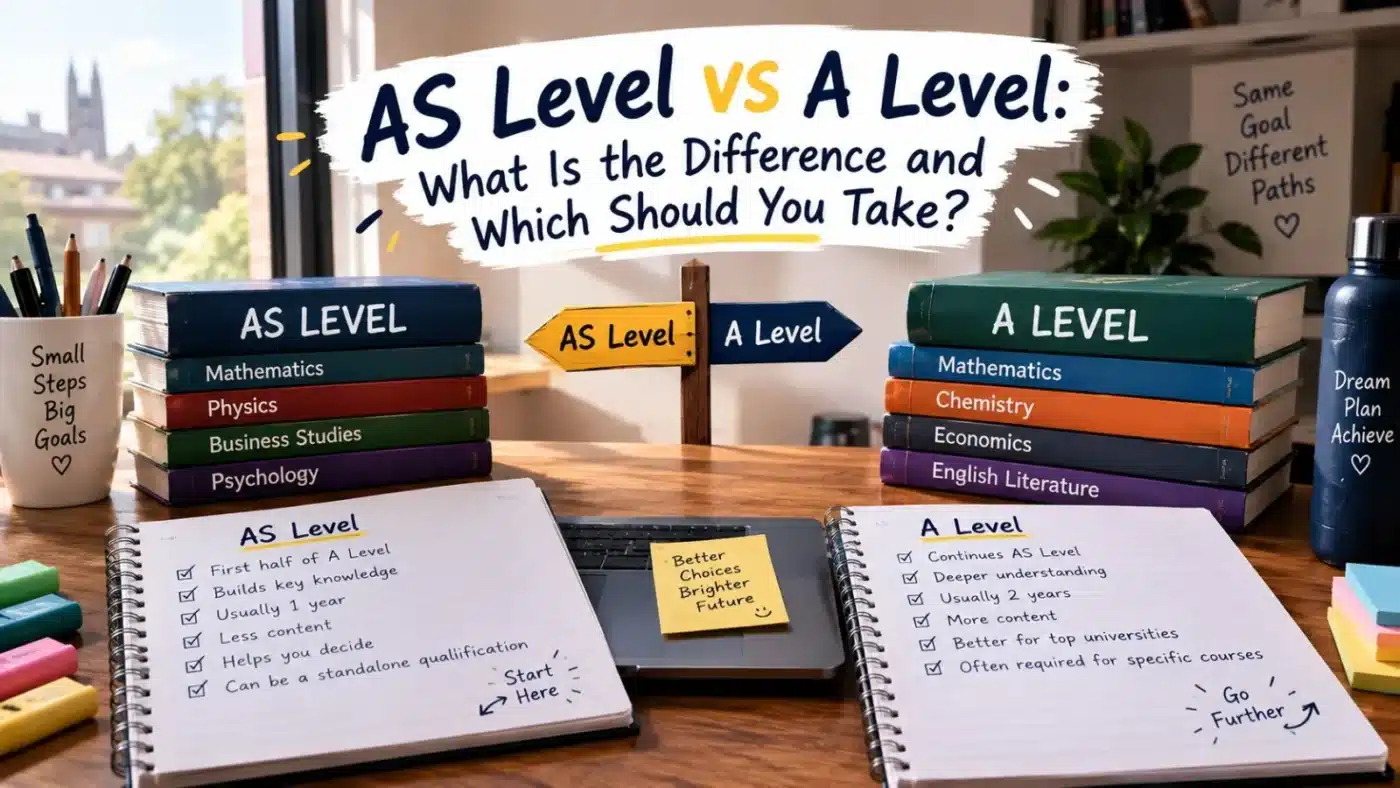
Quick Answer: AS Level is a standalone one-year qualification worth half an A Level, while A Level is a two-year qualification assessed entirely at the end of Year 13. Most students in 2026 take full A Levels rather than AS Levels, as AS results no longer count toward final A Level grades and carry limited weight in UCAS applications. If you have heard both terms thrown around in school and nobody has properly explained the difference, you are not alone. AS Level and A Level sound like they should be part of the same thing, and historically they were. But a series of qualification reforms changed the relationship between them significantly, and the advice students receive about whether to take AS Levels varies so much between schools that many families genuinely do not know what applies to their situation. This guide explains clearly what each qualification is, how they differ, whether AS Levels still matter for university applications, and how to decide which path makes sense for your child. What Is an AS Level? AS Level Explained An AS Level (Advanced Subsidiary Level) is a standalone qualification that covers the first year of A Level content. It is assessed at the end of Year 12 through examinations, and results are awarded on the same A to E grading scale used for A Levels. Before 2015, AS Levels were the first half of a full A Level, students took AS exams at the end of Year 12, and those results contributed 50% of the final A Level grade. Since qualification reforms took effect from 2017 onward, this is no longer the case. AS Levels are now entirely separate from A Levels, and AS results do not count toward A Level grades in any way. An AS Level is roughly equivalent to half an A Level in terms of content and assessment, but it is a complete qualification in its own right, not a stepping stone to a full A Level. AS Level Meaning: What the Qualification Actually Represents In 2026, an AS Level represents: One year of study in a subject at advanced level External examination at the end of Year 12 A standalone qualification graded A to E Approximately 40% of the content of a full A Level (the content covered in Year 12 of the full A Level course) It does not represent the first half of an A Level grade, and it does not automatically progress into a full A Level, though students can continue to A Level in the same subject if their school offers it. What Is the Difference Between AS Level and A Level? AS Level vs A Level: Side by Side Comparison Feature AS Level A Level Duration 1 year (Year 12) 2 years (Years 12 and 13) Assessment Exams at end of Year 12 All exams at end of Year 13 Grading scale A to E A* to E Contributes to A Level grade No, separate qualification Yes, this is the A Level UCAS points Yes, lower than A Level Yes, full tariff points University entry requirement Rarely accepted as substitute Standard requirement Availability Offered by some schools Universal The most important practical difference is that A Level exams are sat entirely at the end of Year 13, covering two full years of content. AS Level exams are sat at the end of Year 12, covering only Year 12 content. A student who takes an AS Level and then continues to A Level in the same subject will sit two separate sets of exams, the AS at the end of Year 12, and the full A Level at the end of Year 13, but neither result affects the other. A Level vs AS Level UK: How the Reform Changed Things Before the Ofqual reforms introduced between 2015 and 2017, the AS Level was formally the first half of an A Level. Students typically took four subjects to AS Level in Year 12, dropped one, and continued three subjects to full A Level in Year 13. The AS result contributed 40 to 50% of the final A Level grade depending on the subject. Since the reform, A Levels are linear, assessed entirely at the end of the two-year course with no contribution from Year 12 performance. The AS Level became a separate qualification that happens to cover similar Year 12 content but carries no weight in the A Level grade. This change fundamentally altered how schools approach Year 12. Most schools in 2026 no longer enter students for AS Level examinations as a matter of course, the additional exam burden in Year 12 without any grade benefit to the A Level has made AS Levels largely redundant in many school settings. Do AS Levels Count for UCAS Points? Yes, AS Levels do generate UCAS tariff points, but significantly fewer than full A Levels. AS Level UCAS Points: What They Are Worth AS Level Grade UCAS Points A 20 B 16 C 12 D 8 E 4 For comparison, a full A Level grade A* generates 56 UCAS points, and a grade A generates 48. An AS Level grade A generates 20, less than half the points of a full A Level grade A. Do AS Levels Count Toward University Applications? This depends entirely on the university and the course. The honest answer in 2026 is: for most competitive university applications, AS Level results carry limited weight and are rarely a decisive factor. Most universities set their entry requirements in terms of full A Level grades. An AS Level result may provide some contextual information, it can show how a student performed in a subject early in their sixth form career, but it does not substitute for a full A Level in the same subject and is not a requirement for most degree programmes. The exception is a small number of universities and programmes that still list AS Levels in their admissions criteria or that use AS results as part of contextual consideration for […]
Sep
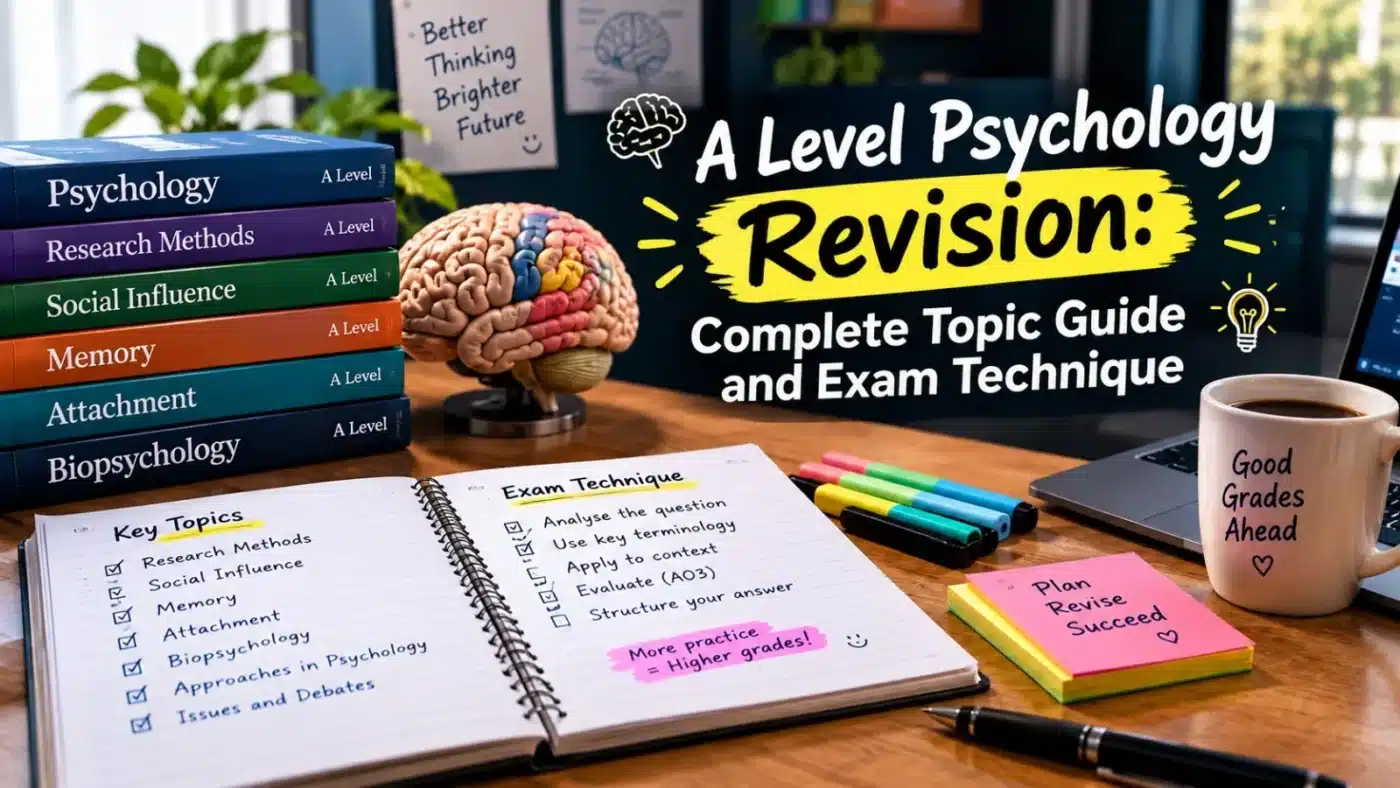
A Level Psychology revision works best when it combines active recall of the extensive factual content with deliberate practice of the specific essay and evaluation skills the AQA and Edexcel mark schemes reward. Students who revise content and exam technique together consistently outperform those who treat them as separate tasks. Most students who choose A Level Psychology do so because the subject genuinely interests them. Human behaviour, mental health, research methods, the biology of the brain. these are topics that feel relevant in a way that abstract academic subjects sometimes do not. What surprises many of them is how demanding it turns out to be. A Level Psychology is not the soft option it is sometimes assumed to be. The content volume is large, the research methodology component is genuinely mathematical, and the mark scheme rewards a very specific type of evaluative writing that takes most students a significant amount of time and practice to develop. Students who arrive expecting an engaging discussion-based subject and find a specification full of precise terminology, statistical tests, and 16-mark essay requirements sometimes feel blindsided. This guide is the honest preparation for what the subject actually demands, and what revision needs to look like to produce the grades the content knowledge deserves. What Is A Level Psychology and What Does It Actually Test? A Level Psychology is a two-year qualification that covers the scientific study of human behaviour and mental processes. It combines biological, cognitive, social, and developmental approaches to psychology with a substantial research methods component that requires students to understand how psychological research is designed, conducted, and evaluated. The subject is assessed through written examinations at the end of Year 13, with no coursework component. The mark scheme rewards three things simultaneously: Knowledge and Understanding: accurate recall and explanation of psychological theories, studies, and concepts Application: the ability to apply psychological knowledge to novel scenarios or case studies presented in exam questions Evaluation: the ability to critically assess theories and research, considering their strengths, limitations, and the evidence for and against them Students who revise only for knowledge: which is the most natural revision instinct, consistently find that the evaluation marks elude them. Those marks require a different kind of preparation. How to Revise A Level Psychology: The Methods That Work Is Active Recall Better Than Re-Reading for Psychology? Yes, significantly. Active recall is the most evidence-supported revision method for content-heavy subjects, and A Level Psychology is one of the most content-heavy A Levels available. Re-reading notes produces recognition, the ability to identify information when you see it. Exams require retrieval, the ability to produce information from memory with nothing in front of you. These are different cognitive tasks, and only one of them is what the exam tests. Active recall for Psychology looks like: Cover and reproduce: covering notes on a study or theory and writing everything recalled from memory, then checking gaps Flashcard testing: one side shows the psychologist’s name or theory, the other shows the key details, methodology, findings, and evaluation points, tested in both directions Self-explanation: explaining a theory or study out loud in precise psychological terminology, as if teaching it to someone who knows nothing about it Past paper questions from memory: attempting short-answer and essay questions without notes before checking the mark scheme What Is the Best Way to Revise Psychology Studies? For each psychological study, students need to know and be able to reproduce: Aim: what the researcher was trying to investigate Methodology: design, sample, procedure, and key methodological decisions Findings: specific results, including quantitative data where relevant Conclusions: what the findings suggest about human behaviour or mental processes Evaluation: at least three specific strengths and three specific limitations, including methodological criticisms, ethical issues, and real-world applications The specific detail matters. “Milgram found that most people obeyed” is not the same as “Milgram found that 65% of participants delivered the maximum 450-volt shock when instructed to do so by an authority figure.” The second is what mark schemes reward. A Level Psychology Topics: Complete Specification Breakdown What Topics Are Covered in AQA A Level Psychology? AQA A Level Psychology, the most widely sat specification, covers the following major topic areas across Years 12 and 13: Social Influence covers conformity, obedience, minority influence, and social change. Key studies include Asch’s conformity experiments, Milgram’s obedience research, and Moscovici’s work on minority influence. This topic appears in almost every paper and is one of the most predictable in terms of question format. Memory covers the multi-store model, the working memory model, eyewitness testimony, and cognitive interview. The evaluation of competing models of memory, their strengths, limitations, and supporting research is regularly examined alongside the applied content on eyewitness testimony. Attachment covers theories of attachment, types of attachment, the Strange Situation procedure, and the role of early attachment in later development. Bowlby’s theory, Ainsworth’s research, and the cross-cultural studies of attachment are all regularly examined. Psychopathology covers definitions of abnormality, characteristics of mental disorders including phobias, depression, and OCD, and psychological and biological treatments. This is a topic where both the characteristics of each disorder and the evaluation of each treatment approach need to be known in specific detail. Approaches in Psychology is a Year 12 topic that covers the biological, behaviourist, cognitive, humanistic, and psychodynamic approaches. This topic is heavily examined in essay questions that ask students to compare approaches or discuss the assumptions of a named approach. Biopsychology covers the nervous system, the brain, localisation of brain function, neuroplasticity, and ways of studying the brain including fMRI, EEG, and post-mortem studies. This is one of the most factually demanding topics in the specification and one where the biological detail needs to be known precisely. Research Methods is the topic that most distinguishes A Level Psychology from what many students expect. It covers experimental design, sampling methods, ethical guidelines, statistical tests, and the interpretation of psychological data. Research methods questions appear on every paper and in every question type, including embedded within questions about specific topics. Year […]

Sep
Economics has a habit of making students feel like they understand it, right up until they sit down to write an exam answer. The content makes sense in class. The concepts feel logical when discussed. Supply and demand, monetary policy, market failure, comparative advantage, these are ideas that click in a way that feels genuinely intuitive. Then the exam paper arrives, and the question asks for something more specific than “explain” and more demanding than “describe,” and the student who felt prepared discovers they were prepared for a different subject than the one being examined. A Level Economics rewards a very particular combination of skills, precise analytical writing, confident data interpretation, and the ability to construct and evaluate arguments rather than simply present them. Those skills do not develop by reading notes or watching explanations. They develop through deliberate practice with honest feedback. This guide shows you exactly what that practice looks like. What A Level Economics Revision Actually Tests Before getting into specific topics and techniques, it is worth being clear about what A Level Economics is fundamentally assessing, because the answer is more specific than most students realise. A Level Economics is not testing whether a student knows the content. It is testing whether a student can use the content to construct, support, and evaluate economic arguments in response to specific questions, using data where it is provided, applying theory to real-world contexts, and demonstrating the kind of evaluative judgement that distinguishes a strong answer from a merely competent one. This distinction matters for how revision should work. A student who knows every diagram in the specification but cannot write a coherent evaluative paragraph will plateau in the middle grade bands. A student who understands what evaluative writing looks like and has practised producing it, with honest mark scheme feedback, will consistently outperform students who know more content but cannot demonstrate it in the required form. AQA A Level Economics vs Edexcel A Level Economics: Know Your Board First The practical foundation of any A Level Economics revision plan is knowing which board is being sat, and aligning every element of revision with that board’s specific papers, mark schemes, and assessment style. AQA A Level Economics assesses through three papers. Paper 1 covers markets and market failure. Paper 2 covers the national and international economy. Paper 3 is a synoptic paper drawing on both micro and macro content, requiring students to apply economic thinking across the full specification in response to a case study and extended essay questions. Edexcel A Level Economics also uses a three-paper structure, with Papers 1 and 2 assessing microeconomics and macroeconomics respectively, and Paper 3, the synoptic paper, requiring integrated application of both. Edexcel uses specific themes rather than general topic headings in some areas of the specification, which affects how content is organised and examined. Both boards reward the same underlying skills, analysis, application, and evaluation, but through question formats, mark scheme structures, and assessment emphasis that differ enough to make board-specific preparation genuinely important. Use the correct specification, correct past papers, and correct mark schemes from the start. A Level Economics Topics: Complete Breakdown A Level Economics is divided between microeconomics and macroeconomics, with content that builds across Years 12 and 13. Here is an honest breakdown of every major topic area and what each demands. Microeconomics Topics: A Level Economics Year 12 Foundation Supply, Demand and Price Determination is the topic that underpins almost everything else in microeconomics. Understanding how markets reach equilibrium, how equilibrium changes when supply or demand conditions change, and how to draw and interpret supply and demand diagrams precisely, these are foundational skills that more advanced microeconomics topics build directly on. The most common error in supply and demand questions is imprecision in diagram drawing and diagram explanation. A shift in demand needs to be drawn correctly, the whole curve moving, not a movement along it, and the explanation needs to identify the specific factor causing the shift, the direction of the resulting price and quantity change, and why. These are learnable habits that only develop through repeated, checked practice. Elasticity covers price elasticity of demand, price elasticity of supply, income elasticity, and cross elasticity. Calculation questions appear regularly and reward students who practise the formula applications carefully, including the interpretation of negative values and the significance of elasticity magnitude. Essay questions on elasticity require students to evaluate the implications of elastic or inelastic demand for firms, consumers, and government policy, which requires genuine understanding rather than formula memorisation. Market Failure is one of the most consistently examined topic areas across both AQA and Edexcel and one where exam questions are most predictable in structure. Public goods, positive and negative externalities, information failure, and market power all appear regularly. The key demand of market failure questions, beyond identifying the failure, is evaluating the effectiveness of different government interventions, which requires understanding the limitations of each policy as well as its intended effect. Theory of the Firm covers different market structures, perfect competition, monopolistic competition, oligopoly, and monopoly, and the behaviour of firms within each. Diagram accuracy matters significantly in theory of the firm questions. The profit-maximising output under different market structures, the shape of cost curves, and the differences between short-run and long-run equilibria all appear in both calculation and essay questions. Macroeconomics Topics: A Level Economics Year 12 and Year 13 Aggregate Demand and Aggregate Supply is the central framework of macroeconomics at A Level and the model that most macroeconomic questions draw on in some form. Understanding the components of aggregate demand, the factors that shift both AD and AS, and the short-run versus long-run implications of demand and supply shocks is essential for almost every macroeconomics essay question. Economic Growth, Unemployment and Inflation the three main macroeconomic policy objectives — are examined both individually and in relation to each other. The conflicts and trade-offs between policy objectives appear consistently in evaluation questions: the trade-off between unemployment and inflation, the short-run versus long-run […]