
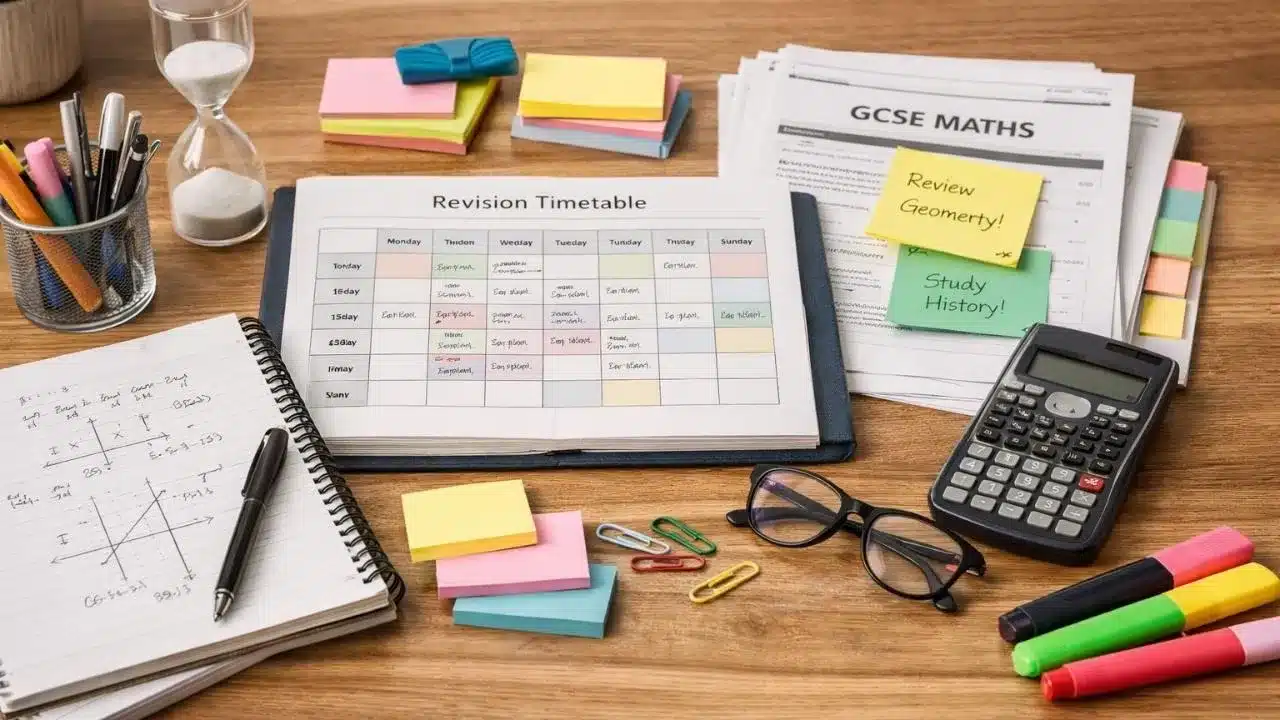
Nobody chooses to struggle with Maths. Students who are finding GCSE Maths genuinely difficult are not lazy, not unintelligent, and not beyond help. They are almost always students who fell behind at some point, a topic that did not click, a term where things moved too fast, a foundational concept that was never quite secure, and who have been trying to keep up ever since while the gaps quietly compounded underneath them.
If that sounds familiar, this guide is written for you. Not the version that assumes you just need to “try harder” or “do more past papers.” The version that starts from where you actually are and gives you a realistic, specific plan for getting to a grade 4 and beyond, if that is what you need.
Why Students Struggle With GCSE Maths: And Why It Is Not What Most People Think
Before getting into the plan, it is worth understanding why GCSE Maths causes so many students genuine difficulty, because the reason matters for how to fix it.
Maths is a sequential subject. Each topic builds on what came before. A student who does not fully understand fractions will struggle with algebra. A student who is shaky on algebra will struggle with quadratics, graphs, and simultaneous equations. A student who misses the foundations of ratio will find proportion and percentage problems consistently unreliable.
This means that when a GCSE Maths student is struggling, the problem is almost never the current topic. It is almost always something that came before the current topic, a gap in foundational knowledge that has been making everything harder for months or years without ever being identified and fixed.
This is the most important thing to understand before starting any revision plan. If a student cannot do quadratics, the answer is not to spend two weeks on quadratics. The answer is to find out what earlier foundation is missing and fix that first. When the foundation is in place, the harder topic usually becomes significantly more manageable.
Why Failing GCSE Maths Happens More Often Than It Should
GCSE Maths failure is rarely about intelligence. It is almost always about foundational gaps, exam technique issues, or bot, combined with a revision approach that addresses neither specifically.
The three most common patterns that lead to underperformance in GCSE Maths:
- Unidentified foundation gaps from Key Stage 3 that were never fully secured and have been silently limiting performance in Year 10 and Year 11 ever since
- Avoiding difficult topics: students naturally gravitate toward practising what they already can do, which means weak areas never improve, while comfortable areas get stronger
- Not showing working method marks account for a significant proportion of available marks in GCSE Maths, and students who do calculations mentally and write only the answer lose those marks, even when their final answer is correct
GCSE Maths Foundation Tier: Understanding What You Are Actually Sitting
What Is GCSE Maths Foundation Tier?
GCSE Maths has two tiers: Foundation and Higher. Foundation tier covers grades 1 to 5. Higher tier covers grades 4 to 9. Most students sitting Foundation tier are aiming for grade 4, the standard pass, or grade 5.
If a student is aiming for grade 4 specifically, Foundation tier is the right entry level. The Foundation tier specification covers the topics needed to demonstrate the level of mathematical understanding that a grade 4 represents — and revising Foundation tier content thoroughly is more effective than attempting Higher tier content without the foundations in place.
What Topics Appear on GCSE Maths Foundation Tier?
Foundation tier covers a broad range of topics across number, algebra, geometry, and statistics. The areas that appear most consistently in Foundation papers and carry significant marks include:
- Number: fractions, decimals, percentages, ratio and proportion, powers and roots, standard form
- Algebra: simplifying expressions, solving equations, substitution, sequences, graphs of linear and quadratic functions
- Geometry: area and perimeter, volume, angles, Pythagoras’ theorem, transformations, similarity
- Statistics and Probability: mean, median, mode and range, probability, interpreting graphs and charts
Students targeting grade 4 should focus the majority of their revision time on these areas, particularly the number and algebra topics that underpin everything else on the paper.
How to Pass GCSE Maths: A Realistic Step by Step Plan
Step One: Find the Gaps Before You Revise Anything
This is the step most struggling students skip, and it is the most important one.
Before starting topic revision, do a diagnostic test across the Foundation tier specification. This does not need to be a full past paper, it can be a set of questions covering each topic area, one or two questions per topic, with the explicit purpose of finding out which areas are solid and which are not.
The results of that diagnostic are the foundation of the entire revision plan. Topics where answers are consistently correct with confidence need less time. Topics where answers are wrong, guessed, or skipped entirely need the most time. Topics where answers are sometimes right but inconsistently need structured practice.
Most students who do this exercise discover that their weaknesses are more specific than they realised, not “I can’t do Maths” but “I struggle specifically with fractions, algebraic manipulation, and anything involving angles.” That specificity is useful. It makes revision targetable rather than overwhelming.
Step Two: Fix Foundation Gaps Before Moving to Harder Topics
Once the gaps are identified, the order of revision matters significantly.
Start with the most foundational topics, number skills, fractions, basic algebra, before moving to topics that build on them. A student who cannot confidently add and subtract fractions should not be spending revision time on algebraic fractions, because they will hit the same wall every time and attribute the difficulty to the new topic rather than the underlying gap.
For each gap identified:
- Find a clear, worked explanation of the topic, not a textbook paragraph to read, but a worked example that shows every step
- Work through similar examples yourself, writing every step even when it feels unnecessary
- Then attempt questions on that topic from past papers or practice resources, under mild time pressure, without reference materials
- Check answers against the mark scheme and identify specifically where errors occurred
This process- explanation, worked examples, independent practice, mark scheme review- is slower than jumping straight into past papers, but it builds genuine understanding rather than superficial familiarity that falls apart under exam pressure.
Step Three: Build Non-Calculator Skills Separately
Paper 1 of most GCSE Maths specifications is non-calculator. Students who revise primarily with a calculator are consistently underprepared for this paper, even when they understand the content.
Non-calculator skills that need deliberate practice:
- Mental arithmetic: addition, subtraction, multiplication and division of whole numbers and decimals without a calculator
- Written methods: long multiplication, long division, and column addition and subtraction for larger numbers
- Fraction arithmetic: adding, subtracting, multiplying, and dividing fractions by hand
- Percentage calculations: finding percentages of amounts, percentage increase and decrease, without calculator assistance
- Estimation: rounding numbers to make approximate calculations, which appears regularly on non-calculator papers
Setting aside specific non-calculator practice sessions, working through problems without touching a calculator even when one is available, builds these skills significantly faster than general revision that allows calculator use throughout.
Step Four: Practise Past Papers the Right Way
Once foundation gaps have been addressed and basic topic confidence is building, past papers become the most valuable revision tool. But how they are used determines whether they produce improvement or just measure it.
Do past papers under timed conditions. The exact time limit of the actual paper, no calculator on Paper 1, no notes. This replicates the exam environment that performance ultimately depends on.
Show every step of the work. Every single step, even the ones that feel obvious. Method marks are independent of the final answer in GCSE Maths, they can be earned even when the final answer is wrong. A student who writes only answers and gets them wrong earns zero. A student who shows the correct method and makes an arithmetic error at the last step earns most of the available marks.
Mark using the official mark scheme. AQA, Edexcel, and OCR all publish past papers and mark schemes on their official websites. Use the official mark scheme, not estimated marking based on whether the answer looks about right.
Track errors by topic, not by paper. After marking, the useful question is not “what did I score on this paper?” but “which topics am I consistently losing marks in?” That pattern tells the next revision session where to focus.
Step Five: Address Exam Technique Specifically
Exam technique costs more marks in GCSE Maths than most students realise, not because of a lack of knowledge, but because of specific habits that lose marks unnecessarily.
The most common exam technique issues in GCSE Maths:
- Not reading the question carefully: missing instructions like “give your answer to 2 decimal places” or “show that” which change what is required
- Not showing working: the single most common source of unnecessary mark loss in GCSE Maths
- Leaving blanks: a blank answer earns zero marks; a partially correct attempt with visible working can earn method marks
- Running out of time: spending too long on hard questions at the expense of easier questions later in the paper, which is a time management habit that only deliberate timed practice corrects
- Not checking units: answers to geometry and measurement questions require units, and omitting them costs marks on otherwise correct responses
Each of these is a specific, fixable habit. Identifying which ones apply to a particular student and addressing them deliberately, not as general advice but as specific practice targets, produces faster mark improvement than more content revision in most cases.
GCSE Maths Grade 4: What It Actually Takes to Get There
What Does a Grade 4 in GCSE Maths Look Like?
A grade 4 in GCSE Maths represents solid, reliable performance across the Foundation tier content. It does not require getting everything right. It requires demonstrating enough correct understanding across enough of the paper to reach the grade boundary.
The specific mark required for grade 4 shifts each year based on paper difficulty, the grade boundary is set after each sitting using comparable outcomes rather than a fixed percentage. But broadly, a student who can reliably answer the questions in the first half to two-thirds of a Foundation tier paper has the foundation for a grade 4.
What that means in practice:
- Strong performance on number and basic algebra questions that appear consistently in the early part of the paper
- Reliable geometry skills including area, perimeter, angles, and basic Pythagoras
- Consistent performance on statistics questions including averages and basic probability
- Reasonable attempts on mid-difficulty questions with working shown, even where the final answer is not perfect
A grade 4 is not out of reach for any student who has the foundational knowledge in place and has practised exam technique sufficiently. It is a threshold that deliberate, targeted preparation consistently achieves.
What Is the Difference Between Grade 4 and Grade 5?
A grade 5 is the strong pass, the threshold that most competitive sixth forms and A-Level programmes use as their minimum for Maths. Achieving grade 5 rather than grade 4 requires reliable performance on the mid-difficulty questions in the paper rather than just the early questions, and consistent accuracy rather than occasional successful attempts.
For students whose target is grade 5, because a sixth form requires it, or because they want to keep Maths-related A-Level options open, the revision plan above applies, with additional focus on the mid-difficulty algebra, geometry, and statistics topics that the harder Foundation questions draw on.
GCSE Maths Tutor: When Getting Help Is the Right Decision
When a GCSE Maths Tutor Makes the Most Difference
There are specific situations where working with a specialist tutor produces significantly faster improvement than self-directed revision:
- When a student has identified foundational gaps but is not sure how to address them, working with a dedicated GCSE Maths tutor who can identify exactly where the gaps started is often the fastest way to close them and explain concepts in a way that makes sense for that specific student.
- When past paper marks have plateaued, a student doing past papers but not improving is almost always making consistent errors that they cannot see themselves, which a tutor can identify quickly.
- When exam anxiety is a significant factor, working through problems with a supportive specialist in a low-pressure environment builds the confidence that exam conditions require.
- When time is limited, a tutor who knows the specification and the grade boundary can direct revision precisely to where marks are most available, which is significantly more efficient than covering everything.
GCSE Maths Help: What to Expect From the Right Specialist
The right GCSE Maths tutor for a struggling student is not just someone who knows Maths well. It is someone who can explain foundational concepts in multiple ways until one of them lands, who has patience for the repetition that building mathematical confidence requires, and who knows the specific papers and mark schemes well enough to focus preparation on what actually earns marks in the exam.
GCSE Maths Resit: What to Know If You Need to Try Again
Failing GCSE Maths: What Happens Next
Students who do not achieve grade 4 in GCSE Maths are required to continue studying and resitting the subject post-16. A November resit is available each year for students in this situation, and most sixth forms and colleges provide resit support.
The November resit is a genuine opportunity for significant improvement, not just a repeat of the same result. Students who approach it differently from their first sit, with a clear understanding of where marks were lost and a targeted plan to address those specific areas, consistently achieve better outcomes.
GCSE Maths Resit: What Needs to Change
The most common resit mistake is revising generally and hoping for a better result. The students who improve most between their first sit and a resit are the ones who:
- Obtained their component marks breakdown to identify which papers and question types underperformed
- Identified specifically whether the gap was in content knowledge, exam technique, or both
- Got targeted support rather than general tutoring, working on the specific areas identified rather than the whole specification again
- Practised under exam conditions consistently rather than only revising content
A resit prepared this way, specifically, honestly, and with proper exam condition practice, is a realistic path to grade 4 for students who were close in their first sitting.
How Tutor Globe Supports Struggling GCSE Maths Students
Struggling with GCSE Maths is one of the most common situations Tutor Globe specialists work with, and it is one where the right match between student and tutor makes the most visible difference.
The specialists on Tutor Globe who work with Foundation tier students and resit candidates understand the specific challenge: building confidence alongside content knowledge, identifying foundational gaps that have been limiting performance for years, and creating the kind of low-pressure learning environment where a student who already feels anxious about Maths can actually progress rather than shutting down.
Tutor Globe’s filtering allows families to find tutors matched specifically to Foundation tier, the relevant exam board, AQA, Edexcel, or OCR, and the specific situation: first-time GCSE preparation or resit. That specificity matters because a Foundation tier resit student needs different support from a Higher tier student aiming at grade 8, and matching the tutor to the actual situation produces better outcomes.
A trial session is the most useful starting point. The tutor will identify within the first session where the foundational gaps are and what a realistic plan to grade 4 looks like, which is exactly the information needed to stop feeling overwhelmed and start working on the right things.
Frequently Asked Questions About Passing GCSE Maths
What is the easiest way to pass GCSE Maths?
There is no shortcut, but there is a smarter approach: identify foundational gaps first rather than revising everything, fix the specific areas that are costing most marks, show all working in every question, and practise under timed exam conditions regularly. That combination is consistently more effective than more hours of general revision.
What grade do you need to pass GCSE Maths?
Grade 4 is the standard pass. Students who do not achieve grade 4 are required to continue studying and resitting Maths post-16. Grade 5 is the strong pass required by most competitive sixth forms and A-Level programmes that involve Maths.
Can you resit GCSE Maths if you fail?
Yes. A November resit is available each year for students who did not achieve grade 4. Further resit opportunities exist in the summer series. Most schools and colleges support resit candidates, and many students improve significantly with targeted preparation between sittings.
How many times can you resit GCSE Maths?
There is no limit on the number of times a student can resit GCSE Maths. Students can sit the exam in each available series until they achieve the grade they need. Each resit is a fresh opportunity, and students who prepare differently rather than repeating the same approach consistently see improvement.
Is Foundation tier GCSE Maths hard to pass?
Foundation tier is designed to be accessible for the full range of students aiming at grades 1 to 5. A grade 4 on Foundation tier is achievable for most students who have the core number, algebra, and geometry foundations in place and have practised exam technique under timed conditions. The challenge for many students is foundational gaps that make topics harder than they need to be, and addressing those specifically is what makes the difference.
How long does it take to improve a GCSE Maths grade?
This depends on how far the grade needs to move and how targeted the preparation is. A student who is close to the grade 4 boundary with specific, identified weaknesses can make meaningful improvement in six to eight weeks of targeted revision. A student with more significant foundational gaps needs longer, which is why starting revision early and getting help quickly matters more in Maths than in most other subjects.
Final Thoughts
Students who are struggling with GCSE Maths often feel like they are the only one finding it hard, like the problem is something fundamental about the way their brain works, and like no amount of revision is going to change that.
None of those things are true.
GCSE Maths difficulty almost always comes from specific, identifiable gaps in foundational knowledge, gaps that, when found and addressed properly, make the topics that seemed impossible suddenly much more manageable. The students who go from failing to passing are not the ones who suddenly became better at Maths. They are the ones who found the gap, fixed it, and practised the right things in the right way.
If your child is struggling with GCSE Maths and needs support that is matched to their actual starting point, not a generic revision programme but a specific plan built around what they need, Tutor Globe is worth exploring. The specialists there work with Foundation tier and resit students regularly and know how to find the gaps, explain the concepts, and build the exam technique that produces results on the day that matters.
A trial session is the first step. It gives a clear picture of where things stand and what needs to happen next, which is exactly what a student who feels overwhelmed by GCSE Maths needs most.
