
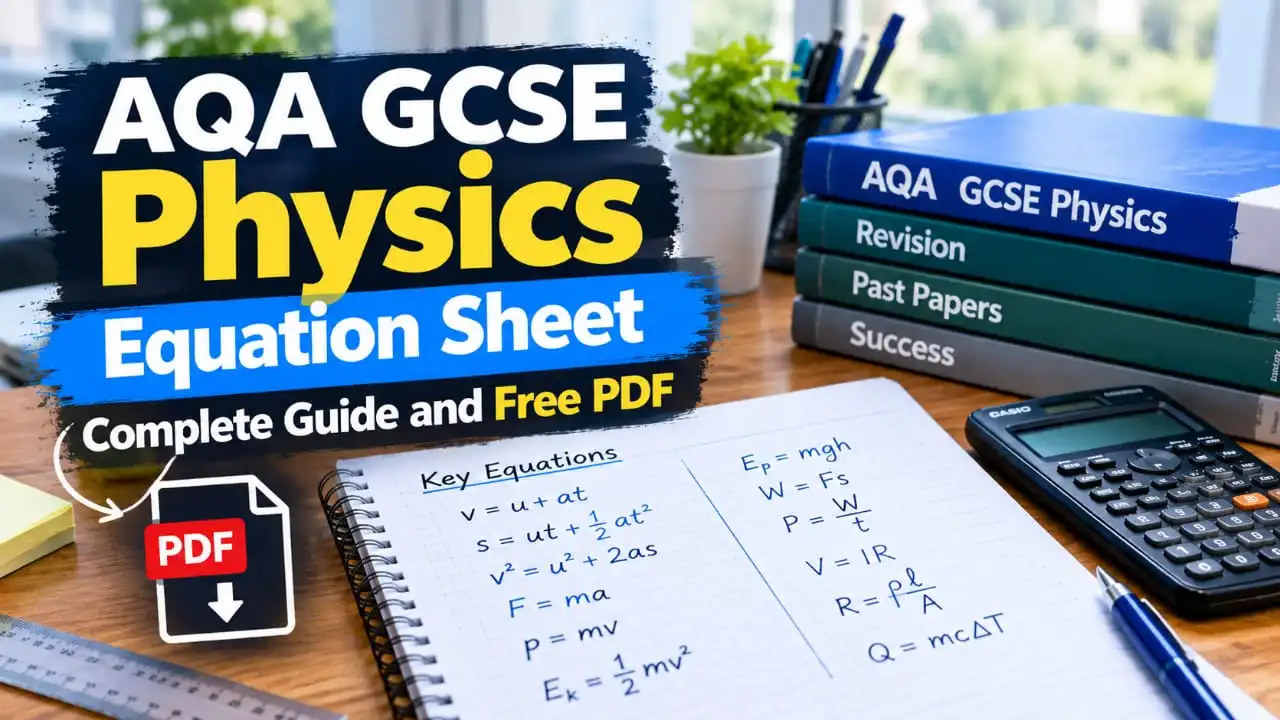
Quick Answer: The AQA GCSE physics equation sheet provides a list of equations students are given in the exam. However, not all physics equations are on the sheet, students must also memorise a separate set of equations from their own recall. Knowing which equations are provided and which must be memorised is one of the most important exam preparation steps for AQA GCSE Physics students.
Every AQA GCSE Physics student gets handed a list of equations at some point in Year 10 or Year 11. Some file it away. Some highlight it. Very few actually use it in the way that genuinely helps exam performance.
The problem is not that students do not have the AQA physics equation sheet, it is that most students do not know how to use it strategically. They are not sure which equations will be given in the exam, which ones they need to have memorised independently, how to rearrange equations under time pressure, or which equations appear most frequently in the hardest questions on the paper.
This guide fixes all of that. By the end, you will know exactly what the AQA GCSE physics equation sheet contains, which additional physics equations GCSE students must memorise themselves, and how to use equation knowledge to pick up marks consistently across every paper.
What Is the AQA Physics Equation Sheet?
The AQA GCSE physics equation sheet is a list of equations provided to students during their GCSE Physics examinations. It covers the equations that AQA has decided students do not need to memorise, instead, they are printed and given out at the start of the exam so students can focus on applying the equations rather than simply recalling them.
The equation sheet is provided for both AQA GCSE Physics (separate science) and AQA GCSE Combined Science: Trilogy for the physics component. The content of the sheet is the same for both, though the number of equations tested differs slightly between the two specifications.
What Does the AQA Physics Formula Sheet Include?
The AQA GCSE physics formula sheet is divided into two sections:
Equations given in the exam: these appear on the formula sheet provided during the exam. Students do not need to memorise these but do need to know how to identify the right equation for a given question, substitute values correctly, rearrange when necessary, and apply appropriate units.
Equations students must memorise: these do not appear on the formula sheet. AQA expects students to have committed these to memory and be able to recall and apply them without any reference material.
Understanding this two-category structure is the foundation of effective physics equation revision. Many students make the mistake of treating all physics equations GCSE papers test as equally important to memorise, without realising that roughly half of them will be provided in the exam.
AQA GCSE Physics Equation Sheet: Equations Provided in the Exam
The following equations appear on the AQA physics equation sheet and are given to students during their GCSE Physics examinations. Students do not need to memorise these, but they do need to understand what each one means and how to use it.
Forces and Motion Equations, Given on Sheet
- Resultant force: F = ma (force = mass × acceleration)
- Work done: W = Fs (work done = force × distance)
- Kinetic energy: Ek = ½mv² (kinetic energy = 0.5 × mass × velocity²)
- Gravitational potential energy: Ep = mgh (GPE = mass × gravitational field strength × height)
- Momentum: p = mv (momentum = mass × velocity)
- Force and momentum: F = mΔv / Δt (force = change in momentum / time)
- Wave speed: v = fλ (wave speed = frequency × wavelength)
Electricity Equations, Given on Sheet
- Charge: Q = It (charge = current × time)
- Power: P = IV (power = current × voltage)
- Power (alternative): P = I²R (power = current² × resistance)
- Energy transferred: E = QV (energy = charge × voltage)
- Energy transferred (alternative): E = Pt (energy = power × time)
- Efficiency: Efficiency = useful output energy / total input energy
Thermal and Nuclear Equations, Given on Sheet
- Change in thermal energy: ΔE = mcΔθ (energy = mass × specific heat capacity × temperature change)
- Thermal energy for change of state: E = mL (energy = mass × specific latent heat)
- Pressure and volume: pV = constant (for a fixed mass of gas at constant temperature)
Physics Equations GCSE Students Must Memorise: Not on the Formula Sheet
This section is where most students lose marks. The following equations do not appear on the AQA GCSE physics equation sheet, students must recall them entirely from memory during the exam.
Forces and Motion, Must Memorise
- Weight: W = mg (weight = mass × gravitational field strength)
- Speed: v = d/t (speed = distance / time)
- Acceleration: a = Δv/t (acceleration = change in velocity / time)
Electricity, Must Memorise
- Ohm’s Law / Resistance: V = IR (voltage = current × resistance)
- Total resistance in series: R_total = R₁ + R₂
- Total resistance in parallel: 1/R_total = 1/R₁ + 1/R₂
Waves, Must Memorise
- Period and frequency: T = 1/f (period = 1 / frequency)
Magnetism and Electromagnetism, Must Memorise
- Transformer equation: Vs/Vp = Ns/Np
- Transformer power: VpIp = VsIs
Space, Must Memorise
- Orbital speed: v = 2πr/T
Edexcel Physics Formula Sheet: How It Compares to AQA
Many students and parents search for information about the Edexcel physics formula sheet when they are actually sitting AQA, or vice versa. Understanding the difference matters for revision.
The Edexcel GCSE Physics formula sheet follows a similar structure to AQA, some equations are provided in the exam, others must be memorised. However, the specific equations in each category differ between the two boards. The wording of equations, the symbols used, and occasionally the form in which an equation is presented can differ between AQA and Edexcel papers.
Students sitting AQA GCSE Physics should revise exclusively using the AQA physics equation sheet and AQA specification. Using Edexcel resources or a mixed set of equation sheets creates confusion and, in some cases, introduces equation formats that AQA does not use.
If your child is sitting Edexcel rather than AQA, the principles in this guide apply, but the specific equation lists will differ. Confirm the board with your child’s school before using any equation sheet as a revision reference.
How to Use the AQA Physics Formula Sheet Effectively in the Exam
Knowing that equations are provided is only the first step. How students use the AQA physics formula sheet during the exam determines whether those provided equations actually earn marks.
The Three Most Common Equation Sheet Mistakes
Mistake one, not reading the equation carefully before using it. The AQA physics equation sheet lists equations in a standard form. Exam questions often require the equation to be rearranged before values can be substituted. Students who substitute into the standard form without rearranging first lose marks on otherwise correct questions.
Mistake two, using the wrong equation for the question. The formula sheet lists multiple equations involving energy, force, and power. Students who pick an equation based on which variables appear in the question without checking whether it applies to the specific physical scenario described will use the wrong equation even though the right one was in front of them.
Mistake three, forgetting units. Equations on the AQA physics formula sheet use SI units. Students who substitute values in incorrect units, kilometres instead of metres, grams instead of kilograms, produce wrong answers even when the equation choice and rearrangement are correct.
How to Rearrange Physics Equations Under Exam Pressure
Equation rearrangement is a skill that requires practice to become automatic. A reliable five-step process for any physics equation:
- Write the equation in its standard form from the formula sheet
- Identify which variable the question is asking you to find
- Rearrange algebraically before substituting any values
- Substitute values with their units clearly shown on a separate line
- Calculate and state the answer with appropriate significant figures and correct units
AQA GCSE Physics Equation Sheet: Which Equations Appear Most in Exams?
Based on analysis of AQA GCSE Physics past papers, some equations appear far more consistently than others. Knowing which equations carry the most exam weight helps direct revision time effectively.
Highest Frequency Equations in AQA Past Papers
Equation | Category | Exam Frequency |
V = IR (Ohm’s Law) | Must memorise | Very high, appears in almost every paper |
W = mg (Weight) | Must memorise | Very high, foundational forces question |
F = ma (Newton’s second law) | Provided on sheet | High, mechanics calculations |
v = d/t (Speed) | Must memorise | High, appears in multiple forms |
Ek = ½mv² (Kinetic energy) | Provided on sheet | High — energy questions |
P = IV (Electrical power) | Provided on sheet | High, electricity calculations |
Ep = mgh (GPE) | Provided on sheet | High, energy store questions |
v = fλ (Wave speed) | Provided on sheet | Medium-high, waves section |
Q = It (Charge) | Provided on sheet | Medium-high, electricity section |
ΔE = mcΔθ (Specific heat capacity) | Provided on sheet | Medium, thermal physics |
The must-memorise equations, V = IR, W = mg, v = d/t, and a = Δv/t appear consistently across every AQA GCSE Physics paper and are the equations most worth prioritising in terms of memorisation and rearrangement practice.
Physics Equations GCSE Revision Strategy: How to Learn Them Properly
Understanding which equations are on the AQA physics formula sheet and which must be memorised is the foundation. Building genuine fluency with all of them requires a specific revision approach.
Active Recall for Must-Memorise Equations
The must-memorise equations cannot be learned passively. Reading through a list of equations and feeling like they are familiar is not the same as being able to reproduce them accurately from memory under exam pressure.
Active recall for physics equations looks like:
- Cover and reproduce: covering the equation list and writing every must-memorise equation from memory, then checking accuracy
- Flashcard testing: one side shows the quantity being calculated, the other shows the equation, tested regularly rather than read passively
- Equation derivation: understanding where equations come from physically, not just what they look like
- Mixed equation practice: attempting questions that require identifying the correct equation without being told which one applies
Using the Formula Sheet Equations Strategically
For the provided equations, the revision goal is not memorisation but fluency, the ability to find the right equation quickly, rearrange it correctly, and apply it accurately. Building this fluency requires working through past paper calculation questions specifically, not reading the equation sheet, but using it while solving actual exam questions under timed conditions.
Past Paper Practice: The Foundation of Equation Fluency
No revision approach builds equation fluency faster than working through past papers under timed conditions. Students who want to improve their overall approach to GCSE Science Revision will find that building equation fluency is the foundation that makes every other physics topic more manageable, because so much of AQA GCSE Physics involves applying equations to novel scenarios rather than simply recalling facts.
For a complete guide to using past papers effectively across all A Level and GCSE subjects, our guide on A Level Past Papers: The Ultimate Revision Strategy Used by Top Students covers the full method in detail.
Understanding what GCSE Grades mean in Physics specifically helps students set realistic equation fluency targets for their grade goal, whether that is grade 4, 6, or 9.
AQA GCSE Physics Equation Sheet PDF: How to Access It
The official AQA GCSE physics equation sheet PDF is available through AQA’s official website at aqa.org.uk. Students and parents can download it directly from the qualification page for AQA GCSE Physics (8463) or AQA GCSE Combined Science: Trilogy (8464).
Where to find the AQA physics equation sheet PDF:
- AQA’s official website: search for GCSE Physics 8463 and navigate to the Teach section for exam materials
- Physics Maths Tutor: hosts the equation sheet alongside past papers and mark schemes
- Your child’s school: most AQA schools provide the equation sheet through the school’s learning platform
- Download the AQA GCSE Physics Equation Sheet PDF — Free: Download the official AQA GCSE Physics Equation Sheet (PDF) — a ready-to-use version you can save and print immediately.
Students should always use the most recent version of the equation sheet. The version on AQA’s official website is always the most current and the one that will appear in the actual exam.
How GCSE Physics Tutoring Helps With Equation Mastery
Understanding the AQA physics equation sheet is one thing. Using equations fluently under timed exam conditions is a different skill that takes targeted practice to develop.
This is where the right GCSE Physics tutor makes a practical difference. As detailed on our GCSE Physics tutors page, the most effective revision combines active recall with specific exam-technique practice, and a specialist tutor who knows the AQA specification in depth can identify exactly which equations a student handles confidently and which consistently cause errors.
Tutor Globe has GCSE Physics specialists who know the AQA specification, the equation sheet structure, and the specific calculation question types that appear most consistently in past papers. Whether a student needs help building confidence with the must-memorise equations, wants targeted support on electricity or mechanics calculations, or is aiming for grade 7 and above, the right specialist makes that process significantly more efficient.
Visit our GCSE Physics Tutors page to find a specialist matched to the AQA specification and your child’s specific grade target.
Key Takeaways: AQA GCSE Physics Equation Sheet
- The AQA GCSE physics equation sheet provides some equations in the exam, students do not need to memorise these but must know how to use them correctly
- A separate set of equations including V = IR, W = mg, and v = d/t must be memorised independently and do not appear on the formula sheet
- The must-memorise equations include some of the most frequently tested in AQA past papers, making memorisation and rearrangement practice genuinely high priority
- The three most common equation mistakes are using the wrong equation, rearranging incorrectly, and substituting values in wrong units
- The official AQA physics equation sheet PDF is available free on AQA’s website and should be used in all practice sessions
- Knowing which equations are provided and which must be memorised is the single most important structural knowledge for AQA GCSE Physics exam preparation
Frequently Asked Questions: AQA GCSE Physics Equation Sheet
What equations are given in the AQA GCSE Physics exam?
The AQA GCSE physics equation sheet provided in the exam includes equations for forces and motion, electricity, waves, and thermal physics, including F = ma, Ek = ½mv², P = IV, Ep = mgh, v = fλ, and others. The full list is available on AQA’s official website and should be downloaded and used throughout revision.
Which physics equations do AQA GCSE students need to memorise?
AQA GCSE Physics students must memorise equations not included on the formula sheet, including V = IR, W = mg, v = d/t, a = Δv/t, T = 1/f, and transformer equations. These must-memorise equations appear consistently in past papers and are among the most frequently tested.
Is the AQA physics equation sheet the same for Combined Science and separate Physics?
Yes — the AQA physics equation sheet content is the same for AQA GCSE Physics (8463) and the physics component of AQA GCSE Combined Science: Trilogy (8464). The equations provided in the exam are identical, though the specific questions and weighting differ slightly between the two qualifications.
Where can I download the AQA GCSE physics equation sheet PDF for free?
The official AQA GCSE physics equation sheet PDF is available free on AQA’s official website at aqa.org.uk. Navigate to GCSE Physics qualification page 8463 and look under teaching and assessment resources. Physics Maths Tutor also hosts it alongside past papers and mark schemes.
How is the AQA physics equation sheet different from the Edexcel physics formula sheet?
Both boards provide some equations in the exam and require others to be memorised, but the specific equations in each category differ between AQA and Edexcel. Students should only use their own board’s equation sheet and specification materials.
How should students practise using the AQA physics equation sheet?
Students should practise using the equation sheet exactly as they will in the real exam, with the sheet available while working through past paper calculation questions under timed conditions. This builds the identification, rearrangement, and application skills the exam tests.
What are the most important equations to memorise for AQA GCSE Physics?
The must-memorise equations that appear most frequently in AQA past papers are V = IR, W = mg, v = d/t, and a = Δv/t. These four equations appear in some form on almost every AQA GCSE Physics paper and should be the first priority for memorisation and rearrangement practice.
Final Thoughts: Mastering the AQA Physics Equation Sheet
The AQA GCSE physics equation sheet is one of the most useful tools available to students in the exam, and one of the most underused in revision.
Students who understand exactly which equations are provided and which must be recalled independently, who have practised rearranging equations under timed conditions, and who have built automatic habits of unit checking and correct substitution consistently pick up more marks on calculation questions than those who know the physics but have not practised the equation application process specifically.
If your child is preparing for AQA GCSE Physics and wants specialist support matched to the AQA specification and the specific topics where marks are being lost, visit our IGCSE Physics Tutors page to find the right specialist today.
