
Everyone has an opinion about which A Levels are hardest. Ask a Maths student and they will tell you Further Maths is in a league of its own. Ask a humanities student and they will quietly suggest that anyone who has not written a 3,000-word History essay under timed conditions has no business calling anything else difficult. Ask a Biology student in the middle of memorising the entire nitrogen cycle at 11pm and they will not even answer the question.
The problem with opinions about A Level difficulty is that they are almost always based on personal experience, which subjects felt hard to that particular person, in their particular school, with their particular teachers and strengths. That is not useless information, but it is not the full picture either.
This guide goes further than opinion. It looks at what the data actually shows, grade distributions, fail rates, pass rates, and the structural features of each subject that make it objectively more or less demanding, alongside honest assessments from teachers, examiners, and the students who have sat these subjects at the highest level.
The goal is not to discourage anyone from any subject. It is to give students and parents the clearest possible picture of what each A Level actually demands, so that subject choices are made with real information rather than myths and hearsay.
Struggling with the hardest A Levels? Get expert support in Maths, Further Maths, Physics, Chemistry and more to boost your confidence and grades.
How A Level Difficulty Is Actually Measured
Before ranking anything, it is worth being clear about what “difficulty” means, because there are several ways to measure it, and they do not always point in the same direction.
Grade distributions and A Level fail rates: the percentage of students who achieve each grade in a subject tells you something about how demanding it is relative to other subjects. A subject where fewer students achieve A and A* grades is not automatically harder — the student intake differs between subjects, but combined with other data, grade statistics provide useful context.
A Level grade statistics: published annually by exam boards and Ofqual, these show the percentage of students achieving each grade in every subject. They allow comparisons across subjects and across years.
Structural demands of the subject: how much content needs to be mastered, how complex the exam questions are, how much independent mathematical or analytical thinking is required, and how much the subject rewards genuine understanding versus careful memorisation.
Student and teacher assessments, surveys of students and subject teachers consistently show similar patterns in perceived difficulty, which correlates reasonably well with grade distribution data.
No single measure captures everything. This guide uses all of them.
A Level Difficulty Ranking: The Full Picture
The Hardest A Level Subjects by Grade Data and Structural Demand
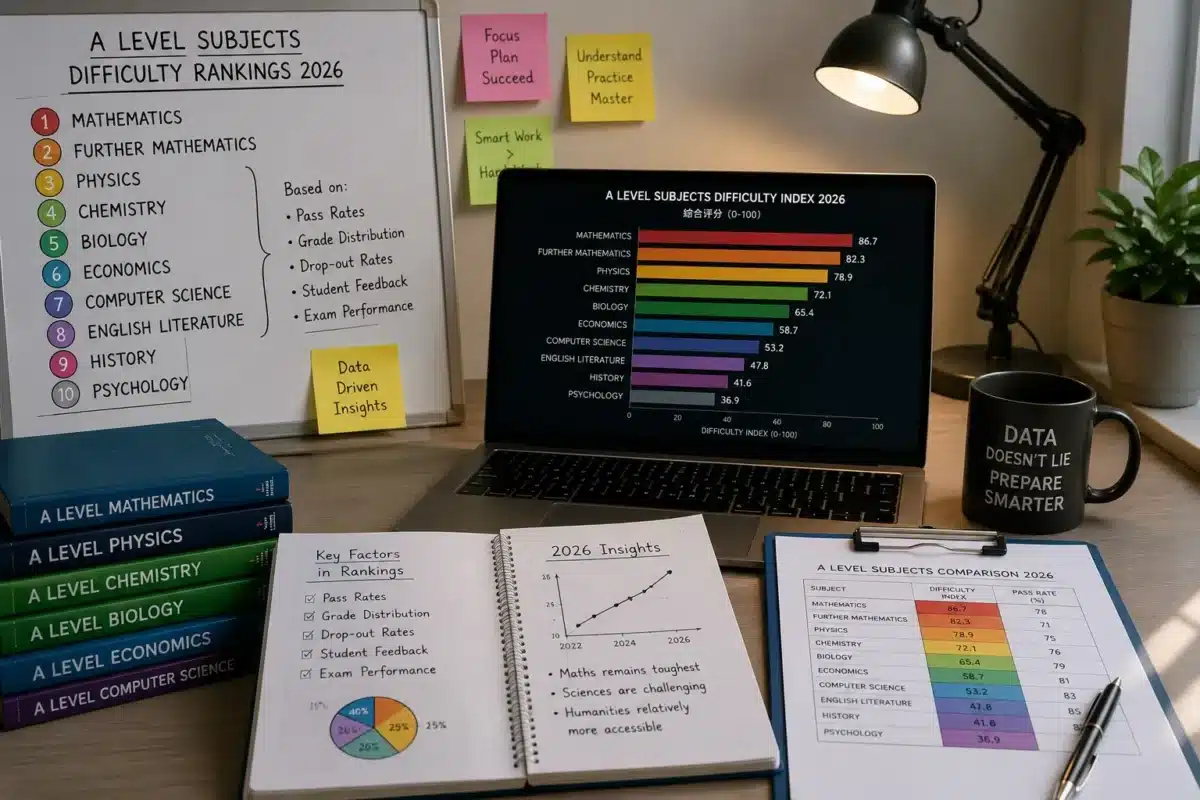
What the data consistently shows across multiple years of A Level grade statistics is a pattern that surprises some students and confirms what others already suspected. Here is the honest ranking, from most demanding to most accessible, with the reasoning for each position.
Further Mathematics: The Hardest A Level by Almost Every Measure
Further Mathematics sits at the top of every credible A Level difficulty ranking, and the data supports that position consistently.
What makes it hardest: Further Maths extends A Level Maths into content that is significantly more abstract and mathematically demanding than anything in the standard A Level, complex numbers, matrices, further calculus, differential equations, and advanced proof. The pace is faster, the content is denser, and the mathematical fluency required is substantially higher than any other A Level subject.
Who takes it: Further Maths is predominantly taken by students who are already strong mathematicians. The self-selection means the student intake is among the most mathematically able of any A Level cohort, which makes the grade distribution data particularly striking. Even among this group, the percentage achieving A and A* is lower than in most other subjects taken by a less-selected cohort.
What the grade statistics show: Consistently lower A and A* rates than standard A Level Maths, even accounting for the high-ability intake. The percentage of students achieving top grades in Further Maths is lower than in humanities subjects taken by a much broader student population.
The honest assessment: Further Maths is genuinely the hardest A Level for the vast majority of students who take it. It is also one of the most valuable for students applying to mathematics, engineering, physics, and computer science at competitive universities, which is exactly why students who find it hard keep going.
Hardest A Level Maths: Standard A Level Mathematics
Standard A Level Mathematics sits just below Further Maths in every difficulty ranking, and consistently shows among the lowest percentages of top grades relative to the number of students who take it.
What makes it hard: The content volume is large, the pace is fast, and the mathematical fluency required, particularly in calculus, proof, and the mechanics and statistics applications. is significantly greater than anything at GCSE. The jump from GCSE grade 9 to A Level Maths is consistently underestimated by students who found GCSE easy, and the first year is often the hardest adjustment of any A Level subject.
What the data shows: A Level Maths has one of the lower percentages of A and A* grades among the major A Level subjects, typically around 40 to 45% of entries achieving A or A* in recent years, which sounds high until you consider that the student intake is already significantly self-selected toward mathematical ability. Among all students who study at sixth form, the pass rate is high, but achieving the top grades is genuinely challenging.
The honest assessment: A Level Maths is hard in a way that is consistent and predictable. Students who build strong algebraic foundations in Year 12 and develop genuine calculus fluency in Year 13 do well. Students who try to memorise methods without understanding them plateau at B or C regardless of effort.
Hardest A Level Sciences: Physics, Chemistry and Biology Ranked
The three sciences are all demanding in different ways. Ranking them against each other is genuinely contested, but the data and structural features suggest a consistent order.
A Level Physics: Abstract Thinking and Mathematical Demands
Physics sits at the top of the science difficulty ranking by most measures. The combination of abstract conceptual content, fields, quantum mechanics, relativistic effects, with significant mathematical demands produces a subject that tests multiple types of thinking simultaneously.
What the data shows: A Level Physics has among the lower A and A* rates of the three sciences. The student intake is already mathematically biased, most A Level Physics students also take Maths, which makes the relatively modest top-grade percentages particularly significant.
What makes it hard: The content is abstract in a way that Chemistry and Biology are not. Electric fields, gravitational potentials, wave-particle duality, and simple harmonic motion require a type of conceptual thinking that GCSE Physics barely touches. The mathematical demands are high and continuous, Physics is the only science where mathematical fluency is required throughout almost every topic.
A Level Chemistry: Precision and Volume Combined
Chemistry is the science that demands the most of students across multiple dimensions simultaneously. The content volume is large, the mathematical treatment of physical chemistry is demanding, and the precision required in organic chemistry, correct mechanisms, exact reagents and conditions, precise mark scheme language, is unlike anything in the other sciences.
What the data shows: A Level Chemistry A and A* rates are slightly higher than Physics in most years but lower than Biology, consistent with the structural demands of the subject.
What makes it hard: Chemistry is three subjects in one, physical chemistry with significant mathematical content, inorganic chemistry with substantial factual content, and organic chemistry with its own unique type of thinking around mechanisms and synthesis. Excelling at all three simultaneously requires a breadth of different skills that few other A Level subjects demand.
A Level Biology: Content Volume and Application Demands
Biology sits third in the science difficulty ranking by most measures. not because it is easy, but because the type of difficulty it presents is more manageable for a wider range of students. The content is extensive but accessible. The mathematical demands are lower than Physics or Chemistry. The challenge is primarily in volume, precision of language, and the ability to apply understanding to unfamiliar contexts.
What the data shows: A Level Biology consistently has among the higher A and A* rates of the three sciences, reflecting both the broader student intake and the somewhat more accessible nature of the subject for students across a wider ability range.
The honest assessment: Biology is the most accessible of the three sciences at A Level, but accessible does not mean easy. The content volume in Year 13 particularly is genuinely large, and the mark scheme precision required in written answers is underestimated by many students.
Most Difficult A Levels in Humanities and Social Sciences
A Level History: Essay Demands and Analytical Rigour
History consistently appears near the top of perceived difficulty rankings among humanities students. and the structural demands justify that position.
What makes it hard: A Level History requires both content mastery across large periods and the ability to construct sophisticated analytical arguments in essay form under timed conditions. The essay demands at A Level are significantly greater than at GCSE, not just more content, but more complex argumentation, more sophisticated use of historiography, and a level of evaluative judgement that takes most students a long time to develop.
What the data shows: A Level History has a moderate A and A* rate, reflecting a broad student intake and a subject that rewards a specific type of analytical thinking that not all students find natural.
A Level Economics: Mathematical and Conceptual Together
Economics sits in an unusual position in difficulty rankings. It is perceived as more accessible than the sciences by students who have not done it, and then discovered to be significantly more demanding than expected by many who take it.
What makes it hard: A Level Economics combines mathematical content, particularly in microeconomics, with conceptual reasoning about how economies work, which requires a type of thinking that is neither purely mathematical nor purely analytical. The essay demands in macroeconomics are substantial, and the ability to evaluate economic arguments rather than just describe them takes significant development.
What the data shows: Economics shows a wide spread of grades reflecting the broad range of students who take it and the diverse skills it demands.
A Level English Literature: Analytical Depth Under Pressure
English Literature is consistently underestimated in difficulty rankings by students considering it from the outside, particularly students from more mathematical backgrounds who perceive humanities subjects as inherently more accessible.
What makes it hard: The ability to write sophisticated literary analysis under timed conditions, close reading of specific moments in texts, construction of evaluative arguments, integration of contextual and critical perspectives, is a skill that most students take much longer to develop than they expect. The open-ended nature of the assessment means there is no right answer to aim for, which is as challenging as it is liberating.
Easiest A Levels: What the Data Actually Shows
This section exists because the question comes up constantly, and pretending it does not is less useful than answering it honestly.
What the grade data shows: A Level subjects with consistently higher A and A* rates include Art and Design, Drama, Media Studies, Physical Education, and Film Studies. This pattern appears in the data every year.
What the data does not show: Whether these subjects are easier to study, easier to enjoy, or easier to turn into strong university applications. The higher grade rates reflect a combination of factors — smaller, more self-selected student intakes, subjects that reward talent developed over many years, and assessment formats that may suit certain students better than others.
The honest assessment: Choosing a subject primarily because the grade data suggests it is easier is almost always a mistake. Universities, particularly selective ones, are aware of grade distribution data across subjects. A subject a student finds genuinely engaging and is motivated to work hard at will almost always produce better outcomes than one chosen for grade accessibility but studied without interest or investment.
Struggling with the hardest A Levels? Get expert support in Maths, Further Maths, Physics, Chemistry and more to boost your confidence and grades.
A Level Fail Rates: What the Numbers Actually Mean
A Level fail rates, the percentage of students who do not achieve grade E or above, are consistently low across almost all A Level subjects. The vast majority of students who complete an A Level course achieve a passing grade. The more meaningful distinction is between the percentage achieving each grade band.
The subjects with the lowest percentage of students achieving A and A* which include Further Maths, Physics, and Chemistry, are also the subjects most valued by the most competitive universities for the most competitive courses. This is not a coincidence. The difficulty of achieving top grades in these subjects is part of what makes those grades signal genuine academic ability.
What A Level grade statistics consistently show across recent years:
Subject | Approx % Achieving A/A* | Difficulty Ranking | University Value |
Further Mathematics | 50–55% | Very high | Extremely high for STEM |
Mathematics | 40–45% | High | Very high — most subjects |
Physics | 35–42% | High | Very high for STEM/sciences |
Chemistry | 38–44% | High | Very high for sciences/medicine |
Biology | 40–48% | Medium-high | High for life sciences/medicine |
History | 35–42% | Medium-high | High for humanities/law |
Economics | 38–45% | Medium-high | High for business/economics |
English Literature | 40–47% | Medium | High for humanities |
Geography | 42–50% | Medium | Good across many fields |
Psychology | 45–52% | Medium | Variable by university |
Note: These figures are approximate based on recent Ofqual data trends. Exact boundaries shift year to year. Always check current Ofqual statistics for the most recent figures.
How to Choose A Levels: What This Data Actually Means for Subject Selection
What the Difficulty Rankings Should and Should Not Influence
The difficulty data is genuinely useful for one purpose: setting realistic expectations about how demanding a subject will be and how much time it will require. It is not useful as a primary driver of subject selection.
The students who make the best A Level choices are the ones who prioritise these factors in roughly this order:
- University and career requirements: does the intended degree or career path require or strongly prefer specific A Level subjects? This is the most important filter.
- Personal genuine interest: A Levels are two years of intensive study. A subject a student finds genuinely engaging produces better results than one chosen strategically without interest.
- Relative strength: a student who is objectively stronger in sciences than humanities is likely to perform better in science A Levels, other things being equal.
- Difficulty and workload: once the first three filters are applied, understanding the relative demands of the remaining options helps build a balanced combination rather than accidentally choosing three of the most demanding subjects simultaneously.
The Hardest A Level Combination to Manage
The combination consistently identified as most demanding is Mathematics, Further Mathematics, and Physics, three subjects that are each individually among the most demanding, that all require high mathematical fluency, and that collectively involve the largest content volume and the most intensive exam preparation of any standard A Level combination.
This combination is also one of the most valued by competitive universities for mathematics, physics, engineering, and computer science courses. Students who can genuinely manage it perform very strongly in competitive admissions. Students who struggle with the combination in Years 12 and 13 often wish they had included a subject with different demands to balance the mathematical intensity.
Subject Combinations That Work Well Together
Beyond the pure difficulty question, some subject combinations work better together than others:
- Mathematics, Physics, and Chemistry: closely connected content with shared mathematical demands, strong for engineering and physical sciences
- Mathematics, Economics, and a Humanity: balances mathematical and analytical demands, strong for PPE, economics, and related university courses
- Biology, Chemistry, and Mathematics: the standard pre-medicine combination, demanding across all three but with well-established support structures at most sixth forms
- English Literature, History, and a Language: heavy essay demands but different analytical skills, strong for humanities, law, and social sciences
How Tutor Globe Supports Students Across the Hardest A Level Subjects
The subjects at the top of the A Level difficulty ranking are also the subjects where the right specialist support makes the most visible difference to outcomes.
A student tackling Further Maths, Physics, and Chemistry simultaneously, or any combination of demanding A Levels — is managing a workload that most students find pushes the limits of what is achievable through self-directed revision alone. The subjects where most marks are typically lost — the abstract topics in Physics, the organic mechanisms in Chemistry, the calculus and proof in Maths, are precisely the areas where a specialist who knows the mark scheme can identify what is going wrong and address it specifically.
Tutor Globe has specialists across all of the subjects covered in this guide. Further Maths, A Level Maths, Physics, Chemistry, Biology, History, Economics, and English Literature. who work with students at A Level specifically and know the AQA and Edexcel specifications in the depth that makes their support genuinely targeted rather than generically helpful.
Whether a student needs help building foundations in a subject they are finding harder than expected, wants targeted support on the specific topics that are limiting their grade, or is aiming at A and A* in a demanding subject and needs the precision of preparation that requires, Tutor Globe’s filtering makes it straightforward to find a specialist who knows the exact subject, board, and level being targeted.
A trial session is the most practical starting point. It gives a clear picture of where things stand and what a realistic path to the target grade looks like, which is exactly the information students need when navigating the most demanding subjects available at sixth form.
Frequently Asked Questions
What is the hardest A Level subject?
By grade data and structural demand, Further Mathematics is consistently the hardest A Level. Standard A Level Mathematics and Physics follow closely. Among the sciences, Physics is generally considered the most demanding, followed by Chemistry and then Biology. Among humanities, History and Economics are consistently rated as the most demanding by both students and teachers.
What are the easiest A Levels?
Grade data shows that Art and Design, Drama, Film Studies, and Physical Education have among the highest proportions of students achieving top grades. However, choosing subjects primarily for grade accessibility is rarely a good strategy, interest, natural ability, and university requirements matter significantly more for long-term outcomes.
Do universities care which A Levels students take?
Yes, significantly. Competitive universities, particularly for STEM courses, medicine, law, and top humanities programmes. have preferences or requirements for specific A Level subjects. Beyond specific requirements, admissions teams are aware of the relative demands of different subjects and factor this into their assessment of applications.
Is A Level Maths harder than A Level Biology?
By most measures, yes. A Level Maths has lower proportions of students achieving top grades than A Level Biology, the content is more abstract, and the mathematical demands are more intensive. Biology is more content-heavy, but the type of challenge it presents is more accessible to a wider range of students.
Should students avoid the hardest A Levels?
Not if those subjects are required for the intended degree or career, or if the student has genuine strength and interest in them. The hardest A Levels are also the most valued by competitive universities. Avoiding them to get higher grades in easier subjects is a strategy that often backfires at the application stage for competitive courses.
How do A Level fail rates compare across subjects?
Fail rates, the percentage not achieving grade E. are low across almost all A Level subjects, typically below 5%. The more meaningful comparison is the percentage achieving each grade band. The subjects with the lowest A and A* rates are the sciences and mathematics, reflecting genuine difficulty rather than high fail rates.
Final Thoughts: What the Data Actually Tells Students and Parents
The hardest A Levels by the data are Further Maths, standard Maths, Physics, and Chemistry, in roughly that order, with History and Economics close behind among humanities subjects.
But the most important thing this data tells students is not which subjects to avoid. It is which subjects to take seriously, to start preparing for early, and to get the right support in when the difficulty becomes apparent.
The students who achieve A and A* in the hardest A Level subjects are not the ones who found them easy. They are the ones who understood what was demanded, built the right habits early, got targeted help when they needed it, and did not let the difficulty become an excuse for lower expectations.
If your child is choosing A Levels or is already studying demanding subjects and needs specialist support to reach their target grades, Tutor Globe is worth exploring. The specialists there work with students across all of the subjects in this guide, at the level of difficulty that A Level demands, matched to the specific board and specification being set.
