
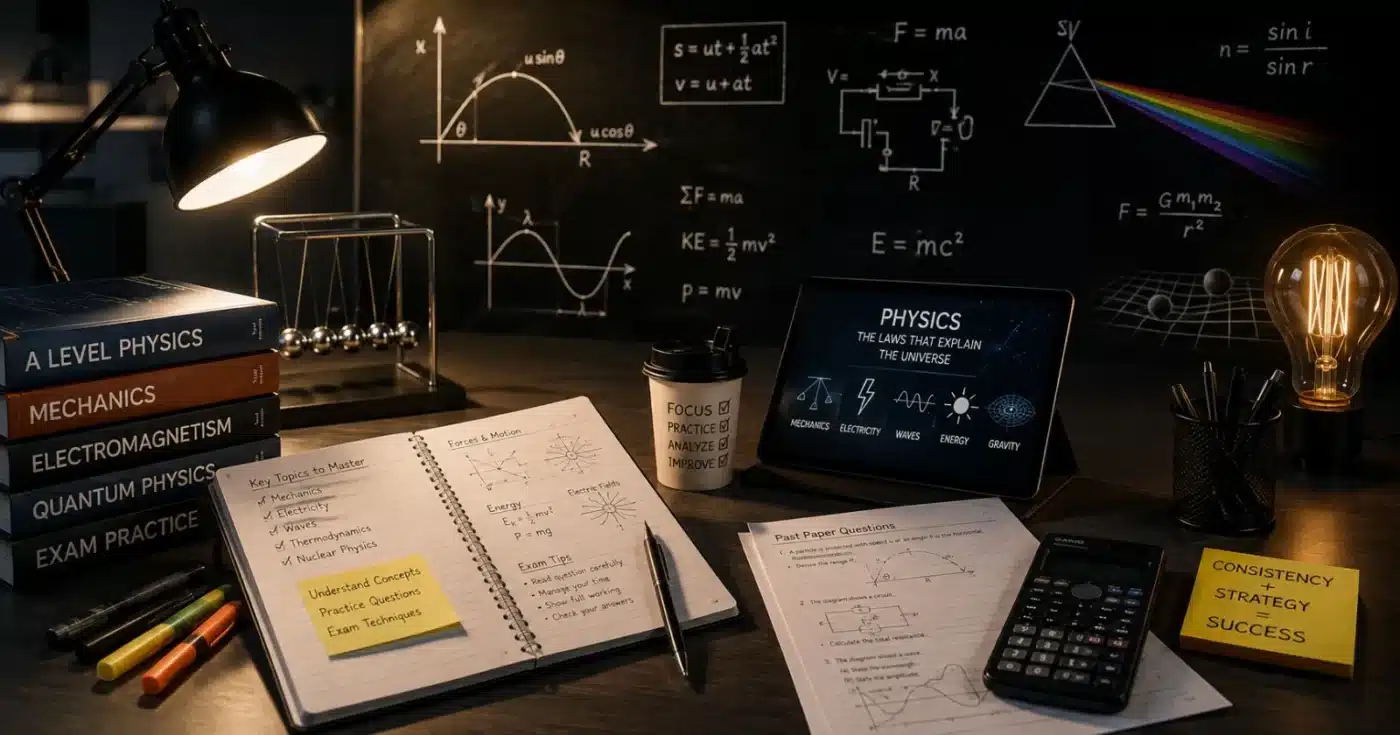
Physics has a reputation that is partly deserved and partly myth. The deserved part: A Level Physics is genuinely demanding. It combines mathematical rigour with conceptual depth in a way that few other A Level subjects do, and the questions it asks are often unlike anything a student has encountered before, requiring them to apply principles to unfamiliar situations rather than recall familiar answers. If you’d rather work through these challenging areas with a specialist, our A Level Physics tutors build a targeted revision plan around your exact weak points.
The myth part: that struggling with A Level Physics means you are not cut out for it. The students who find A Level Physics hardest are almost never the ones who lack the ability. They are almost always the ones whose revision approach has not caught up with what the subject actually requires. Reading notes and watching explanations feels like preparation. It is not, not for Physics, not at this level.
This guide explains what actually works. The topics that carry most marks, the specific habits that earn them, and what separates students who achieve A and A* from those who understand the content but cannot show it when the exam paper arrives. If you’d rather work through these topics with a specialist, our A Level Physics tutors build a revision plan around exactly the gaps below.
Struggling with A Level Physics? Get expert help with challenging topics, equations and exam technique to boost your grades.
What A Level Physics Revision Needs to Look Like
Before covering specific topics, it is worth being honest about why Physics revision fails for so many capable students, because the reason matters for what to do differently.
Physics at A Level tests three things simultaneously, and most revision approaches only address one of them.
Conceptual understanding: grasping what is actually happening physically in a situation. Why does a particle accelerate in an electric field? What does it mean for a wave to interfere destructively? Why does a gas expand when heated? Without genuine conceptual understanding, questions that present unfamiliar contexts produce blank pages.
Mathematical fluency: the ability to select the right equation, rearrange it correctly, substitute values with correct units, and carry through multi-step calculations accurately under time pressure. Mathematical fluency in Physics is a practical skill that only develops through repeated practice — reading equations is not the same as using them.
Exam technique: knowing what each question type is asking, what the mark scheme expects in written answers, how to structure a “show that” question, when to draw a diagram, how to handle data analysis questions. Exam technique in Physics is as learnable as the content itself, and as consequential for the final grade.
A Level Physics revision that addresses all three simultaneously, through active problem-solving rather than passive content review, is what produces results. That is what this guide builds toward.
AQA A Level Physics vs Edexcel A Level Physics
The practical foundation of any A Level Physics revision plan is knowing exactly which board is being sat and building every element of revision around that board’s specification and papers.
AQA A Level Physics is the most widely sat specification. It is assessed through three papers at the end of Year 13, Paper 1 covering mechanics, materials, and waves; Paper 2 covering electricity, further mechanics, thermal physics, fields, and nuclear physics; and Paper 3 which combines practical skills assessment with optional topic content. AQA questions are known for presenting unfamiliar contexts and requiring students to apply core principles rather than recall standard scenarios.
Edexcel A Level Physics has a similar three-paper structure but with different optional topics and a slightly different balance between conceptual and mathematical assessment. Edexcel questions often provide more structured scaffolding in multi-step problems than AQA, guiding students through the method more explicitly.
Both boards cover the same core content, the A Level Physics specification is regulated to ensure consistent standards, but the paper formats, question styles, and mark scheme language differ enough that mixed-board revision creates confusion rather than breadth. Download the correct specification. Use the correct past papers. Read the correct examiner reports. Every revision resource matters more when it is precisely matched to the actual exam.
A Level Physics Topics: Complete Breakdown of the Core Content
Mechanics: A Level Physics Foundation
Mechanics covers kinematics, dynamics, Newton’s laws, momentum, work, energy, and power. It is the first major topic in most A Level Physics courses and the one that underpins the largest number of other topic areas, including circular motion, oscillations, and gravitational fields.
Kinematics extends GCSE motion content significantly. The SUVAT equations are present but used in more complex scenarios, projectile motion, problems where multiple SUVAT equations need to be applied in sequence, and situations where the equations of motion need to be derived from first principles using calculus. Students who learned SUVAT as a set of formulas to apply directly at GCSE need to develop a deeper understanding of what each equation means physically.
Newton’s Laws and Dynamics at A Level involve more complex force situations than GCSE, inclined planes, systems of connected particles, friction at multiple interfaces, and problems where forces need to be resolved into components before Newton’s second law can be applied. The ability to draw clear free body diagrams and set up equations systematically from them is a skill that comes from practice and is essential for mechanics questions.
Momentum and Impulse covers conservation of momentum in more complex collision scenarios than GCSE, including two-dimensional momentum problems and the relationship between impulse and the area under a force-time graph. Momentum questions appear consistently across A Level Physics papers and reward students who understand the physics rather than just the formula.
Energy, Work and Power at A Level involves more sophisticated energy analysis than GCSE, the work-energy theorem, the relationship between work done against friction and energy dissipation, and problems where multiple energy transformations need to be tracked through a system.
Waves and Optics: A Level Physics Topics With Consistent Exam Presence
Waves covers wave properties, superposition, interference, diffraction, stationary waves, and the electromagnetic spectrum. Optics covers refraction, total internal reflection, and in some specifications, lenses.
Superposition, Interference and Diffraction are topics where the conceptual understanding and the mathematical treatment need to develop together. Young’s double slit experiment, diffraction gratings, and the conditions for constructive and destructive interference appear in almost every A Level Physics paper and reward students who understand why the interference patterns form, not just how to calculate the fringe spacing.
Stationary Waves is a topic that many students find confusing initially because it requires thinking about two wave patterns simultaneously. The nodes and antinodes of a stationary wave, the relationship between harmonic frequency and string length, and the application of stationary wave principles to open and closed pipe resonance all appear regularly in exam questions.
Progressive vs Stationary Waves knowing the specific differences between the two in terms of energy transfer, phase relationships between particles, and the physical situations that produce each, is a comparison that appears frequently in short-answer questions and is an easy source of marks for students who have revised it specifically.
Electricity: A Level Physics Topics That Carry Significant Marks
Electricity at A Level extends GCSE content into more complex circuit analysis, internal resistance, and the use of potential dividers.
Kirchhoff’s Laws allow the analysis of circuits that cannot be simplified by series and parallel rules alone. Applying Kirchhoff’s current and voltage laws systematically, setting up simultaneous equations for complex circuits, is a skill that requires practice to become fluent. Students who can only handle simple series-parallel circuits leave marks on the table in every paper.
Internal Resistance and EMF is a topic where both calculation questions and experimental analysis questions appear regularly. Understanding the relationship between terminal pd, EMF, internal resistance, and current, and being able to analyse graphs of terminal pd against current to determine EMF and internal resistance, requires understanding the physics of what internal resistance means, not just the formula.
Potential Dividers appear both as standalone questions and embedded within larger circuit analysis problems. The ability to calculate output voltage, analyse how changing component values affects the output, and explain the use of potential dividers in sensing circuits is regularly examined across both AQA and Edexcel papers.
Further Mechanics and Thermal Physics: Year 13 A Level Physics Content
Circular Motion is the first significant new mechanics topic of Year 13 and one where the conceptual understanding required is genuinely different from anything covered before. Understanding that centripetal acceleration is directed toward the centre of the circle, that the centripetal force is provided by whatever resultant force acts toward the centre in a given scenario, and being able to identify what that force is in different physical situations, a string tension, a normal reaction, gravity, is more important than knowing the formula.
Simple Harmonic Motion is one of the most mathematically sophisticated topics in the specification and one that appears consistently in challenging questions. The relationship between displacement, velocity, and acceleration in SHM, the energy interchange between kinetic and potential, the graphs of these quantities against time and displacement, and the conditions required for SHM to occur, all appear in extended exam questions that test understanding at multiple levels simultaneously.
Thermal Physics covers the kinetic theory of gases, the gas laws, and thermodynamic processes. Temperature, internal energy, and the distinction between them, along with the specific heat capacity and specific latent heat calculations that appear regularly in paper questions, need both conceptual clarity and calculation fluency.
Fields: A Level Physics Topics That Define the Top Grades
Fields, gravitational, electric, and magnetic, is the topic area that most clearly separates A and A* students from those below them. The content is abstract, the mathematical treatment is sophisticated, and the analogies between different field types reward students who understand the underlying physics deeply enough to transfer understanding across contexts.
Gravitational Fields covers Newton’s law of gravitation, gravitational field strength, gravitational potential, and orbital mechanics. Questions involving satellite orbits, the calculation of orbital speeds and periods, and the use of gravitational field strength at different distances from a planet all appear regularly and require precise mathematical treatment.
Electric Fields uses a parallel mathematical structure to gravitational fields, Coulomb’s law mirrors Newton’s law of gravitation, electric field strength mirrors gravitational field strength, electric potential mirrors gravitational potential, and exam questions frequently exploit this parallel by presenting a gravitational scenario and asking students to write the equivalent electric field relationships.
Magnetic Fields and Electromagnetic Induction covers the force on a current-carrying conductor, the force on a moving charge in a magnetic field, and Faraday’s and Lenz’s laws of electromagnetic induction. The direction conventions, Fleming’s left and right hand rules, the direction of an induced current, need to be known precisely and applied reliably under time pressure.
Capacitors is a topic that combines electrical understanding with exponential mathematics. Charging and discharging curves, the time constant, and the use of logarithmic graphs to determine RC values all appear in questions that test both physical understanding and mathematical fluency.
Nuclear Physics: A Level Physics Topics Students Underrevise
Nuclear physics covers radioactive decay, nuclear instability, nuclear reactions, and in some specifications, the binding energy and nuclear fission and fusion.
Radioactive Decay involves both qualitative understanding, types of radiation, properties, penetrating power, uses, and quantitative treatment through the decay law, half-life calculations, and the use of logarithmic graphs to determine decay constants. The mathematical treatment of radioactive decay follows the same exponential structure as capacitor discharge and is worth understanding as a connected pattern rather than an isolated topic.
Nuclear Reactions and Mass-Energy Equivalence covers the calculation of binding energy, mass defect, and the energy released in fission and fusion reactions. E = mc² calculations at A Level require careful attention to units, the distinction between atomic mass units, kilograms, and the conversion between them is a consistent source of errors in exam responses.
A Level Physics Topics Priority Table
Based on analysis of AQA and Edexcel A Level Physics past papers, here is a clear prioritisation of which topics deserve most revision attention:
Topic Area | Exam Frequency | Mark Value | Revision Priority |
Fields — Gravitational, Electric, Magnetic | Very high | Very high | Essential, abstract content, high mark value |
Simple Harmonic Motion | Very high | High | Essential, complex maths, always examined |
Electricity and Circuits | High | High | Essential, Kirchhoff, internal resistance, capacitors |
Mechanics, Kinematics and Dynamics | High | High | Essential, underpins multiple other topics |
Nuclear Physics and Radioactivity | High | Medium-High | High, calculation and conceptual questions both |
Waves, Interference and Diffraction | High | Medium-High | High, consistent exam presence |
Thermal Physics and Kinetic Theory | Medium-High | Medium | High, calculation questions are reliable marks |
Circular Motion | Medium-High | Medium | High, conceptual understanding critical |
Particle Physics | Medium | Medium | Medium, content-based, manageable through recall |
Astrophysics / Options | Varies | Medium | Board-dependent, revise the correct optional topic |
A Level Physics Equations: What Students Need to Know
One of the most significant differences between GCSE Physics and A Level Physics is the treatment of equations. At GCSE, equation sheets are provided. At A Level, the approach differs by board.
AQA A Level Physics provides a data and formulae booklet in the exam containing many, but not all, of the equations used in the specification. Students need to know which equations are provided and which need to be memorised, and this is a specific revision task that many students neglect until too late.
Edexcel A Level Physics similarly provides a formulae sheet with a specific set of equations. Again, knowing what is and is not provided, and ensuring that the equations not provided are memorised precisely, is a practical revision task separate from content understanding.
Beyond memorisation, the skill that matters most with equations in A Level Physics is fluent rearrangement. Exam questions rarely present an equation in the form required, values are given for different variables, units are in unexpected forms, or the equation needs to be derived from two or more standard formulae. This rearrangement fluency only develops through practice, working through problems rather than reading equation lists.
Here are the equation habits that distinguish high-scoring A Level Physics students:
- Always write the equation in its standard form first before rearranging, this earns the formula mark even when subsequent working contains errors
- Show unit conversions explicitly converting nm to m, eV to J, or minutes to seconds on a separate line rather than in the head prevents the unit errors that cost marks consistently
- State what each symbol represents when using an equation for the first time in an extended response, this prevents marks being lost when the examiner cannot follow which value was substituted for which symbol
- Check the order of magnitude of the final answer, a calculated gravitational field strength of 10,000 N/kg when the question asks about the surface of a planet similar to Earth should prompt a recheck
How to Revise A Level Physics: The Methods That Produce Results
Active Problem Solving Over Passive Content Review
The most important shift in A Level Physics revision is replacing passive content review with active problem solving as the primary revision activity.
Reading a textbook explanation of circular motion is not Physics revision at A Level. Working through a problem that requires identifying the centripetal force in a specific scenario, applying the equations correctly, and checking whether the answer is physically reasonable, that is Physics revision.
The revision habits that build the skills A Level Physics actually tests:
- Attempt past paper questions before reviewing content this identifies specifically where understanding breaks down rather than producing a general sense of the topic
- Work through problems step by step, writing every line showing substitution, rearrangement, and unit conversion explicitly rather than doing steps mentally
- Explain solutions out loud after completing them, describing what each step is doing physically, not just mathematically, builds the conceptual understanding that application questions test
- Attempt questions from first principles when stuck rather than immediately checking the solution, the struggle to reconstruct a method is more productive than reading the answer
Using A Level Physics Past Papers to Maximum Effect
Past papers are the most valuable revision resource available, but only when used in a way that produces learning rather than just measurement.
The approach that produces genuine improvement:
- Full papers under strict exam conditions: time limit, no notes, data sheet available if provided in the exam, mark scheme only after completion
- Mark using the official AQA or Edexcel mark scheme: paying specific attention to the required method steps in calculation questions and the precise language required in explanation questions
- Read examiner reports immediately after marking: A Level Physics examiner reports are specific about what cost marks in that sitting. Common errors identified include: failing to define symbols in equations, incorrect unit conversion, not showing working clearly, and explanation answers that describe rather than explain
- Track errors by topic and error type: is the issue conceptual understanding, mathematical error, or exam technique? Each requires a different response
- Redo questions where marks were lost: not just noting the error, but reworking the question correctly before moving to the next paper
A Level Physics Study Guide: Structuring the Two-Year Course
Effective A Level Physics revision across Years 12 and 13 requires a structure that accumulates understanding rather than leaving it all to the exam period.
The habits that make the biggest cumulative difference:
- Consolidate each topic immediately after it is taught: spending forty-five minutes reproducing key equations, worked examples, and concept explanations from memory after each topic builds understanding that makes revision in Year 13 significantly more efficient
- Build a personal equation sheet throughout the course: adding equations as they are introduced, noting which are provided in the exam and which need to be memorised, creating a resource that is genuinely useful because it was built actively
- Attempt past paper questions on each topic as it is completed: not full papers, but topic-level questions from multiple years, which builds familiarity with how each topic is examined before the full paper stage begins
- Connect topics explicitly: understanding how SHM connects to circular motion, how electric fields connect to capacitors, how the exponential decay law connects nuclear physics to thermal physics and capacitor discharge, builds the synoptic understanding that Paper 3 questions specifically test
How Tutor Globe Supports A Level Physics Students
A Level Physics is the subject where the gap between classroom understanding and exam performance is most consistently wide, and where the right specialist support closes that gap most efficiently.
The pace of A Level Physics teaching rarely allows time for individual students’ conceptual blocks to be identified and addressed. A student who did not fully understand how to identify the centripetal force in a vertical circular motion problem when it was taught will encounter variations of that scenario in every paper thereafter, losing marks in a pattern they may not recognise as connected.
Tutor Globe has A Level Physics specialists who work across AQA and Edexcel specifications, covering mechanics, fields, electricity, waves, and the optional topics that appear in Paper 3. Whether a student needs help building genuine conceptual understanding in fields or SHM, the topics that carry most marks and cause most difficulty, wants targeted support on the calculation methods and equation fluency that determine performance in mathematical questions, or is pushing from a B toward an A in the final months before exams, the right specialist makes that process significantly more efficient than working through it alone.
The board-specific filtering on Tutor Globe means finding a tutor who knows AQA A Level Physics or Edexcel A Level Physics specifically, not a general Physics tutor, but someone who knows the exact papers being sat, the data sheet, and what the mark scheme rewards in both calculation and explanation questions. Bring a marked past paper to the trial session. The analysis of where marks were lost and what the examiner was looking for is almost always the most productive conversation an A Level Physics student has in their entire revision period.
Struggling with A Level Physics? Get expert help with challenging topics, equations and exam technique to boost your grades.
Frequently Asked Questions About A Level Physics Revision
Is A Level Physics harder than Chemistry or Biology?
A Level Physics has the steepest mathematical demands of the three sciences and the most abstract content, fields, quantum mechanics, and relativistic concepts require a type of thinking that differs significantly from GCSE. Whether it is harder depends on a student’s strengths. Mathematically confident students often find Physics more manageable than the content volume of Biology or the precision demands of Chemistry. The honest answer is that all three A Level sciences are demanding in different ways.
How should I start A Level Physics revision?
Start with the specification for your specific board and identify which topics are covered in which papers. Build a revision plan that allocates more time to topics with high mark value, fields, SHM, electricity, and less to content-heavy but more straightforward topics. Begin with problem-solving practice rather than content review, and use the errors produced by initial problem-solving to direct where content review is actually needed.
What A Level Physics equations do I need to memorise?
This depends entirely on which board is being sat. Both AQA and Edexcel provide equation sheets in the exam, but not all equations are included. Download the data sheet for the correct board and systematically identify which equations are provided and which need to be memorised. This is a specific, practical revision task that should be completed early rather than discovered in the exam.
How many past papers should I do for A Level Physics?
As many as possible under proper exam conditions with careful mark scheme review. Working through the five most recent sittings fully, with detailed examiner report review after each. is more valuable than doing ten papers without systematic analysis of what went wrong. Quality of review determines how much each paper improves performance.
How are AQA and Edexcel A Level Physics different?
Both cover the same core content but differ in paper structure, question style, and optional topic content in Paper 3. AQA tends toward more open-ended application questions. Edexcel provides more structured scaffolding in multi-step problems. Students should revise exclusively using their own board’s materials to avoid building habits that do not match the actual exam.
What do A Level Physics examiners look for in explanation answers?
Precise physical language, not “the electrons move faster” but “the electrons gain kinetic energy and therefore move with greater mean drift velocity.” Cause-and-effect chains that explain each step in the process rather than stating the outcome. Defined symbols before they are used in equations. Direction specified for vector quantities. Examiner reports consistently identify incomplete physical reasoning and imprecise language as the most common sources of mark loss in extended answer questions.
Final Thoughts: A Level Physics Revision That Actually Gains Marks
A Level Physics rewards students who think physically about problems, who understand what is happening in a situation well enough to apply principles to contexts they have never seen before, and who have the mathematical fluency to express that understanding in the precise, worked form that mark schemes reward.
Building both of those things requires active problem-solving rather than passive content review, consistent practice under exam conditions rather than comfortable revision of familiar material, and the kind of specific feedback that shows exactly where the gap between current performance and the target grade actually sits.
The students who make the biggest grade improvements in A Level Physics are not the ones who put in the most hours. They are the ones who used those hours differently, practising problems rather than reading about them, analysing past paper errors rather than just noting the score, and getting targeted support on the specific topics and techniques that were limiting their performance.
If your child is working toward A Level Physics and wants specialist support matched to their specific board, their current grade, and the topics where marks are being lost, Tutor Globe is worth exploring. A trial session with a Physics specialist who knows the exact specification being sat is the most productive starting point available.
