
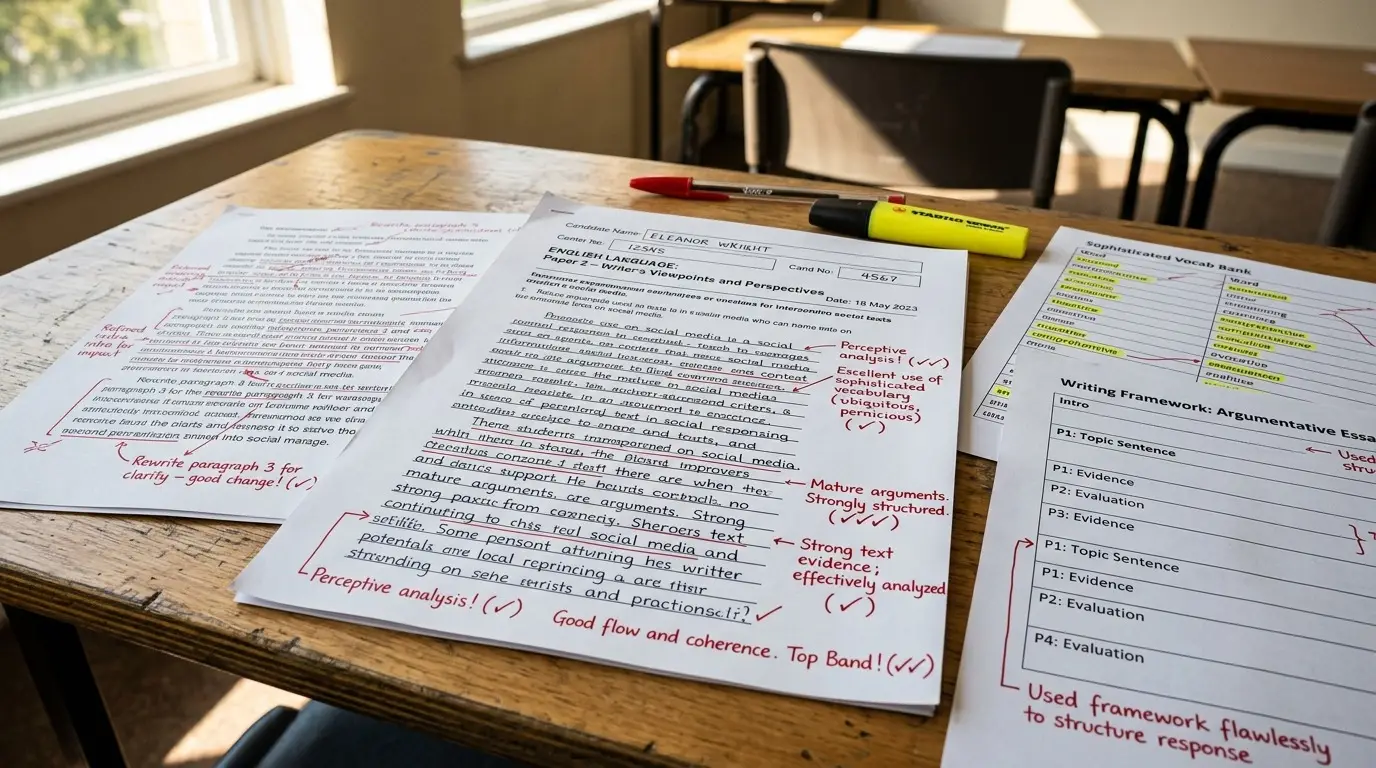
English Language is the subject almost every student takes and surprisingly few feel truly confident about. That is not because it is the hardest subject on the timetable. It is because it is one of the least understood. Students spend years being told to “write better” or “read more carefully” without ever being shown specifically what those phrases mean in the context of an exam that has clear mark schemes, defined band descriptors, and very particular ideas about what a top-band response looks like.
The result is that a huge number of capable students sit GCSE English Language papers and come out with grades that do not reflect their actual ability, not because they cannot write, but because nobody explained what the examiner was actually looking for.
This guide does that. It covers every paper, every skill type, and the specific habits that separate students who score in the top bands from those who understand the subject but cannot quite show it when it counts.
Understanding GCSE English Language: What the Subject Actually Tests
Before looking at individual papers, it helps to understand what GCSE English Language is fundamentally assessing, because the answer is more specific than most students realise.
GCSE English Language does not test how much a student knows. It tests what a student can do with language, as a reader and as a writer. Every question on every paper is assessing one or more of these core skills:
- Reading carefully and selectively, finding relevant information and understanding what it implies
- Analysing how writers use language, explaining the effect of specific choices, not just what the text says
- Writing for different purposes and audiences, producing controlled, purposeful writing in different forms
- Structuring and organising writing effectively, demonstrating that structural choices are deliberate rather than accidental
The mark scheme rewards students who demonstrate these skills explicitly and consistently. A student who reads well but writes vaguely will plateau. A student who writes fluently but does not engage carefully with reading questions will leave significant marks on the table. Both sides of the subject require specific attention, and both reward specific preparation habits.
AQA GCSE English vs Edexcel GCSE English, Know Your Board First
The first practical step in GCSE English Language revision is knowing exactly which board and which papers apply.
AQA GCSE English Language is the most widely sat version in the UK. It has two papers, Paper 1 focuses on fiction reading and creative writing, Paper 2 focuses on non-fiction reading and transactional writing. Both papers carry equal weighting.
Edexcel GCSE English Language has a different structure. Component 1 assesses fiction and imaginative writing. Component 2 assesses non-fiction reading and transactional writing. Edexcel also has a spoken language endorsement that is assessed separately and reported alongside the main grade.
AQA and Edexcel assess similar skills but through different question formats, different text types, and different mark scheme emphases. A student who revises using AQA past papers and sits the Edexcel exam — or vice versa — will find the question styles unfamiliar in ways that cost marks.
Get the board right before anything else. Every past paper, every mark scheme, and every examiner report used in revision should come from the correct board.
GCSE English Language Paper 1: Fiction Reading and Creative Writing
What GCSE English Language Paper 1 Actually Tests
Paper 1 in both AQA and Edexcel structures assesses two distinct skill areas: reading a fiction or literary non-fiction extract and responding to questions about it, then producing a piece of creative writing.
For most students, the creative writing section feels more natural and receives more revision attention. The reading section, which carries significant marks, is often underrevised because students assume that if they understood the passage, they can answer questions about it adequately.
That assumption is where marks are quietly lost.
GCSE English Language Paper 1 Reading: What Examiners Look For
Reading questions on Paper 1 test increasingly sophisticated skills as they progress through the paper. Earlier questions tend to test basic retrieval and identification. Later questions test analysis of language, structure, and the writer’s craft.
The most marks, and the biggest grade differences, sit in the analysis questions. These ask students to explain how a writer uses language or structure to achieve a particular effect. The difference between a mid-band and a top-band response to these questions is almost entirely about whether the student writes about the writer’s choices and their effect, or simply describes what the text says.
Here is the distinction in practice:
Mid-band response: “The writer uses the word ‘thunderous’ to describe the noise. This shows it was very loud.”
Top-band response: “The writer’s choice of ‘thunderous’ evokes a sense of overwhelming, almost violent sound, suggesting the noise is not merely loud but threatening, as if nature itself is asserting dominance over the characters.”
The second response is not longer for the sake of it. It is more analytical — it explains what the word choice does to the reader rather than just what it means. That analytical habit is what top-band mark schemes reward, and it is a learnable skill that develops through deliberate practice, not through reading more fiction.
Creative Writing in GCSE English Language Paper 1: What Actually Gets Marks
Creative writing is assessed on two broad criteria: communication, organization, and technical accuracy. Both matter, but students tend to focus on content (what happens in the story) and neglect craft (how the writing works).
The most common mistake in GCSE creative writing is writing a story with an interesting plot but weak writing. Examiners are not marking the plot. They are marking the language. A piece of writing that uses varied sentence structures deliberately, chooses words with precision, controls the pace of narrative, and uses structural features like non-linear time or repeated motifs, even if the storyline is very simple, will outscore a piece with an exciting plot written in flat, undifferentiated prose.
Specific habits that move creative writing grades up:
- Vary sentence length deliberately; a single short sentence after several long ones creates rhythm and emphasis that flat, uniform sentences do not
- Avoid clichés; “the moon shone brightly” is the kind of phrase that marks a student as a mid-band writer. Finding a fresher, more specific image is what top-band writing looks like
- Start in the middle of something: creative writing that begins with action, dialogue, or a striking image is immediately more engaging than writing that starts by describing the setting for two paragraphs
- Edit ruthlessly: students who write quickly and spend the last five minutes reading back and cutting weak phrases consistently produce better final work than those who write to the end and stop
GCSE English Language Paper 2: Non-Fiction Reading and Transactional Writing
What GCSE English Language Paper 2 Requires
Paper 2 assesses students’ ability to read and respond to non-fiction texts, often two texts from different time periods or perspectives, and to produce a piece of transactional writing for a specific audience and purpose.
This paper trips up students who approach it the same way they approach Paper 1. Non-fiction reading requires a different set of analytical skills from fiction reading. The focus shifts from how a writer uses language for literary effect to how a writer constructs an argument, presents information, and tries to influence the reader.
Non-Fiction Reading Skills for GCSE English Language Paper 2
Non-fiction reading questions typically ask students to:
- Identify and summarise information from one or both texts
- Compare how two writers present their perspectives or ideas
- Evaluate the effectiveness of a writer’s argument or use of language
The comparison question, asking students to compare how two writers present their views, is where the most marks are available and where the most marks are lost. Students who write about both texts separately, without making genuine comparative points, miss the core demand of the question.
Effective comparison means making a point about one text, immediately connecting it to the other text, and explaining the difference or similarity in terms of what each writer is trying to achieve and how their choices reflect that. That structure, point, evidence from text one, connection to text two, comparison of effect, is what top-band responses consistently demonstrate.
Transactional Writing in Paper 2: Form, Audience and Purpose
Transactional writing tasks ask students to write in a specific form, a letter, a speech, an article, a report, for a defined audience and purpose. The form and audience are not decorative details. They determine everything about how the writing should sound, what format features to include, and what register to maintain throughout.
Students who ignore the form and write a generic essay lose marks before the examiner has assessed the quality of the writing itself. A speech that does not address the audience directly, a letter that does not include appropriate opening and closing conventions, or an article that does not use subheadings where they would naturally appear, all of these signal to the examiner that the student has not engaged with the task fully.
The most effective preparation for transactional writing is reading examples of real-world versions of each form, actual newspaper opinion pieces, real formal letters, genuine speeches, and noticing what structural and language features each form naturally uses. That familiarity makes the format features feel natural rather than mechanical when the exam question arrives.
GCSE English Language Revision: The Most Effective Study Approach
Understanding what each paper tests is the foundation, but getting objective feedback on your exam technique is what transforms average writing into top band responses. Working alongside a specialized GCSE English tutor helps you pinpoint exactly where your reading analysis falls short and how to refine your writing style under timed conditions.
How to Revise GCSE English Language Reading Skills
Reading skills in GCSE English Language do not improve by reading more fiction or non-fiction for pleasure, though that has background value. They improve through deliberate analytical practice on exam-style texts with mark scheme feedback.
The most effective reading revision routine:
- Take a past paper reading question: a language analysis or comparison question
- Write a response under timed conditions: giving yourself the same time the exam allocates
- Mark it against the band descriptor: honestly, placing it in the band it belongs in rather than the band you hoped for
- Read the examiner report for that paper: which describes in plain terms what distinguished top-band responses from mid-band ones
- Write an improved version of the same response: incorporating what the examiner report and band descriptor showed was missing
This cycle, repeated across multiple past papers, builds analytical reading skill faster than any other approach.
GCSE English Language Revision for Writing Skills
Writing skills improve through writing and feedback, not through reading about writing. The revision habit that makes the biggest difference is simple and uncomfortable: write regularly under timed conditions and evaluate the output honestly.
For creative writing specifically:
- Set a timer for the same duration as the exam allocates
- Write to a past paper prompt
- Read the response back and identify three specific things that would earn higher marks if changed
- Rewrite those sections deliberately
For transactional writing:
- Identify which forms appear most frequently in past papers for the relevant board
- Practise each form at least twice under timed conditions
- Pay specific attention to the register, read the response back and ask whether every sentence sounds like it was written for the stated audience and purpose
GCSE English Study Guide: Using Examiner Reports Effectively
Examiner reports are one of the most underused revision resources available, and they are free. After every sitting, AQA and Edexcel publish reports from the examiners who marked the papers, describing what high-scoring responses did, what mid-band responses typically missed, and what errors appeared most frequently.
Reading examiner reports for the last three to five sittings of the relevant board gives a student clearer, more specific feedback on what to do and avoid than most revision guides provide. The language is direct and specific, “many candidates described the language rather than analysing its effect” is more useful than any general piece of writing advice.
GCSE English Grade Boundaries: What Students Need to Hit
Grade boundaries in GCSE English Language shift each year based on paper difficulty and cohort performance. What stays consistent is what quality of performance each grade represents.
What Grade Boundaries Mean for Each Paper
Students should not target a specific percentage based on past paper grade boundaries and assume it will apply to their sitting. The boundaries move, sometimes significantly, between years.
What does not move is the quality of response that earns each band in the mark scheme. A student who consistently produces top-band writing responses and top-band reading analyses will perform at grade 7 and above regardless of where any particular year’s boundary lands. That consistency of quality is what revision should build, not a target percentage that may not apply.
Key Grade Thresholds for GCSE English Language
Two grade thresholds are most practically significant:
Grade 4: the standard pass, required for most post-16 pathways. Students who do not achieve grade 4 in English Language are typically required to resit in sixth form or college.
Grade 5: the strong pass, required for entry to competitive sixth forms, many A-Level English programmes, and university courses that list English as a prerequisite.
Students targeting grade 6 and above need to be demonstrating consistent analytical skill in reading responses and consistent craft in writing responses, not just meeting the minimum criteria for each band.
How to Pass GCSE English Language: The Habits That Make the Difference
There are a small number of specific habits that consistently appear in the students who score highest across all four papers. These are worth knowing explicitly rather than hoping they develop by accident.
Habits That Separate High Scoring Students in GCSE English Language
Here is what top-band students do consistently that middle-band students do not:
- They read the question twice before writing a word. The specific wording of every question in GCSE English Language matters. “How does the writer use language” is a different question from “what impressions do you get.” The command word determines the type of answer required, and students who miss it write well-crafted responses to the wrong question.
- They embed quotations rather than listing them. A quotation dropped into a paragraph without integration or comment earns minimal marks. A short quotation woven into a sentence of analysis, “the writer’s use of ‘corroded’ suggests a slow, gradual decay rather than sudden collapse” — demonstrates analytical thinking rather than just retrieval.
- They write about effect, not meaning. The word “suggests” is more useful in English analysis than the word “means.” Explaining what a writer’s choice suggests about character, tone, theme, or the reader’s experience is what analytical writing looks like. Explaining what a word or phrase means is description, which earns fewer marks.
- They plan writing tasks before starting. Students who spend three minutes planning, deciding on the structure, the key ideas, and the ending, before writing consistently produce more coherent, better-organised pieces than those who begin immediately and decide as they go. The plan does not need to be detailed. It needs to exist.
- They leave time to check their work. The most common source of lost marks in the technical accuracy component is errors that students would catch themselves if they read back through their work. Two minutes at the end of each writing section spent checking punctuation, sentence boundaries, and spelling recovers marks that took no additional knowledge to earn.
How Tutor Globe Supports GCSE English Language Students
English Language is the subject where the right feedback makes the most visible difference, and where self-directed revision has the most obvious limitations.
A student can write a timed creative writing response and mark it against band descriptors, but they cannot easily see what a top-band version of their response would look like, or identify the specific patterns in their writing that are keeping them in band 3 rather than band 4. That is where targeted guidance from an experienced GCSE English tutor makes all the difference.
Tutor Globe has GCSE English Language specialists across AQA and Edexcel who work with students at this level regularly. They know the papers, the mark schemes, and the examiner reports, and they know how to look at a student’s written responses and identify specifically what needs to change to reach the next band up.
Whether a student needs help developing analytical reading responses, wants to improve the craft and control of their creative writing, is working on transactional writing register and form, or is targeting grade 7 and above and needs top-band level feedback, the right specialist makes that progress significantly faster than any amount of general revision.
The board-level filtering on Tutor Globe means finding someone who knows AQA GCSE English or Edexcel GCSE English specifically, not a general English tutor, but a specialist in the exact papers being sat. Bring a past paper attempt to the first session. The tutor’s analysis of what the mark scheme was looking for and what was missing is almost always the most useful feedback a student receives in their entire English revision period.
Frequently Asked Questions About GCSE English Language
What is the difference between GCSE English Language and GCSE English Literature?
English Language assesses reading and writing skills using unseen texts and writing tasks. English Literature assesses students’ knowledge and analysis of specific set texts, novels, plays, and poetry studied during the course. They are separate qualifications with separate grades, though the analytical skills developed in one support performance in the other.
How many papers does GCSE English Language have?
AQA GCSE English Language has two papers, Paper 1 and Paper 2, each worth 50% of the final grade. Edexcel GCSE English Language has two components with a similar structure, plus a separately assessed spoken language endorsement. Students should confirm the exact structure for their specific board.
What is the best way to improve creative writing for GCSE?
Write regularly under timed conditions and evaluate output honestly against band descriptors. Focus on craft, sentence variety, word choice, structural features, rather than plot. Read the examiner reports for creative writing sections of past papers, which describe specifically what top-band responses do that mid-band ones do not.
How important is spelling and punctuation in GCSE English Language?
Significant. Technical accuracy is assessed explicitly in writing questions and contributes marks in its own right. Consistent errors in spelling, punctuation, and grammar place a response in a lower technical accuracy band regardless of the quality of ideas. This is one area where careful proofreading during the exam has a direct and immediate impact on marks.
Can students resit GCSE English Language?
Yes. GCSE English Language can be resit in subsequent exam series. Most schools support resit candidates, and many students who did not achieve grade 4 in their first sitting improve significantly with targeted support and a better understanding of what the exam requires.
What should students do the night before the GCSE English Language exam?
Read through the examiner reports one more time. Review the band descriptors for writing. Make sure they know the format features of the transactional writing forms that appear most frequently on their board. Sleep properly. Avoid trying to cram new techniques the night before, the exam rewards skills built over months, not information absorbed overnight.
Final Thoughts: GCSE English Language Revision That Actually Produces Results
GCSE English Language rewards students who understand specifically what the exam is asking and have practised producing it, not students who write well generally or read widely in a vague hope that it will help.
The students who score highest across all four papers are the ones who know their board’s papers thoroughly, write analytically about language rather than describing it, produce creative and transactional writing that is crafted rather than just competent, and have received enough specific feedback on their actual responses to know exactly what their current writing does and does not do.
That level of precision does not come from general revision. It comes from deliberate practice with honest feedback, which is exactly what working with the right specialist through Tutor Globe provides.
If your child is preparing for GCSE English Language and wants support that is matched to their specific board, their current performance level, and the skills that are limiting their grade, Tutor Globe is worth exploring. A trial session with a past paper response in hand is the most useful starting point.
