
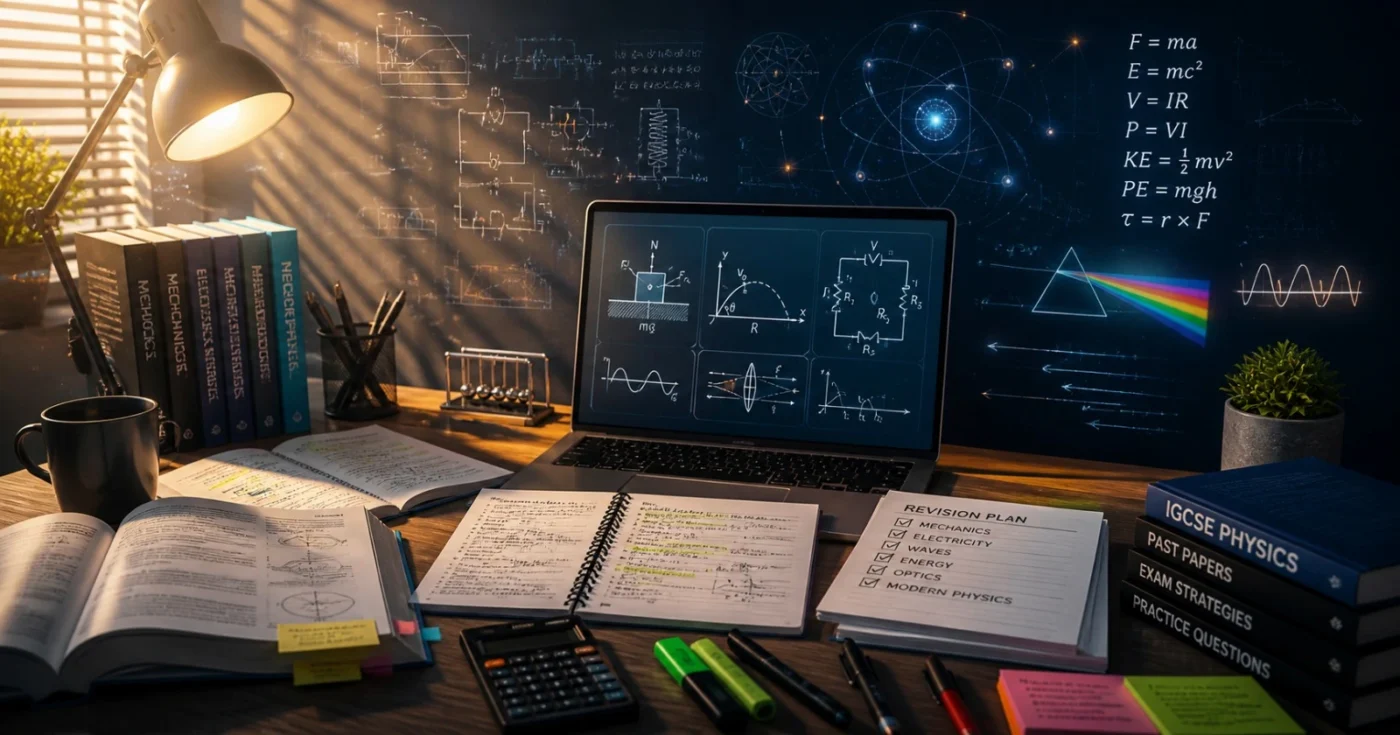
Let me be honest with you, IGCSE Physics is not easy. There are moments when you stare at a circuit diagram or a wave equation and genuinely wonder if any of it will ever make sense. I get it. Most students feel exactly the same way.
But here is something worth knowing: the students who do well in IGCSE Physics are rarely the ones who are naturally “good at science.” They are the ones who figured out how to revise properly. And that is something anyone can learn.
This guide will show you exactly what to do, from building your revision plan to nailing your exam technique. Let us get into it.
Start With the Syllabus, Seriously, Do Not Skip This
I know this sounds boring. But downloading the official Cambridge IGCSE Physics syllabus before you start revising is honestly one of the smartest things you can do.
Why? Because it tells you exactly what will and will not be tested. No guessing, no wasted time studying something that is not even on the paper. Every topic, every command word, every learning objective, it is all laid out for you.
Go through it once. Highlight the topics where you already feel okay. Circle the ones that make you go “I have absolutely no idea what this is.” Those circled topics? That is where you start.
The main areas covered in Cambridge IGCSE Physics are general physics, thermal physics, waves, electricity and magnetism, and atomic physics. Each one has sub-topics, and some carry more exam weight than others, which brings us to the next point.
Focus on the Topics That Show Up Every Single Year
Not all topics are equal. Some come up in almost every past paper. If you are short on time, and most students are, you need to know where to focus your energy first.
Electricity and circuits is probably the topic that catches the most students off guard. It looks simple on the surface, but the questions get tricky fast. Make sure you genuinely understand series and parallel circuits, not just which formula to use. Know how current, voltage, and resistance relate to each other. Understand how transformers work and why they matter for power transmission.
Forces and motion comes up constantly. Speed, velocity, acceleration, Newton’s Laws, these are the building blocks of the whole paper. Get comfortable reading and drawing distance-time graphs and velocity-time graphs. A lot of students lose easy marks here simply because they confuse the two.
Waves and the electromagnetic spectrum, know all seven parts of the EM spectrum in order. Know the difference between transverse and longitudinal waves. Be able to describe what happens when a wave reflects, refracts, or diffracts. These questions are very predictable, which means they are very winnable.
Radioactivity comes up every year without fail. Alpha, beta, gamma, know their properties inside out. Know what happens to the nucleus during each type of decay. Understand half-life and how to work with decay graphs. Once you get this topic, it actually becomes one of the more straightforward ones.
Do Past Papers, More Than You Think You Need To
If there is one piece of advice I would give to every IGCSE Physics student, it is this: do more past papers than you think you need to.
Not to tick a box. Not to feel productive. But because past papers are literally a window into the exam. The question styles repeat. The phrasing repeats. The types of mistakes the examiner is watching out for, they repeat too.
Here is how to actually use them well. Sit down, set a timer, and do the paper properly under exam conditions. No notes, no phone, no looking things up. Then go through the mark scheme question by question, not just to see if you got it right, but to understand exactly what the examiner wanted. That gap between what you wrote and what the mark scheme says? That is your revision target.
Cambridge IGCSE Physics past papers are available on the Cambridge Assessment International Education website. Physics and Maths Tutor is also excellent, they have questions sorted by topic, which is really useful when you are revising one specific area.
Learn Your Equations in a Way That Actually Sticks
There is no getting around it, you need to know your IGCSE Physics equations. But cramming a list of formulas the night before the exam is one of the least effective ways to learn them.
Instead, make yourself a single equations sheet. Every formula, what each letter means, and the units. Keep it somewhere visible, your bedroom wall, the back of your door, your desk. Look at it every day, even just for thirty seconds. Passive exposure does more than you think.
Then go further. Practise rearranging equations regularly. The exam loves to give you two values and ask you to find the third. If you freeze up every time you need to rearrange a formula, you are going to lose a lot of time. The more you practise it, the more automatic it becomes.
Some equations to be especially confident with: speed equals distance divided by time, power equals voltage multiplied by current, and wave speed equals frequency multiplied by wavelength. These come up in one form or another on almost every paper.
Make Revision Notes That Are Actually Useful
Most students make revision notes the wrong way. They sit down, open a textbook, and copy out pages of information word for word. An hour later, they feel like they have done a lot of revision. In reality, they have just done a lot of writing.
Useful revision notes are short, visual, and force you to think. Try mind maps for connecting topics, put something like “Waves” in the middle and branch out to reflection, refraction, diffraction, and the EM spectrum. Add quick definitions and examples as you go.
Flashcards work brilliantly for equations, definitions, and key facts. Write the question on the front, the answer on the back. Use spaced repetition, go back to the cards you keep getting wrong more often than the ones you know well.
For each topic, aim for one tight summary page. The main ideas, the key equations, the most common exam questions. When you are in the final week before your exam, you can review ten topics in an afternoon using these, which is exactly when you need that kind of speed.
Good Exam Technique Makes a Real Difference
You can know your physics inside out and still lose marks if your exam technique is poor. A few things that actually matter:
Use the right scientific vocabulary. If the mark scheme says “force,” do not write “push.” If it says “wavelength,” do not write “the length of a wave.” Precision matters, especially in IGCSE Physics where single words can be the difference between full marks and half marks.
For calculation questions, always show your working. Even if your final answer is wrong, correct working earns you method marks. Write out the equation, substitute the values clearly, and show every step.
Check the number of marks a question is worth before you answer it. A two-mark question needs two distinct points. A six-mark question needs a detailed, structured response. Matching the depth of your answer to the marks available sounds simple, but a lot of students ignore it under exam pressure.
And always, always, check your units. A correct number with the wrong unit will cost you a mark. It takes ten seconds and it is absolutely worth doing.
Build a Revision Timetable You Will Actually Follow
The best revision timetable is one that is realistic. If you tell yourself you will study for eight hours every Saturday, you probably will not. And then you will feel guilty, which makes you study less, which makes you feel more guilty. It is a bad cycle.
Instead, break the IGCSE Physics syllabus into chunks of two or three related topics. Spend a couple of days on each chunk, one day to understand and make notes, one day to do practice questions, and a third day to try past paper questions on that specific topic. Keep sessions to around 45 to 60 minutes, with proper breaks in between.
Leave your final week for full past papers only. That week is not for learning new things, it is for consolidating, practising, and building confidence.
The Final Few Days Before Your IGCSE Physics Exam
When exam week arrives, your approach should change. Stop trying to learn new material. Focus entirely on what you already know.
Review your equations sheet every morning. Do a full past paper each day under timed conditions. Flick through your summary notes. Get good sleep, genuinely, this is not just advice people give to fill space. A well-rested brain performs noticeably better under exam pressure than a tired one.
The night before, do a light review and then stop. You have put the work in. The revision is done. Now it is just about showing up and doing it.
Frequently Asked Questions About IGCSE Physics Revision
How long should I revise for IGCSE Physics each day?
There is no magic number, but most students find that two to three focused hours per day, broken into shorter sessions, is more effective than one long exhausting stretch. Quality matters more than quantity. Forty-five minutes of active revision beats three hours of passively re-reading notes.
When should I start IGCSE Physics revision?
Ideally, three to four months before your exam. This gives you enough time to go through each topic properly, do past papers, and review your weak areas without panicking. If you are starting later than that, do not worry, prioritise the high-frequency topics and past papers above everything else.
What are the hardest topics in IGCSE Physics?
This varies from student to student, but electricity, electromagnetic induction, and nuclear physics tend to be the topics students find most challenging. Waves and optics can also be tricky when it comes to drawing accurate diagrams. Spend extra time on whichever of these feels most unfamiliar to you.
Are IGCSE Physics past papers really that important?
Yes, genuinely, yes. Past papers are the closest thing you have to the real exam. They show you the question styles, the language the examiner uses, and the level of detail expected. Students who do a lot of past papers almost always perform better than those who only revise from notes.
How do I remember all the IGCSE Physics equations?
Make a dedicated equations sheet and look at it every day. Practise rearranging equations regularly rather than just memorising them in one form. Use flashcards with spaced repetition. And most importantly, do calculation questions as often as possible. Using equations repeatedly in context is far more effective than trying to memorise a list.
What resources should I use for IGCSE Physics revision?
The Cambridge past papers and mark schemes are essential. Physics and Maths Tutor is excellent for topic-by-topic practice. Save My Exams has solid structured notes. For visual learners, the YouTube channels Cognito and Freesciencelessons explain concepts clearly and are completely free.
Can I get an A in IGCSE Physics without a tutor?
Absolutely. Many students achieve top grades through self-study alone. What matters is consistency, using the right resources, doing plenty of past papers, and being honest with yourself about where your weak spots are. That said, working with an expert IGCSE Physics tutor can help accelerate topic mastery and eliminate weak spots ahead of exams far more efficiently.
Physics is one of those subjects that genuinely rewards effort. The more you practise, the more confident you feel. And the more confident you feel, the better you perform. If you’re looking for personalized guidance, working with an IGCSE Physics tutor can provide tutor-led topic mastery ahead of your exams to ensure you walk into the test room completely prepared. Start early, stay consistent, and trust the process. You will surprise yourself.
